An Upper Bound for the Number of Rectangulations of a Planar Point Set
We prove that every set of n points in the plane has at most $(16+5/6)^n$ rectangulations. This improves upon a long-standing bound of Ackerman. Our proof is based on the cross-graph charging-scheme technique.
💡 Research Summary
The paper investigates the combinatorial problem of counting rectangulations of a planar point set. Given a set P of n points in general position inside an axis‑aligned rectangle B, a rectangulation of (B,P) is a partition of B into axis‑parallel rectangles such that each point of P lies on exactly one interior segment of the partition. The authors denote by R(P) the family of all such rectangulations and by rc(P)=|R(P)| the number of rectangulations of P; rc(n) is the maximum of rc(P) over all n‑point sets.
Historically, Ackerman, Barequet, and Pinter proved rc(n)=O(20ⁿ), later improved by Ackerman to rc(n)=O(18ⁿ·n⁴). Felner gave a matching lower bound rc(n)=Ω(8ⁿ·n⁴). Closing the exponential gap has been an open problem. The present work reduces the exponential base from 18 to 16 + 5/6, establishing the bound rc(n) ≤ (16 + 5/6)ⁿ.
The proof rests on the cross‑graph charging scheme, originally introduced by Sharir and Welzl and refined by Sharir and Sheffer. The authors first assign an initial “charge” to each segment of a rectangulation according to its degree (the number of intersections it participates in). Specifically, a segment of degree i receives 5 − i units of charge. Summing over all segments in a rectangulation G yields a total charge of 5n − ∑ i·d_i(G), where d_i(G) denotes the number of degree‑i segments. Since the sum of degrees is at most 4n (each of the 2n endpoints contributes at most two to the degree count), the total charge is at least n for any rectangulation.
Next, the authors “trim” every segment of degree larger than 2 by repeatedly applying valid rotations (shortening a segment while extending the intersecting one). The charge of a higher‑degree segment is transferred to the resulting degree‑2 segment. This process does not change the overall charge but concentrates it on degree‑2 segments. By analyzing how many higher‑degree segments can contribute to a single degree‑2 segment, they show that a degree‑2 segment can receive at most nine units of charge. Consequently, the average number of degree‑2 segments per rectangulation satisfies ˆd₂(P) ≥ n/9. Lemma 3.1 then yields the recurrence rc(n) ≤ 2·(n/9)·rc(n‑1), which solves to rc(n) ≤ 18ⁿ. This reproduces Ackerman’s bound (up to a polynomial factor) and serves as a warm‑up.
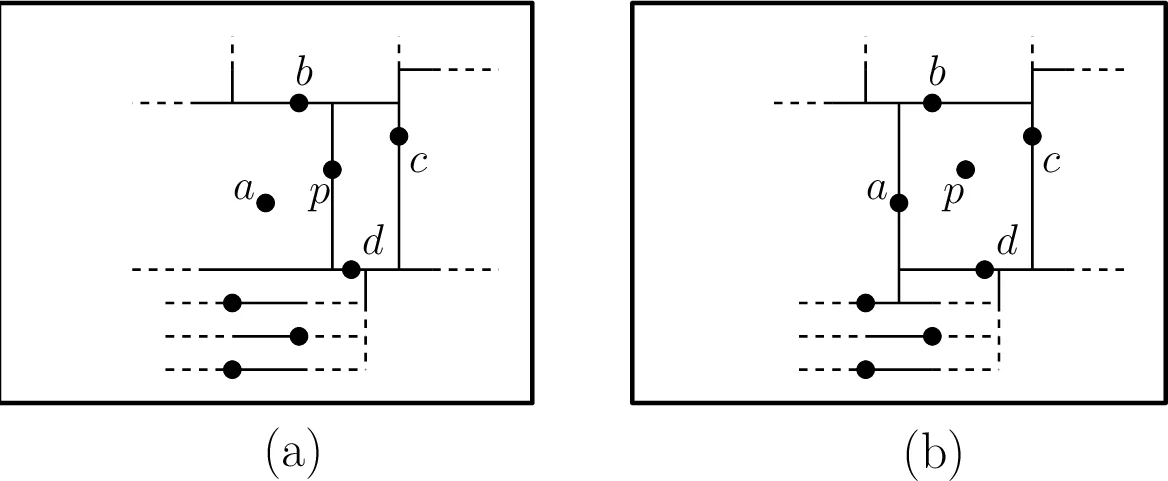
To achieve a better exponential constant, the authors introduce a more sophisticated charging redistribution among degree‑2 segments. For each point p∈P they identify its four “boundary segments” (left, top, right, bottom) in a given rectangulation of P{p}. These four segments form an internal rectangle surrounding p. The geometry of this configuration falls into two cases:
-
Non‑spiral configuration – at least one of the four boundary segments cannot be extended beyond p because it either belongs to the outer rectangle or its critical subsegment contains an endpoint or another intersection. In this case a degree‑2 segment associated with p can receive charge only from itself, at most one degree‑3 segment, and at most one degree‑4 segment, giving a total of at most 6 units. Since the earlier trimming step already guarantees ≤9 units, the combined bound is 15 units for the pair of degree‑2 segments incident to p.
-
Spiral configuration – each boundary segment has exactly one endpoint lying on another boundary segment, and none of the critical subsegments contain endpoints or intersections. Here the point p can be extended in all four directions. The authors devise two procedures to redistribute charge:
- Procedure 1: If at least one corner of the internal rectangle can be rotated (i.e., a valid rotation exists at that corner), they perform the rotation, which lengthens one boundary segment and shortens another. They then move 1.5 units of charge from the configuration before rotation to the configuration after rotation, ensuring that both configurations assign at most 16.5 units to p.
- Procedure 2: If no corner is rotatable but there exists an interior intersection on a boundary segment that can be rotated, they rotate that intersection, breaking the spiral structure. Again they transfer 1.5 units of charge, yielding the same 16.5 bound.
Each point p is charged at most once by either procedure, so the total charge assigned to all points is bounded by (16 + 2/3)·n. Since each point contributes two degree‑2 segments, the average charge per degree‑2 segment is at most 8 + 1/3. This translates to ˆd₂(P) ≥ n/(8 + 5/12).
Plugging this improved lower bound on the average number of degree‑2 segments into Lemma 3.1 gives the recurrence rc(n) ≤ (16 + 5/6)·rc(n‑1), which solves to the main theorem:
Theorem. For every n, rc(n) ≤ (16 + 5/6)ⁿ.
Thus the paper improves the exponential base from 18 to approximately 16.833…, a significant step toward closing the gap with the known lower bound of 8ⁿ·n⁴.
The contribution is twofold: (i) a careful adaptation of the cross‑graph charging scheme to the setting of rectangulations, and (ii) a novel geometric analysis of “spiral” configurations that enables a finer redistribution of charge. The techniques may be applicable to other planar graph enumeration problems, such as counting triangulations, spanning trees, or non‑crossing matchings, where degree‑based charging arguments are useful.
In conclusion, the authors present a clean combinatorial proof that substantially tightens the known upper bound on the number of rectangulations of a planar point set, advancing the state of knowledge in combinatorial geometry and providing tools that could inspire further improvements or extensions to related enumeration problems.
Comments & Academic Discussion
Loading comments...
Leave a Comment