A tight quasi-polynomial bound for Global Label Min-Cut
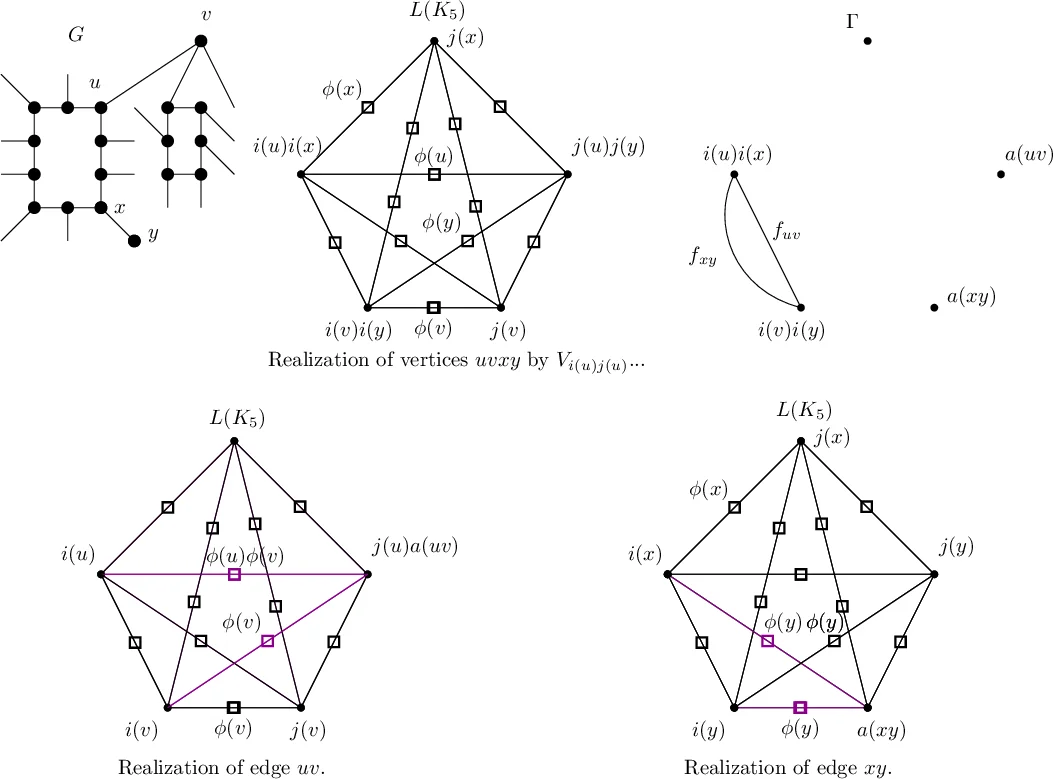
We study a generalization of the classic Global Min-Cut problem, called Global Label Min-Cut (or sometimes Global Hedge Min-Cut): the edges of the input (multi)graph are labeled (or partitioned into color classes or hedges), and removing all edges of the same label (color or from the same hedge) costs one. The problem asks to disconnect the graph at minimum cost. While the $st$-cut version of the problem is known to be NP-hard, the above global cut version is known to admit a quasi-polynomial randomized $n^{O(\log \mathrm{OPT})}$-time algorithm due to Ghaffari, Karger, and Panigrahi [SODA 2017]. They consider this as ``strong evidence that this problem is in P’’. We show that this is actually not the case. We complete the study of the complexity of the Global Label Min-Cut problem by showing that the quasi-polynomial running time is probably optimal: We show that the existence of an algorithm with running time $(np)^{o(\log n/ (\log \log n)^2)}$ would contradict the Exponential Time Hypothesis, where $n$ is the number of vertices, and $p$ is the number of labels in the input. The key step for the lower bound is a proof that Global Label Min-Cut is W[1]-hard when parameterized by the number of uncut labels. In other words, the problem is difficult in the regime where almost all labels need to be cut to disconnect the graph. To turn this lower bound into a quasi-polynomial-time lower bound, we also needed to revisit the framework due to Marx [Theory Comput. 2010] of proving lower bounds assuming Exponential Time Hypothesis through the Subgraph Isomorphism problem parameterized by the number of edges of the pattern. Here, we provide an alternative simplified proof of the hardness of this problem that is more versatile with respect to the choice of the regimes of the parameters.
💡 Research Summary
The paper settles the exact computational complexity of the Global Label Min‑Cut problem, a natural generalization of the classic global min‑cut where edges are partitioned into color (or label) classes and removing all edges of a single color costs one unit. While the $st$‑cut version (Label $st$‑Cut) is known to be NP‑hard, the global version was shown in 2017 by Ghaffari, Karger, and Panigrahi to admit a randomized algorithm running in $n^{O(\log \text{OPT})}$ time, where $n$ is the number of vertices and $\text{OPT}$ is the optimum cost. The authors of the current work demonstrate that this quasi‑polynomial running time is essentially optimal under the Exponential Time Hypothesis (ETH).
The main contributions are twofold. First, they prove that Global Label Min‑Cut is W
Comments & Academic Discussion
Loading comments...
Leave a Comment