STRIKE-GOLDD 4.0: user-friendly, efficient analysis of structural identifiability and observability
Abstract Motivation STRIKE-GOLDD is a toolbox that analyses the structural identifiability and observability of possibly non-linear, non-rational ODE models that may have known and unknown inputs. Its broad applicability comes at the expense of a lower computational efficiency than other tools. Results STRIKE-GOLDD 4.0 includes a new algorithm, ProbObsTest, specifically designed for the analysis of rational models. ProbObsTest is significantly faster than the previously available FISPO algorithm when applied to computationally expensive models. Providing both algorithms in the same toolbox allows combining generality and computational efficiency. STRIKE-GOLDD 4.0 is implemented as a Matlab toolbox with a user-friendly graphical interface. Availability and implementation STRIKE-GOLDD 4.0 is a free and open-source tool available under a GPLv3 license. It can be downloaded from GitHub at https://github.com/afvillaverde/strike-goldd. Supplementary information Supplementary data are available at Bioinformatics online.
💡 Research Summary
The paper presents STRIKE‑GOLDD 4.0, an upgraded MATLAB toolbox for assessing structural local identifiability (SLOI) and observability (SLO) of dynamic models. Structural identifiability asks whether model parameters can be uniquely recovered from ideal output data, while observability asks whether internal states can be reconstructed from outputs and inputs. Both properties are essential in systems biology, pharmacokinetics, and control engineering because they determine whether a model can be meaningfully calibrated against experimental data.
Earlier releases of STRIKE‑GOLDD were distinguished by their broad applicability: they could handle nonlinear, non‑rational ordinary differential equation (ODE) models and could incorporate unknown (unmeasured) inputs. This generality, however, came at a computational cost: for rational models (i.e., models whose right‑hand sides are ratios of polynomials) the toolbox was slower than specialized tools. To remedy this, version 4.0 introduces two major innovations.
First, the ProbObsTest algorithm is added. ProbObsTest is an extension of the probabilistic observability test originally proposed by Sedoglavic (2002). The method replaces symbolic Lie‑derivative calculations with a numerical rank test on a matrix whose entries are coefficients of a power‑series expansion of the output. By assigning random integer values to the model’s parameters and states, the algorithm evaluates the observability matrix numerically, avoiding costly symbolic manipulation. The authors further extend the method to support models with unknown inputs and to automatically transform certain non‑rational expressions (logarithms, trigonometric functions, non‑integer exponents) into rational form before the test. As a result, ProbObsTest delivers a dramatic speed‑up for large rational models while preserving the probabilistic guarantee of correctness.
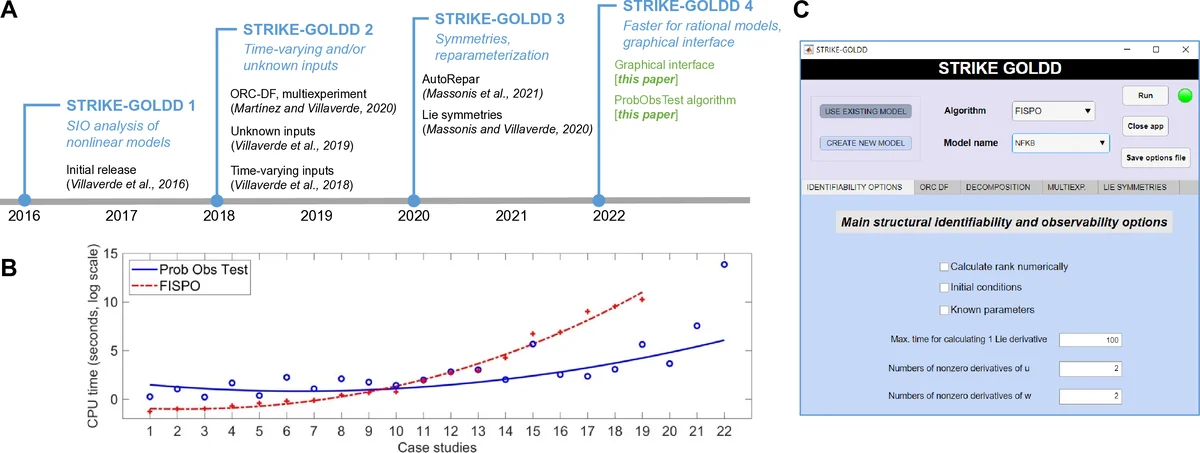
Second, the toolbox is now delivered as a MATLAB app with a graphical user interface (GUI). Users can select the analysis algorithm (FISPO, ORC‑DF, or ProbObsTest), load a model from a drop‑down list or create a new one, adjust options, and launch the analysis with a few clicks. Results—including rank conditions, identified unidentifiable parameters, and suggested symmetry‑based re‑parameterizations—are displayed directly in the GUI, making the tool accessible to researchers without deep programming expertise. The GUI co‑exists with the traditional script‑based workflow, preserving flexibility for advanced users.
The authors benchmarked ProbObsTest against the previously available FISPO algorithm on 22 case studies ranging from simple two‑state models to a complex Chinese Hamster Ovary (CHO) cell model with 117 parameters. For low‑complexity models (cases 1‑10) ProbObsTest is marginally slower, but for medium and high complexity models (cases 11‑22) it is substantially faster—often three to ten times—allowing analysis of models that FISPO cannot finish due to memory or time limits. The paper also compares ProbObsTest with Sedoglavic’s original ObservabilityTest on the subset of models where both are applicable, confirming identical identifiability/observability conclusions while highlighting the superior runtime of ProbObsTest.
Beyond speed, STRIKE‑GOLDD 4.0 retains the powerful features of earlier versions: (i) the FISPO algorithm remains for full‑generality, handling non‑rational dynamics and unknown inputs; (ii) ORC‑DF provides a deterministic rank‑test for rational models affine in the inputs; (iii) automatic Lie‑symmetry detection and model re‑parameterization (via the AutoRepar module) help users eliminate structural non‑identifiabilities. By offering all three algorithms in a single package, users can choose the most appropriate method for their specific model class.
The paper includes a detailed mathematical appendix describing the observability rank condition, the derivation of the probabilistic test, and the algorithmic steps for rational‑to‑non‑rational conversion. The supplementary material provides the full set of benchmark models, their parameter counts, and a side‑by‑side comparison with other popular tools such as DAISY, COMBOS, GenSSI, and SIAN.
In conclusion, STRIKE‑GOLDD 4.0 delivers a unique combination of breadth and efficiency: it is the most generally applicable toolbox for local structural identifiability and observability analysis, capable of handling non‑rational ODEs, unknown inputs, and large‑scale rational models with unprecedented speed. The addition of a user‑friendly GUI further lowers the barrier to entry for experimental biologists and engineers, positioning the toolbox as a practical, high‑performance solution for model validation in a wide range of scientific domains.
Comments & Academic Discussion
Loading comments...
Leave a Comment