Optimizing Opinions with Stubborn Agents
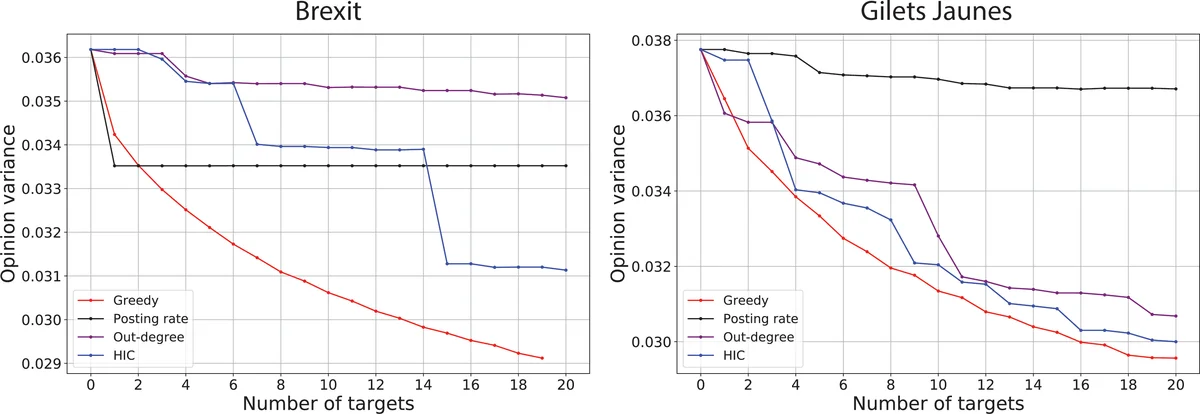
We consider the problem of optimizing the placement of stubborn agents in a social network in order to maximally influence the population. We assume the network contains stubborn users whose opinions do not change, and non-stubborn users who can be persuaded. We further assume the opinions in the network are in an equilibrium that is common to many opinion dynamics models, including the well-known DeGroot model. We develop a discrete optimization formulation for the problem of maximally shifting the equilibrium opinions in a network by targeting users with stubborn agents. The opinion objective functions we consider are the opinion mean, the opinion variance, and the number of individuals whose opinion exceeds a fixed threshold. We show that the mean opinion is a monotone submodular function, allowing us to find a good solution using a greedy algorithm. We find that on real social networks in Twitter consisting of tens of thousands of individuals, a small number of stubborn agents can non-trivially influence the equilibrium opinions. Furthermore, we show that our greedy algorithm outperforms several common benchmarks. We then propose an opinion dynamics model where users communicate noisy versions of their opinions, communications are random, users grow more stubborn with time, and there is heterogeneity is how users’ stubbornness increases. We prove that under fairly general conditions on the stubbornness rates of the individuals, the opinions in this model converge to the same equilibrium as the DeGroot model, despite the randomness and user heterogeneity in the model.
💡 Research Summary
The paper tackles the problem of strategically placing a limited number of stubborn agents in a social network to shift the equilibrium opinions of the entire population. The authors first formalize the network as a directed graph with two types of nodes: stubborn agents whose opinions never change, and non‑stubborn agents whose opinions evolve according to an influence‑weighted averaging rule. Under the classic DeGroot model, the equilibrium of non‑stubborn opinions satisfies a linear system G θ₁ = F θ₀, where G captures interactions among non‑stubborn nodes and F captures the influence of stubborn nodes.
Three objective functions are considered: (i) the mean opinion of all non‑stubborn agents, (ii) the variance of opinions, and (iii) the count of agents whose opinion exceeds a preset threshold. The authors prove that the mean opinion is a monotone submodular set function of the chosen target nodes for new stubborn agents. This property enables the use of a greedy algorithm that iteratively adds the node yielding the largest marginal increase in the mean. By classic results of Nemhauser et al., the greedy solution attains a (1 − 1/e) approximation guarantee.
To evaluate the approach, the authors collect large Twitter follower graphs (tens of thousands of users) and estimate each user’s opinion on a binary issue using a neural‑network‑based sentiment classifier that maps tweet content to a scalar in
Comments & Academic Discussion
Loading comments...
Leave a Comment