Conservation of `moving energy in nonholonomic systems with affine constraints and integrability of spheres on rotating surfaces
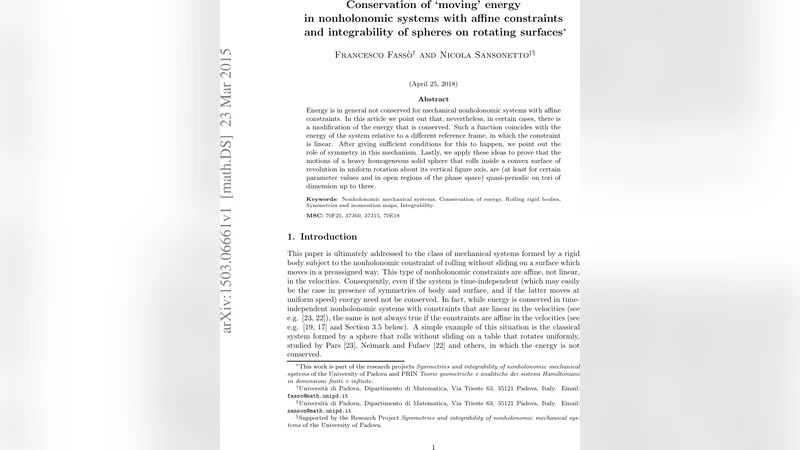
Energy is in general not conserved for mechanical nonholonomic systems with affine constraints. In this article we point out that, nevertheless, in certain cases, there is a modification of the energy that is conserved. Such a function coincides with the energy of the system relative to a different reference frame, in which the constraint is linear. After giving sufficient conditions for this to happen, we point out the role of symmetry in this mechanism. Lastly, we apply these ideas to prove that the motions of a heavy homogeneous solid sphere that rolls inside a convex surface of revolution in uniform rotation about its vertical figure axis, are (at least for certain parameter values and in open regions of the phase space) quasi-periodic on tori of dimension up to three.
💡 Research Summary
**
The paper investigates a subtle but powerful mechanism by which a modified energy—called “moving energy”—remains conserved in nonholonomic mechanical systems that possess affine (i.e., velocity‑dependent with a constant term) constraints. In the usual theory, energy is conserved only when the nonholonomic constraints are linear in the velocities; affine constraints typically break this conservation, as exemplified by the classic problem of a sphere rolling on a uniformly rotating turntable.
The authors’ central observation is that if one passes to a reference frame that moves with the prescribed motion of the constraint surface, the affine constraints become linear in the new coordinates. In that moving frame the Lagrangian is often time‑independent, and consequently the ordinary mechanical energy relative to that frame is conserved. When this conserved quantity is expressed back in the original inertial coordinates, it takes the form of the usual kinetic‑plus‑potential energy plus a correction term involving the momentum map of the symmetry group that generated the moving frame. This corrected quantity is the “moving energy”.
Two main theoretical results are established. Theorem 1 provides sufficient conditions for the existence of a conserved moving energy: there must exist a time‑dependent change of coordinates that renders the constraints linear and makes the transformed Lagrangian autonomous. Theorem 2 links these conditions to symmetry: if a Lie group acts on configuration space and both the Lagrangian and the affine constraints are invariant under this action, then a specific combination of the ordinary energy and a component of the momentum map is conserved. This combination can be viewed as a nonholonomic analogue of Noether’s theorem, where the usual Noether conserved quantity is replaced by the sum of two non‑conserved pieces.
The paper first illustrates the mechanism with the well‑known sphere‑on‑turntable problem. By switching to a frame rotating with the table, the rolling constraint becomes linear, the transformed Lagrangian is autonomous, and the moving energy is shown to be constant, confirming the abstract theory.
The main application concerns a heavy homogeneous solid sphere that rolls without slipping inside a convex surface of revolution that itself rotates uniformly about its vertical symmetry axis with angular speed Ω. When Ω = 0 the system is integrable: the reduced dynamics lives on three‑dimensional invariant tori and the motion is quasi‑periodic. For Ω ≠ 0 the system retains an SO(3) × S¹ symmetry, but prior work had identified only two first integrals and an invariant measure, yielding integrability “by quadratures” but not a full description of the phase‑space geometry.
Using the moving‑energy construction, the authors obtain an additional first integral for small Ω. Theorem 3 states that for sufficiently small rotation speeds there exists an open, non‑empty region of the reduced phase space where the reduced flow is periodic; consequently, in the full (unreduced) phase space the dynamics is quasi‑periodic on invariant tori of dimension up to three. The proof relies on a continuity argument from the Ω = 0 case together with the existence of the moving‑energy integral, showing that the invariant tori persist under small perturbations of the rotation speed.
Overall, the work provides a clear geometric framework for uncovering hidden conserved quantities in nonholonomic systems with affine constraints, demonstrates how symmetry can be exploited to construct them, and applies the theory to obtain stronger integrability results for a classical rolling‑sphere problem. The methodology opens the way to treat many other nonholonomic models where constraints are affine—e.g., wheeled vehicles on moving platforms, robotic manipulators with time‑varying joint limits, or particles on time‑dependent curved surfaces—by seeking an appropriate moving frame that linearizes the constraints and reveals a conserved moving energy. Future research directions suggested include extending the approach to non‑ideal constraints, exploring the role of non‑compact symmetry groups, and developing numerical schemes that preserve the moving energy for long‑time simulations.
Comments & Academic Discussion
Loading comments...
Leave a Comment