Exact Bayesian inference for discretely observed Markov Jump Processes using finite rate matrices
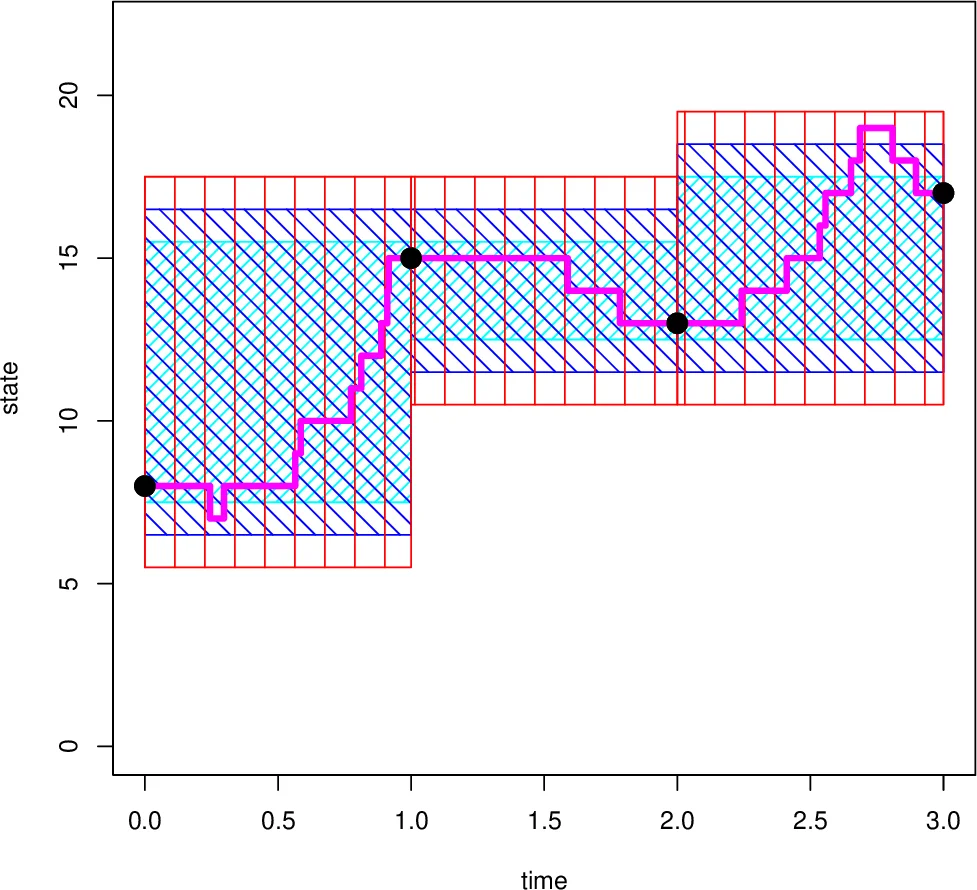
We present new methodologies for Bayesian inference on the rate parameters of a discretely observed continuous-time Markov jump processes with a countably infinite state space. The usual method of choice for inference, particle Markov chain Monte Carlo (particle MCMC), struggles when the observation noise is small. We consider the most challenging regime of exact observations and provide two new methodologies for inference in this case: the minimal extended state space algorithm (MESA) and the nearly minimal extended state space algorithm (nMESA). By extending the Markov chain Monte Carlo state space, both MESA and nMESA use the exponentiation of finite rate matrices to perform exact Bayesian inference on the Markov jump process even though its state space is countably infinite. Numerical experiments show improvements over particle MCMC of between a factor of three and several orders of magnitude.
💡 Research Summary
The paper tackles Bayesian inference for continuous‑time Markov jump processes (MJPs) whose state space is countably infinite, a setting that frequently arises in stochastic reaction networks, population dynamics, and gene‑regulation models. When observations are exact (i.e., measurement noise is negligible), the standard workhorse—particle Markov chain Monte Carlo (particle MCMC) with a bootstrap particle filter—fails dramatically because almost all simulated particle trajectories receive near‑zero weight, leading to an almost complete loss of efficiency.
To overcome this, the authors introduce two novel Markov chain Monte Carlo algorithms: the Minimal Extended State‑space Algorithm (MESA) and its variant, the nearly Minimal Extended State‑space Algorithm (nMESA). Both methods rely on a clever decomposition of the infinite state space into a nested sequence of finite regions
\
Comments & Academic Discussion
Loading comments...
Leave a Comment