Efficient classical simulation of random shallow 2D quantum circuits
Random quantum circuits are commonly viewed as hard to simulate classically. In some regimes this has been formally conjectured, and there had been no evidence against the more general possibility that for circuits with uniformly random gates, approximate simulation of typical instances is almost as hard as exact simulation. We prove that this is not the case by exhibiting a shallow circuit family with uniformly random gates that cannot be efficiently classically simulated near-exactly under standard hardness assumptions, but can be simulated approximately for all but a superpolynomially small fraction of circuit instances in time linear in the number of qubits and gates. We furthermore conjecture that sufficiently shallow random circuits are efficiently simulable more generally. To this end, we propose and analyze two simulation algorithms. Implementing one of our algorithms numerically, we give strong evidence that it is efficient both asymptotically and, in some cases, in practice. To argue analytically for efficiency, we reduce the simulation of 2D shallow random circuits to the simulation of a form of 1D dynamics consisting of alternating rounds of random local unitaries and weak measurements – a type of process that has generally been observed to undergo a phase transition from an efficient-to-simulate regime to an inefficient-to-simulate regime as measurement strength is varied. Using a mapping from quantum circuits to statistical mechanical models, we give evidence that a similar computational phase transition occurs for our algorithms as parameters of the circuit architecture like the local Hilbert space dimension and circuit depth are varied.
💡 Research Summary
The paper challenges the prevailing belief that random quantum circuits are almost as hard to simulate classically as the worst‑case instances, especially in two dimensions. It does so by constructing a family of constant‑depth (depth‑3) 2D circuits with uniformly random two‑qubit gates for which worst‑case exact simulation remains #P‑hard under standard complexity assumptions (e.g., the polynomial hierarchy is infinite), yet typical instances can be simulated approximately with very small total variation distance in time linear in the number of qubits and gates.
Two simulation algorithms are introduced. The first, Space‑evolving Block Decimation (SEBD), slices the 2D circuit into horizontal blocks, maps the evolution of each block to a one‑dimensional quantum dynamics consisting of alternating layers of random local unitaries and weak measurements, and represents the resulting state as a matrix‑product state (MPS). Because the weak measurements suppress entanglement, the MPS bond dimension grows only polynomially, allowing the whole process to be simulated in O(N) time where N is the number of qubits. The second algorithm, called Patching, divides the lattice into small patches, exactly contracts each patch using tensor‑network methods, and stitches the patches together by matching boundary conditions. When the patch size is kept below a threshold that depends on the local Hilbert‑space dimension q and the circuit depth d, the total cost again scales linearly with system size.
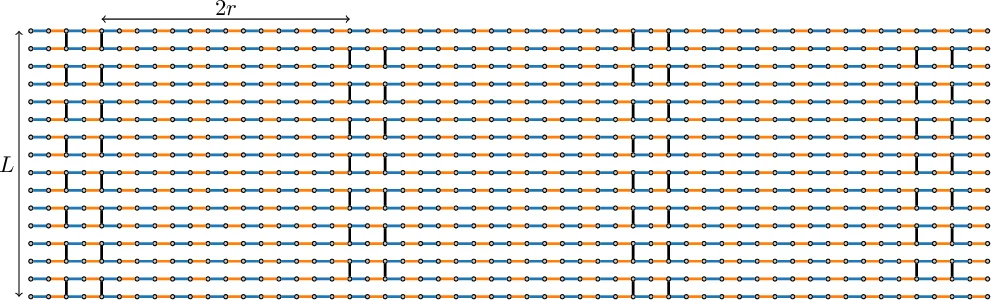
The authors provide a rigorous complexity separation for a contrived “extended brickwork” architecture: exact worst‑case simulation is #P‑hard, while average‑case approximate simulation (both sampling and computing output probabilities up to additive error) can be performed efficiently for all but a super‑polynomially small fraction of instances. This separation circumvents known worst‑to‑average‑case reductions that require near‑exact computation, because the algorithms only need to produce results with small, controllable error.
A key conceptual contribution is the reduction of 2D shallow random circuit simulation to a 1D unitary‑plus‑measurement dynamics. Recent work on measurement‑induced phase transitions shows that such dynamics can exhibit a transition from a volume‑law entangled phase to an area‑law phase as the measurement strength increases. The paper argues that for the shallow random circuits considered, the effective measurement strength is large enough to keep the system in the area‑law phase, which explains why the MPS bond dimension remains small.
To support this picture, the authors map the quantum circuit to a classical statistical‑mechanical model (a spin model with disorder). In this mapping, circuit depth d and local dimension q correspond to temperature‑like parameters. Analytical arguments and numerical simulations indicate a computational phase transition: when d or q exceed certain critical values, the statistical model enters a disordered phase, and the corresponding quantum dynamics becomes hard to simulate; below the threshold, the model is ordered and the algorithms run in polynomial time.
Numerical experiments focus on the depth‑3 brickwork architecture on a 409 × 409 qubit grid (≈1.6 × 10⁵ qubits). Implementing SEBD, the authors achieve variational‑distance error below 0.01 per sample in roughly one minute on a standard laptop, a task that would be infeasible for prior tensor‑network methods. Additional tests varying depth and local dimension show that the runtime scales almost linearly as long as the error tolerance is respected, confirming the conjectured efficiency for a broad class of shallow random circuits.
The paper concludes with two conjectures: (1) that any constant‑depth 2D random circuit with uniformly random gates is efficiently simulable on average, and (2) that the computational phase transition observed in the statistical‑mechanical mapping governs the boundary between easy and hard instances. It also outlines future directions, including extending the algorithms to more general architectures, proving rigorous entanglement bounds for the 1D dynamics, and refining the statistical‑mechanical analysis to pinpoint the exact critical parameters.
Overall, the work provides (i) a rigorous worst‑case vs. average‑case complexity separation for a specific architecture, (ii) concrete, implementable algorithms that achieve linear‑time approximate simulation of large‑scale shallow random circuits, and (iii) a unifying theoretical framework linking measurement‑induced entanglement transitions to classical simulation complexity. This substantially revises our understanding of the simulability frontier for random quantum circuits and has implications for the design of quantum‑supremacy experiments.
Comments & Academic Discussion
Loading comments...
Leave a Comment