Symplectic transversality and the Pego-Weinstein theory
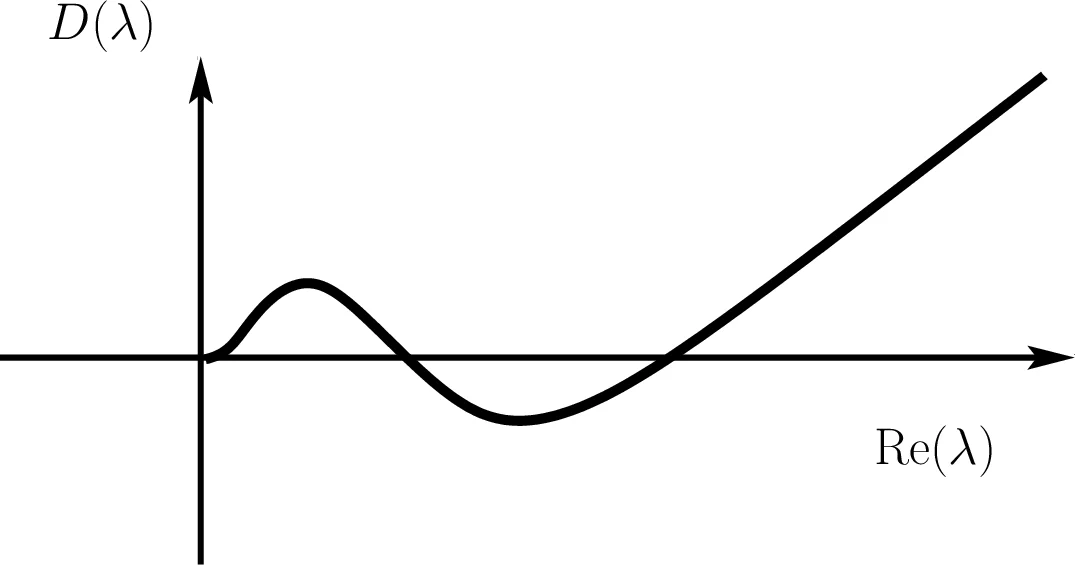
This paper studies the linear stability problem for solitary wave solutions of Hamiltonian PDEs. The linear stability problem is formulated in terms of the Evans function, a complex analytic function denoted by $D(\lambda)$, where $\lambda$ is the spectral parameter. The main result is the introduction of a new factor, denoted $\Pi$, in the Pego & Weinstein (1992) derivative formula [ D’’(0) = \chi \Pi \frac{dI}{dc},, ] where $I$ is the momentum of the solitary wave and $c$ is the speed. Moreover this factor turns out to be related to transversality of the solitary wave, modelled as a homoclinic orbit: the homoclinic orbit is transversely constructed if and only if $\Pi\neq 0$. The sign of $\Pi$ is a symplectic invariant, an intrinsic property of the solitary wave, and is a key new factor affecting the linear stability. The factor $\chi$ was already introduced by Bridges & Derks (1999) and is based on the asymptotics of the solitary wave. A supporting result is the introduction of a new abstract class of Hamiltonian PDEs built on a nonlinear Dirac-type equation, which model a wide range of PDEs in applications. Examples where the theory applies, other than Dirac operators, are the coupled mode equation in fluid mechanics and optics, the massive Thirring model, and coupled nonlinear wave equations. A calculation of $D’’(0)$ for solitary wave solutions of the latter class is included to illustrate the theory.
💡 Research Summary
The paper addresses the linear stability of solitary‑wave (soliton) solutions of Hamiltonian partial differential equations (PDEs) by extending the Evans‑function framework originally developed by Pego and Weinstein. In the classical Grillakis‑Shatah‑Strauss (GSS) approach, stability is inferred from the sign of the derivative of the momentum functional (I(c)) under the constraint of fixed momentum, together with a spectral hypothesis that the constrained second variation has exactly one negative eigenvalue and a simple zero eigenvalue. This hypothesis is often violated for coupled or multi‑component systems, limiting the applicability of GSS.
Pego and Weinstein (PW) circumvented the GSS spectral condition by introducing the Evans function (D(\lambda)), a complex‑analytic determinant whose zeros correspond to eigenvalues of the linearized operator. They proved that for a broad class of scalar Hamiltonian PDEs, \
Comments & Academic Discussion
Loading comments...
Leave a Comment