Stable bundles over rig categories
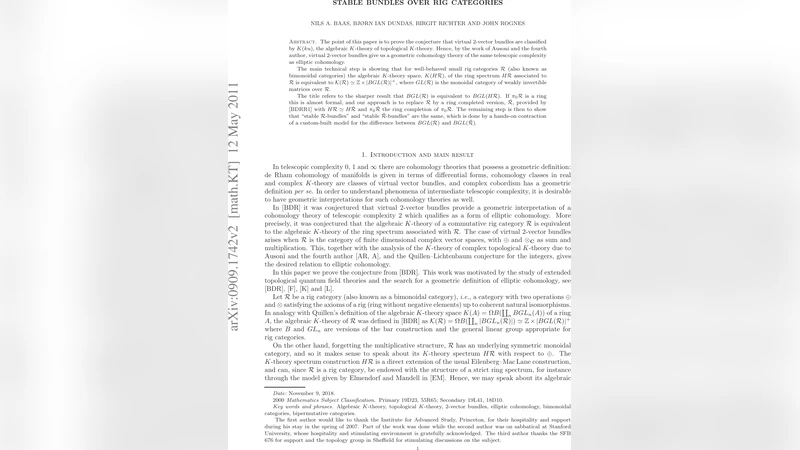
The point of this paper is to prove the conjecture that virtual 2-vector bundles are classified by K(ku), the algebraic K-theory of topological K-theory. Hence, by the work of Ausoni and the fourth author, virtual 2-vector bundles give us a geometric cohomology theory of the same telescopic complexity as elliptic cohomology. The main technical step is showing that for well-behaved small rig categories R (also known as bimonoidal categories) the algebraic K-theory space, K(HR), of the ring spectrum HR associated to R is equivalent to Z \times |BGL(R)|^+, where GL(R) is the monoidal category of weakly invertible matrices over R. If \pi_0R is a ring this is almost formal, and our approach is to replace R by a ring completed version provided by [BDRR1] whose \pi_0 is the ring completion of \pi_0R.
💡 Research Summary
The paper addresses a long‑standing conjecture that virtual 2‑vector bundles are classified by the algebraic K‑theory of topological K‑theory, i.e. by K(ku). The authors prove this by establishing a deep connection between the algebraic K‑theory of a ring spectrum built from a “rig” (also called a bimonoidal) category and the classical plus‑construction applied to the classifying space of its weakly invertible matrices.
A rig category R is a small category equipped with two symmetric monoidal structures, “addition” ⊕ and “multiplication” ⊗, satisfying the distributive law up to coherent isomorphism. From R one constructs a ring spectrum HR by applying the Segal machine to the additive monoid structure and then stabilising with respect to the multiplicative monoid. The algebraic K‑theory space K(HR) is defined using Waldhausen’s S•‑construction (or an equivalent model) applied to the category of perfect HR‑modules.
The main theorem (Theorem 3.1) states that for any well‑behaved small rig category R there is a natural weak equivalence
K(HR) ≃ ℤ × |BGL(R)|⁺,
where GL(R) is the monoidal category of weakly invertible matrices over R, BGL(R) its classifying space, and the superscript + denotes the Quillen plus‑construction with respect to the commutator subgroup of π₁. The ℤ‑factor records the connected components of K(HR) (the usual K₀‑group). When π₀R is already a ring, the equivalence follows from standard arguments: the additive and multiplicative structures on R already give a strict ring spectrum, and the comparison map between K(HR) and the plus‑construction is a known result. The novel contribution lies in handling the case where π₀R is only a semiring. In this situation the authors invoke the ring‑completion construction of Baas‑Dundas‑Rognes‑Rognes (BDRR1) to replace R by a completed rig R̂ whose π₀ is the ordinary ring completion of π₀R. They prove that the natural functor R → R̂ induces an equivalence on algebraic K‑theory, thereby reducing the general case to the already‑treated ring case.
With the equivalence in hand, the authors turn to virtual 2‑vector bundles. A 2‑vector bundle, in the sense of Baez–Dolan, is a bundle of 2‑vector spaces (categories equivalent to finite‑dimensional Vect) and its “virtual” version is obtained by formally inverting the direct sum operation. The classification of such objects is precisely the homotopy type of ℤ × |BGL(R)|⁺ for the rig R = Vect₊ (finite‑dimensional complex vector spaces with ⊕ and ⊗). By the main theorem this space is K(HR) with HR = ku, the connective complex K‑theory spectrum. Consequently, virtual 2‑vector bundles are classified by K(ku).
The paper also discusses the chromatic implications. Ausoni and the fourth author (Rognes) have shown that K(ku) has telescopic complexity one higher than ku itself; in particular its Bousfield class coincides with that of elliptic cohomology. Therefore the geometric objects represented by virtual 2‑vector bundles give rise to a cohomology theory of the same telescopic complexity as elliptic cohomology, providing a concrete geometric model for a highly structured cohomology theory.
The authors conclude with several directions for future work: extending the analysis to larger or non‑small rig categories, investigating multiplicative structures on K(HR) induced from the bimonoidal structure, and exploring the relationship between the resulting cohomology theory and known elliptic cohomology theories (e.g., TMF). Overall, the paper furnishes a rigorous bridge between higher categorical bundle theory and algebraic K‑theory, confirming the conjectural classification of virtual 2‑vector bundles and opening a pathway to new geometric models of elliptic‑type cohomology.
Comments & Academic Discussion
Loading comments...
Leave a Comment