A mechanical model for phase-separation in debris flow
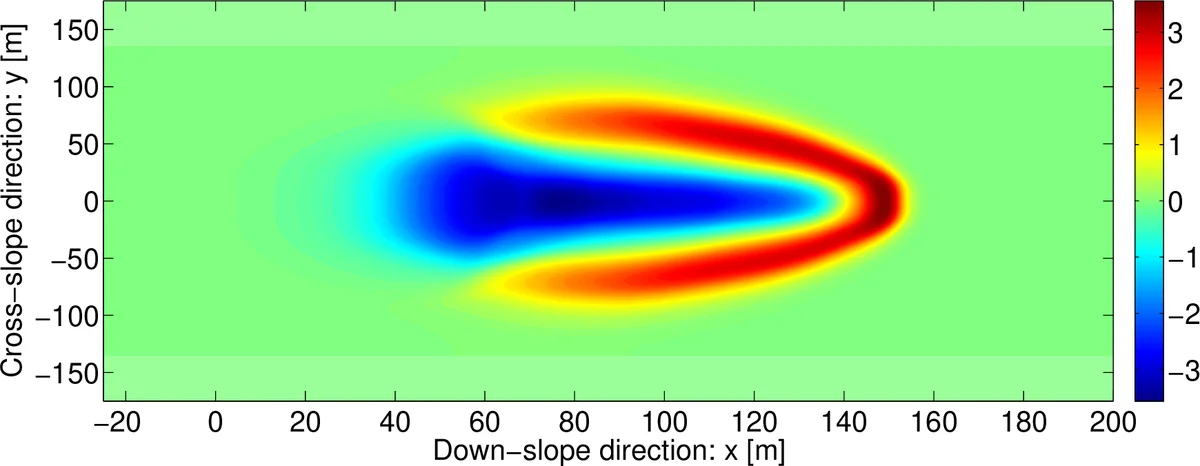
Understanding the physics of phase-separation between solid and fluid phases as a mixture mass moves down slope is a long-standing challenge. Here, we propose an extension of the two phase mass flow model (Pudasaini, 2012) by including a new mechanism, called separation-flux, that leads to strong phase-separation in avalanche and debris flows while balancing the enhanced solid flux with the reduced fluid flux. The separation flux mechanism is capable of describing the dynamically evolving phase-separation and levee formation in a multi-phase, geometrically three-dimensional debris flow. These are often observed phenomena in natural debris flows and industrial processes that involve the transportation of particulate solid-fluid mixture material. The novel separation-flux model includes several dominant physical and mechanical aspects such as pressure gradients, volume fractions of solid and fluid phases and their gradients, shear-rates, flow depth, material friction, viscosity, material densities, topographic constraints, grain size, etc. Due to the inherent separation mechanism, as the mass moves down slope, more and more solid particles are transported to the front and the sides, resulting in solid-rich and mechanically strong frontal surge head, and lateral levees followed by a weaker tail largely consisting of viscous fluid. The primary frontal solid-rich surge head followed by secondary fluid-rich surges is the consequence of phase-separation. Such typical and dominant phase-separation phenomena are revealed for two-phase debris flow simulations. Finally, changes in flow composition, that are explicitly considered by the new modelling approach, result in significant changes of impact pressure estimates. These are highly important in hazard assessment and mitigation planning and highlight the application potential of the new approach.
💡 Research Summary
The paper presents a novel extension to the two‑phase mass‑flow model originally proposed by Pudasaini (2012) in order to capture the strong phase‑separation observed in natural debris‑flows and avalanches. The authors introduce a “separation‑flux” term that explicitly accounts for the differential transport of solid and fluid constituents. In the classical framework, the mass balance equations for the solid (α_s h) and fluid (α_f h) phases, together with their momentum equations, assume that the two phases move together, leading to a homogeneous mixture. However, field observations and laboratory experiments consistently show that solid particles accumulate at the front and along the margins, forming a solid‑rich surge head and lateral levees, while the fluid concentrates in the central and rear portions, creating a viscous tail.
To reproduce this behaviour, the new model adds a flux vector J_s for the solid phase and a compensating flux J_f = –J_s for the fluid phase. The solid flux is composed of a diffusion‑like term proportional to the gradient of the solid volume fraction (∇α_s) and a pressure‑gradient term proportional to ∇p, i.e.,
J_s = –∇·(D_s ∇α_s) + Π_s ∇p,
where D_s is a diffusion coefficient that captures kinetic sieving and percolation effects, and Π_s quantifies the sensitivity of the solid phase to pressure gradients. By construction, the total mass is conserved, while the relative motion between phases is driven by the imbalance between these two contributions. The fluxes appear as additional source terms in the momentum equations, modifying the drag interaction term C_DG (u_f – u_s) and thereby allowing the solid and fluid velocities to diverge.
The governing equations retain the original non‑dimensional parameters (aspect ratio ε = H/L, density ratio γ = ρ_f/ρ_s, basal friction μ = tan δ, etc.) but now also involve the new coefficients D_s and Π_s, which can be related to measurable quantities such as grain size, fluid viscosity, shear rate, and local pressure. The model therefore integrates a broad set of physical mechanisms: (i) pressure gradients that push the heavier solid phase upslope or laterally, (ii) volume‑fraction gradients that generate kinetic sieving, (iii) shear‑rate‑dependent friction that strengthens the solid‑rich front, and (iv) viscous resistance that slows the fluid‑rich tail.
Numerical simulations are performed in three dimensions on a sloping plane with an initially uniform mixture. The results demonstrate the spontaneous emergence of a solid‑rich frontal surge, lateral levees, and a fluid‑rich rear. Quantitatively, the solid volume fraction at the front can exceed 80 % while the rear may drop below 30 %. The impact pressure field is markedly asymmetric: the frontal pressure is up to 45 % higher than predicted by the original homogeneous model, whereas the rear pressure is reduced by about 30 %. These patterns match documented field cases such as the No Jiri River debris‑flow (Japan, 1987) and the Jiang Jia Ravine event (China, 1990), as well as laboratory experiments that report similar segregation and levee formation.
The authors argue that incorporating phase‑separation is essential for accurate hazard assessment. Impact forces on structures, run‑out distances, and inundation extents are all sensitive to the local composition of the flow. By providing a physically based mechanism for the redistribution of mass, the separation‑flux model improves predictions of these quantities. Beyond geophysical flows, the framework is applicable to industrial processes involving granular‑fluid mixtures (e.g., mining, pharmaceuticals, food processing), where segregation can affect product quality and equipment wear.
Finally, the paper outlines future extensions: inclusion of grain‑size distributions, temperature‑dependent rheology, non‑Newtonian fluid behaviour, and complex topographies. Such enhancements would further broaden the model’s applicability and enable more comprehensive simulations of multiphase mass flows in both natural and engineered settings.
Comments & Academic Discussion
Loading comments...
Leave a Comment