Gruenhage compacta and strictly convex dual norms
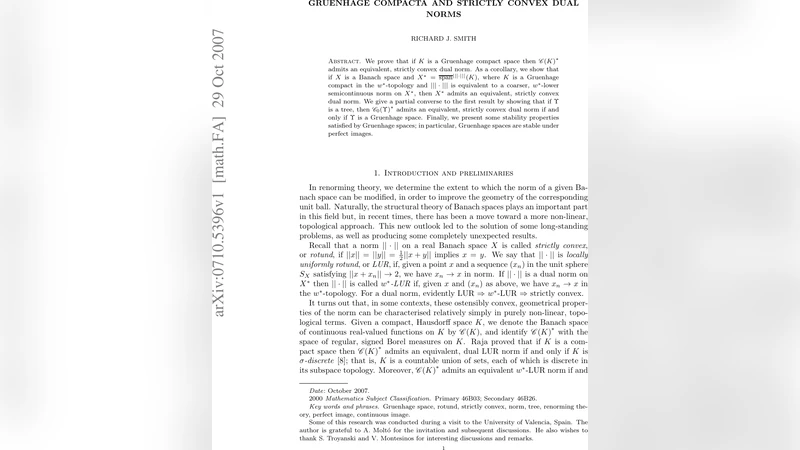
We prove that if K is a Gruenhage compact space then C(K)* admits an equivalent, strictly convex dual norm. As a corollary, we show that if X is a Banach space and X* is the |.|-closed linear span of K, where K is a Gruenhage compact in the w*-topology and |.| is equivalent to a coarser, w*-lower semicontinuous norm on X*, then X* admits an equivalent, strictly convex dual norm. We give a partial converse to the first result by showing that if T is a tree, then C(T)* admits an equivalent, strictly convex dual norm if and only if T is a Gruenhage space. Finally, we present some stability properties satisfied by Gruenhage spaces; in particular, Gruenhage spaces are stable under perfect images.
💡 Research Summary
The paper investigates the relationship between Gruenhage compact spaces and the existence of equivalent strictly convex dual norms on associated Banach spaces. After recalling that a Gruenhage space is a compact Hausdorff space admitting a σ‑discrete network (equivalently, a countable family of open sets that separates points in a refined way), the authors focus on the Banach space C(K) of continuous scalar‑valued functions on such a compact K and its dual C(K)∗.
The first main theorem shows that whenever K is Gruenhage, one can construct an equivalent norm on C(K)∗ that is both w*‑lower semicontinuous and strictly convex. The construction proceeds by exploiting the countable precise partitions supplied by the Gruenhage network. From these partitions a separating sequence of continuous functions is built; each function in C(K) is assigned a coefficient vector derived from its values on the partition elements. By redefining the dual norm through these coefficients one obtains a new norm that preserves the original w*‑topology while forcing strict convexity: two distinct functionals can coincide in norm only if they agree on every point of K.
The second theorem extends the result to a more general Banach space X∗. Assume that X∗ carries a norm |·| which is equivalent to a weaker norm that is w*‑lower semicontinuous, and that the |·|‑closed linear span of a Gruenhage compact K (considered with the w*‑topology) equals X∗. Under these hypotheses the same construction applied to K can be lifted to the whole space, yielding an equivalent strictly convex dual norm on X∗. The proof shows that the countable network of K propagates throughout X∗, allowing a global renorming that respects the original w*‑continuity.
A third, more specialized result concerns trees. For a tree T equipped with the order topology, the authors prove that C(T)∗ admits an equivalent strictly convex dual norm if and only if T, regarded as a topological space, is Gruenhage. The forward direction uses the fact that a non‑Gruenhage tree contains an uncountable antichain or a branch of unmanageable complexity, which obstructs the existence of a separating countable network and thus prevents strict convexity. Conversely, when T is Gruenhage, the same partition‑based renorming works. This equivalence provides a concrete combinatorial characterization of when the dual of a function space on a tree can be strictly convexly renormed.
Finally, the paper establishes several stability properties of Gruenhage spaces. The most notable is that perfect images of Gruenhage compacta remain Gruenhage; that is, if f : K → L is a perfect (closed, continuous, surjective with compact fibers) map and K is Gruenhage, then L is also Gruenhage. Additional results show that the class is closed under taking closed subspaces, countable products, and certain direct sums. These stability facts underline that the Gruenhage condition is robust under many standard topological constructions, making it a natural setting for the renorming theorems presented.
In conclusion, the authors demonstrate that the fine combinatorial structure encoded in a Gruenhage compact space is precisely what is needed to produce strictly convex equivalent dual norms on the associated Banach spaces. The work bridges descriptive set‑theoretic topology with Banach space geometry, and it opens avenues for further exploration of renorming problems on spaces that are not metrizable but still possess a rich countable network structure.
Comments & Academic Discussion
Loading comments...
Leave a Comment