Light subgraphs in graphs with average degree at most four
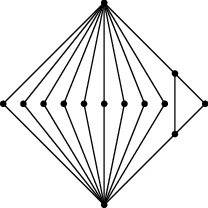
A graph $H$ is said to be {\em light} in a family $\mathfrak{G}$ of graphs if at least one member of $\mathfrak{G}$ contains a copy of $H$ and there exists an integer $\lambda(H, \mathfrak{G})$ such that each member $G$ of $\mathfrak{G}$ with a copy of $H$ also has a copy $K$ of $H$ such that $\deg_{G}(v) \leq \lambda(H, \mathfrak{G})$ for all $v \in V(K)$. In this paper, we study the light graphs in the class of graphs with small average degree, including the plane graphs with some restrictions on girth.
💡 Research Summary
The paper investigates the existence of “light” subgraphs in families of graphs whose average degree is bounded by a constant, focusing particularly on graphs with average degree at most four and on planar graphs with additional girth constraints. A subgraph H is called light in a family ℱ if at least one member of ℱ contains a copy of H and there exists an integer λ(H,ℱ) such that every member of ℱ that contains H also contains a copy K of H whose vertices all have degree at most λ(H,ℱ). The authors also recall the stronger notion of “strongly light” where every graph in the family must contain such a bounded‑degree copy.
The central theme is to identify small configurations—paths of length three or four with prescribed degree sequences, and stars whose center and leaves have bounded degrees—that must appear in any graph satisfying certain global sparsity conditions. The sparsity is measured by the average degree d̄(G)=2|E(G)|/|V(G)| and by the maximum average degree mad(G)=max_{H⊆G} d̄(H). For planar graphs, the relationship between girth g and mad(G) (namely (g−2)·mad(G)<2g) provides a convenient way to translate girth conditions into average‑degree bounds.
The main results are a series of theorems (Theorems 2.1–2.8) that give precise lists of unavoidable configurations under various combinations of minimum degree δ(G), average‑degree upper bound, and forbidden substructures (most notably the absence of (2,2,∞)-triangles). For example:
-
Theorem 2.1 deals with graphs of minimum degree 2 and average degree less than 2+2ρ, where ρ is a small rational number. Depending on the value of ρ (≤1/5, ≤1/4, ≤2/7, ≤5/16, ≤1/3) the theorem guarantees the presence of a (2,2,2)-path or one of a collection of stars and longer paths illustrated in Figures (a)–(l). As ρ becomes smaller, more complex configurations such as (3;2,2,5⁻)-stars become unavoidable.
-
Theorem 2.2 shows that any planar graph with minimum degree at least 2 and face size at least 7 must contain either a (2,2,5⁻)-path, a (2,5⁻,2)-path, or a (3,3,2,3)-path.
-
Theorem 2.5 treats graphs with δ(G)=2 and average degree <10/3, proving that one of the following must appear: a (2,2,∞)-path, a (2,3,6⁻)-path, a (3,3,3)-path, a (2,4,3⁻)-path, or a (2,9⁻,2)-path.
-
Theorem 2.6 focuses on graphs with δ(G)=3 and average degree <4, guaranteeing a (4⁻,3,7⁻)-path, a (5,3,5)-path, or a (5,3,6)-path.
-
Theorem 2.7 and 2.8 address triangle‑free normal plane maps, providing exhaustive lists of unavoidable 3‑paths and 4‑paths such as (5⁻,3,6⁻)-paths, (4⁻,3,7⁻)-paths, (3,5⁻,3)-paths, etc.
All proofs rely on the discharging method. The authors assign an initial charge μ(v)=deg(v)−(2+2ρ) to each vertex v. Vertices of degree 2 receive ρ from each endpoint of the maximal thread they belong to (Rule R1). Vertices of higher degree then distribute charge to adjacent 3⁺‑vertices according to the specific bound on ρ (Rules R2–R5). The key technical Lemma 1 establishes that for the relevant ranges of κ (the degree of a vertex) and ρ, the expression κ−(2+2ρ)−2κρ is non‑negative, ensuring that after redistribution no vertex ends up with negative charge provided the forbidden configurations are absent. This leads to a contradiction, proving that at least one of the listed configurations must exist.
To demonstrate the sharpness of each bound, the authors construct families of graphs that attain the average‑degree thresholds and contain exactly one of the configurations while avoiding all others. These constructions typically start from regular graphs (3‑regular, 4‑regular, or 8‑regular) and insert vertices on edges in a controlled manner, thereby adjusting the average degree to the desired value (e.g., 2+2/5, 2+1/2, etc.) and preserving the absence of the other configurations.
The paper situates its contributions within a broader literature on light edges and light subgraphs, citing classic results by Kotzig, Borodin, Jendrol’, and recent surveys. By extending the notion of light subgraphs from planar or 3‑connected graphs to more general sparse graph families characterized by average‑degree constraints, the work opens new avenues for applying these structural results to coloring problems, decomposition algorithms, and the study of minor‑closed families. The systematic catalog of unavoidable configurations under precise sparsity parameters constitutes a valuable reference for researchers working on extremal graph theory and planar graph algorithms.
Comments & Academic Discussion
Loading comments...
Leave a Comment