Bayesian regional moment tensor from ocean bottom seismograms recorded in the Lesser Antilles: Implications for regional stress field
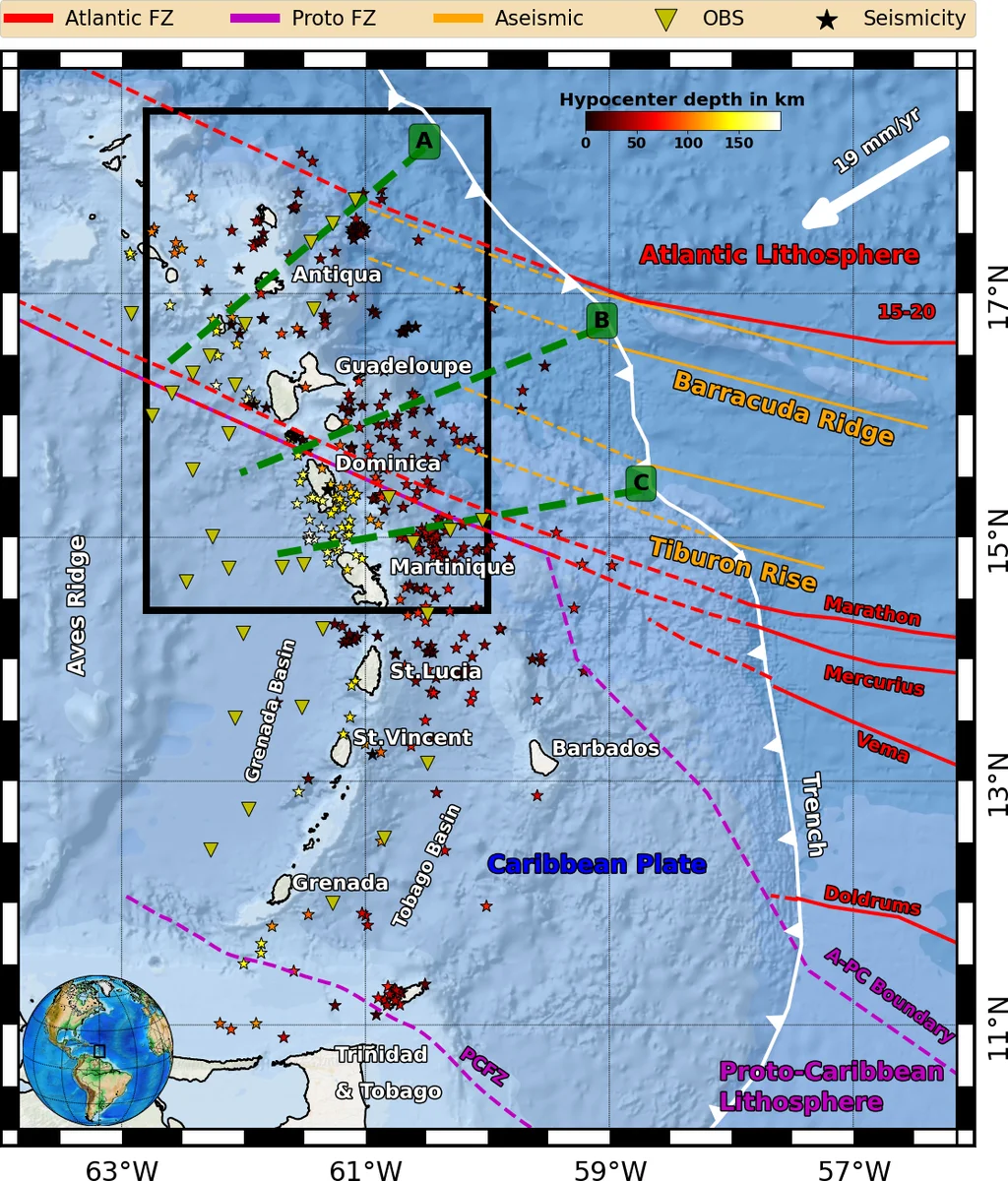
Seismic activity in the Lesser Antilles (LA) is characterized by strong regional variability along the arc reflecting the complex subduction setting and history. Although routine seismicity monitoring can rely on an increasing number of island stations, the island-arc setting means that high-resolution monitoring and detailed studies of fault structures require a network of ocean bottom seismometers (OBS). As part of the 2016-2017 Volatile recycling at the Lesser Antilles arc (VoiLA) project, we deployed 34 OBS stations in the fore- and back-arc. During the deployment time, 381 events were recorded within the subduction zone. In this paper, we perform full-waveform regional moment tensor (RMT) inversions, to gain insight into the stress distribution along the arc and at depth. We developed a novel inversion approach, AmΦB - “Amphibious Bayesian”, taking into account uncertainties associated with OBS deployments. Particularly, the orientation of horizontal components (alignment uncertainty) and the high noise level on them due to ocean microseisms are accounted for using AmΦB. The inversion is conducted using a direct, uniform importance sampling of the fault parameters within a multi-dimensional tree structure: the uniXtree-sampling algorithm. We show that the alignment of the horizontal OBS components, particularly in high noise level marine environments, influences the obtained source mechanism when using standard least-squares (L2) RMT inversion schemes, resulting in systematic errors in the recovered focal mechanisms including high artificial compensated linear vector dipole (CLVD) contributions. Our Bayesian formulation in AmΦB reduces these CLVD components by nearly 60% and the aberration of the focal geometry as measured by the Kagan angle by around 40% relative to a standard L2 inversion. Subsequently, we use AmΦB-RMT to obtain 45 (Mw > 3.8) regional MT solutions, out of which 39 are new to any existing database. Combining our new results with existing solutions, we subsequently analyze a total of 151 solutions in a focal mechanism classification (FMC) diagram and map them to the regional tectonic setting. We also use our newly compiled RMT database to perform stress tensor inversions along the LA subduction zone. On the plate interface, we observe the typical compressional stress regime of a subduction zone and find evidence for upper-plate strike slip and normal fault behaviour in the north that becomes a near arc-perpendicular extensional stress regime towards the south. A dominant slab perpendicular extensional stress regime is found in the slab at 100-200 km beneath the central part of the arc. We interpret this stress condition to be a result of slab pull varying along the arc due to partial slab detachment along previously hypothesized lateral slab tear near Grenada, at the southern end of the LA arc, leading to reactivation of preexisting structures around the subducted Proto-Caribbean ridge.
💡 Research Summary
The Lesser Antilles (LA) arc is a tectonically complex subduction zone with strong north‑south variations in seismicity and slab structure. Conventional land‑based networks, while extensive, cannot fully resolve the mechanisms of moderate‑size events because of the arc’s island geometry and limited offshore coverage. To address this, the VoiLA (Volatile recycling at the Lesser Antilles arc) project deployed 34 ocean‑bottom seismometers (OBS) across the fore‑ and back‑arc during 2016‑2017, recording 381 earthquakes.
This study introduces a novel Bayesian full‑waveform regional moment‑tensor (RMT) inversion framework called AmΦB (Amphibious Bayesian). AmΦB explicitly models two dominant sources of error inherent to OBS data: (i) high ambient noise on the horizontal components caused by ocean microseisms, and (ii) uncertainty in the azimuthal alignment of the horizontal sensors, which is typically unknown after deployment. The noise is represented by a data covariance matrix C_d that incorporates both variance and the effect of sampling frequency. Alignment uncertainty is captured by a model covariance matrix C_T derived from a Gaussian distribution of possible rotation angles Φ_n; the rotation matrix R(Φ_n) redistributes energy between the radial (R) and transverse (T) components. The total error covariance is C = C_d + C_T.
The inversion problem is cast in a Bayesian likelihood form Q(m) ∝ exp
Comments & Academic Discussion
Loading comments...
Leave a Comment