The finite harmonic oscillator and its associated sequences
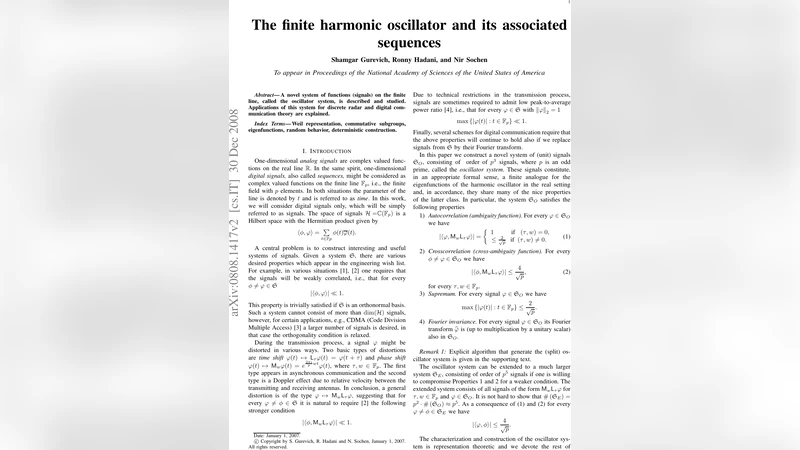
A system of functions (signals) on the finite line, called the oscillator system, is described and studied. Applications of this system for discrete radar and digital communication theory are explained. Keywords: Weil representation, commutative subgroups, eigenfunctions, random behavior, deterministic construction
💡 Research Summary
The paper introduces a novel system of discrete functions defined on the finite line, called the finite harmonic oscillator system, and demonstrates how this system can be used to construct deterministic sequences with excellent correlation properties for radar and digital communication applications. The authors begin by recalling the finite Heisenberg group (H) over a prime field (\mathbb{F}_p) and its symplectic automorphism group (Sp(2,\mathbb{F}_p)). They then invoke the Weil representation (\rho) of (Sp(2,\mathbb{F}_p)) on the Hilbert space of complex‑valued functions on (\mathbb{F}_p). This representation is unitary, intertwines the Fourier transform, and maps each element of a maximal commutative subgroup (T\subset Sp(2,\mathbb{F}_p)) to a simultaneously diagonalizable operator.
For each character (\chi) of the multiplicative group (\mathbb{F}_p^\times) the authors construct an eigenfunction (the “oscillator function”) of the commuting family (\rho(T)). Explicitly, the eigenfunctions have the form
\
Comments & Academic Discussion
Loading comments...
Leave a Comment