Kinetic dissipation and anisotropic heating in a turbulent collisionless plasma
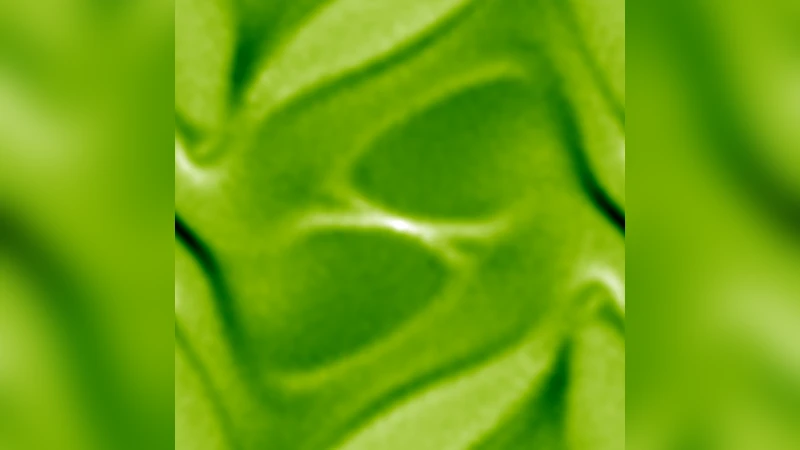
The kinetic evolution of the Orszag-Tang vortex is studied using collisionless hybrid simulations. In the magnetohydrodynamic regime this vortex leads rapidly to broadband turbulence. Significant differences from MHD arise at small scales, where the fluid scale energy dissipates into heat almost exclusively through the magnetic field because the protons are decoupled from the magnetic field. Although cyclotron resonance is absent, the protons heat preferentially in the plane perpendicular to the mean field, as in the corona and solar wind. Effective transport coefficients are calculated.
💡 Research Summary
The paper investigates the kinetic evolution of the classic Orszag‑Tang vortex using collisionless hybrid simulations, where ions (protons) are treated as kinetic particles and electrons as a mass‑less fluid. In the magnetohydrodynamic (MHD) regime—i.e., at scales larger than the ion inertial length—the vortex rapidly generates broadband turbulence. The energy spectrum follows a Kolmogorov‑like –5/3 slope, and the dynamics are well described by conventional MHD transport coefficients (viscosity ν and resistivity η).
When the cascade reaches ion‑scale and sub‑ion scales (k⊥ρi ≈ 1 and beyond), the protons decouple from the magnetic field. The simulation shows that the fluid‑scale energy is no longer dissipated through viscous or collisional processes; instead, magnetic fluctuations themselves become the primary channel for converting electromagnetic energy into ion heat. This “magnetic‑field‑driven” dissipation occurs without cyclotron resonance (ω ≈ Ωi), which is absent in the hybrid model.
Despite the lack of resonant wave‑particle interaction, protons are heated preferentially in the direction perpendicular to the mean magnetic field B0. The perpendicular temperature T⊥ grows to 2.5–3 times the parallel temperature T∥, reproducing the anisotropic heating observed in the solar corona and solar wind. The authors attribute this to non‑resonant Landau‑type interactions combined with the anisotropic nature of the turbulent fluctuations: as the cascade proceeds to smaller scales, magnetic structures become increasingly filamentary, producing electric fields that accelerate ions more efficiently across field lines than along them.
A key contribution of the work is the quantitative extraction of effective transport coefficients from the simulation data. By measuring the scale‑dependent energy dissipation rate ε(k) and the spectral energy density E(k), the authors infer an effective viscosity νeff(k) and resistivity ηeff(k). At large scales νeff and ηeff are comparable to their MHD counterparts, but as kρi exceeds unity, νeff drops sharply while ηeff rises dramatically, roughly scaling as k². This demonstrates that, in a collisionless plasma, the effective resistivity is not a constant but is strongly enhanced at kinetic scales, providing an efficient pathway for magnetic energy to be thermalized.
The study bridges a gap between fluid‑scale turbulence theory and kinetic plasma physics. It shows that even in the absence of particle collisions, turbulent magnetic fluctuations can dissipate energy and produce the observed perpendicular ion heating. The findings have direct relevance for interpreting in‑situ measurements of the solar wind, where similar anisotropic temperature ratios are routinely observed, and for modeling coronal heating where collisional processes are negligible.
In conclusion, the hybrid simulation of the Orszag‑Tang vortex reveals a two‑regime picture: (1) an MHD‑like cascade at fluid scales, and (2) a kinetic regime at ion and sub‑ion scales where magnetic‑field‑driven, non‑resonant processes dominate dissipation and generate strong perpendicular ion heating. The derived scale‑dependent transport coefficients underscore the inadequacy of constant‑coefficient MHD models for collisionless plasmas and point toward the necessity of incorporating kinetic dissipation mechanisms in large‑scale space‑plasma modeling. Future work should extend these results to three dimensions, include electron kinetic effects, and explore the role of plasma β and guide‑field strength on the heating anisotropy.