Topology-free immersed boundary method for incompressible turbulence flows: An aerodynamic simulation for dirty CAD geometry
To design a method to solve the issues of handling ‘dirty’ and highly complex geometries, the topology-free method combined with the immersed boundary method is presented for viscous and incompressible flows at a high Reynolds number. The method simultaneously employs a ghost-cell technique and distributed forcing technique to impose the boundary conditions. An axis-projected interpolation scheme is used to avoid searching failures during fluid and solid identification. This method yields a topology-free immersed boundary, which particularly suits flow simulations of highly complex geometries. Difficulties generally arise when generating the calculation grid for these scenarios. This method allows dirty data to be handled without any preparatory treatment work to simplify or clean-up the geometry. This method is also applicable to the coherent structural turbulence model employed in this study. The verification cases, used in conjunction with the second-order central-difference scheme, resulted in first-order accuracy at finer resolution, although the coarser resolution retained second-order accuracy. This method is fully parallelized for distributed memory platforms. In this study, the accuracy and fidelity of this method were examined by simulating the flow around the bluff body, past a flat plate, and past dirty spheres. These simulations were compared with experimental data and other established results. Finally, results from the simulation of practical applications demonstrate the ability of the method to model highly complex, non-canonical three-dimensional flows. The countermeasure based on the accurate classification of geometric features has provided a robust and reasonable solution.
💡 Research Summary
The paper introduces a “topology‑free” immersed boundary method (TF‑IBM) designed to eliminate the need for pre‑processing of dirty, non‑watertight CAD geometries in incompressible turbulent flow simulations. Conventional immersed‑boundary approaches require a closed‑volume description of the solid, which forces users to spend days or weeks repairing gaps, overlaps, zero‑thickness plates, and other defects that are common in early‑stage CAD data. The authors combine two well‑known IBM strategies—ghost‑cell enforcement (Mittal et al.) and Peskin’s distributed forcing—into a single framework that can operate directly on raw Cartesian grids.
Key innovations are: (1) a dummy‑cell definition that automatically classifies each Cartesian cell as fluid or solid without an explicit inside/outside test; (2) an axis‑projected interpolation scheme that projects interpolation points onto the local axial direction of the immersed surface, thereby avoiding search failures that plague conventional multi‑dimensional interpolation when the surface is highly irregular or contains thin plates; (3) the simultaneous use of ghost‑cell velocity correction and a discrete force term derived from the filtered Navier–Stokes equations, which together enforce the no‑slip condition even for zero‑thickness surfaces.
The governing equations are the spatially filtered incompressible Navier–Stokes equations with a sub‑grid‑scale (SGS) stress modeled by an eddy‑viscosity formulation. A finite‑volume discretization on a collocated Cartesian mesh is employed; velocity and pressure reside at cell centers, eliminating the need for face‑center interpolation of the IBM forcing. Temporal integration uses a Crank–Nicolson scheme with a fractional‑step predictor‑corrector, while the pressure Poisson equation is solved with either BiCGStab or red‑black SOR, enabling efficient scaling on distributed‑memory clusters. The domain is partitioned into a pure fluid region (Ω_f) and an IBM region (Ω_IB) that contains all cells intersected by the immersed surface, ensuring a clean, non‑overlapping decomposition for parallel execution.
Verification is performed on four benchmark problems: (i) Taylor‑Green vortex decay, demonstrating proper temporal convergence; (ii) flow around the Ahmed body at various angles of attack, showing good agreement with wind‑tunnel data and high‑fidelity CFD; (iii) flat‑plate flow over a wide range of attack angles, accurately capturing boundary‑layer development and separation; and (iv) flow past “dirty” spheres whose surfaces contain holes, overlaps, and intersecting patches. In the sphere cases the method reproduces drag and lift coefficients without any geometry cleaning, confirming its robustness. Convergence studies reveal second‑order spatial accuracy on coarse grids (as expected for the central‑difference scheme) and first‑order accuracy on the finest grids, a behavior typical of ghost‑cell IBM implementations where the forcing introduces a localized truncation error.
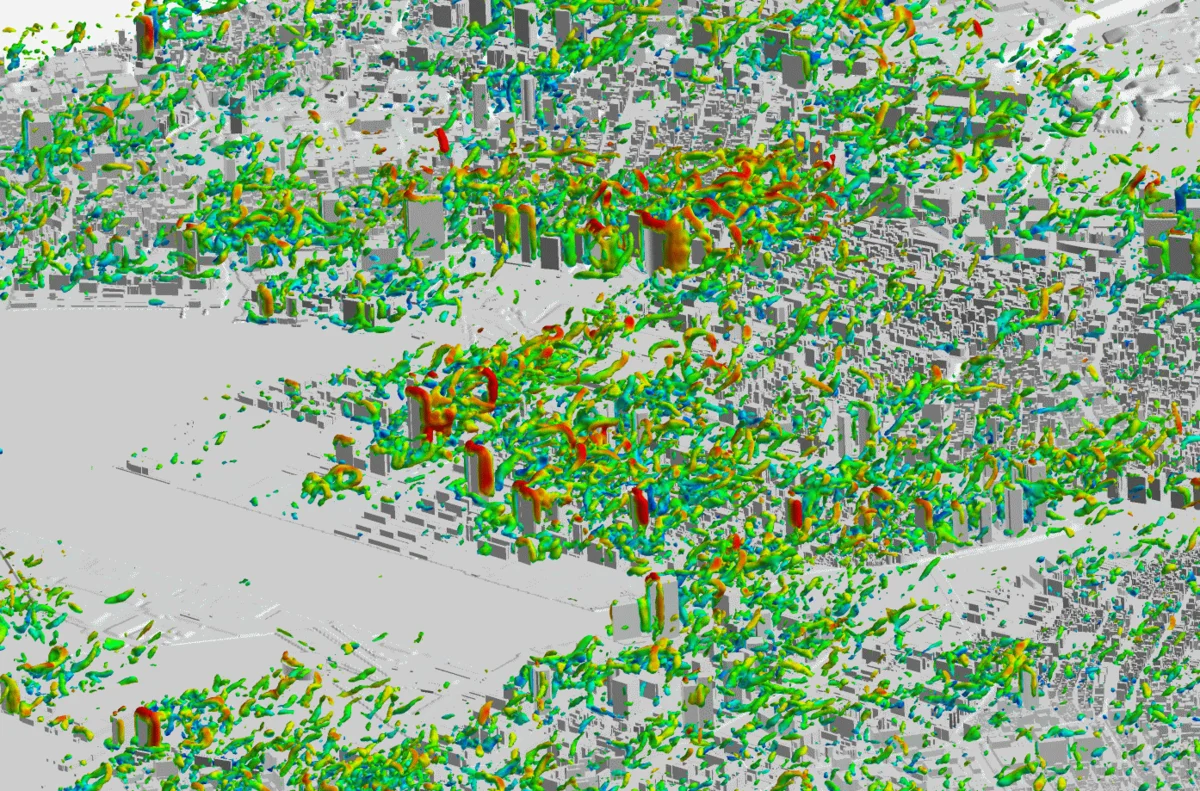
Two large‑scale applications illustrate the method’s practical value. First, a full‑vehicle aerodynamic analysis includes thousands of components (engine bay, under‑floor, suspension, wiring harnesses, bolts, etc.) many of which are thin plates or intersecting parts. The TF‑IBM runs directly on a uniform Cartesian mesh, bypassing surface‑wrapping or unstructured mesh generation, and yields pressure distributions, drag, and vortex structures that match experimental wind‑tunnel measurements. Second, an urban wind‑environment simulation models a city block with buildings, streets, and moving vehicles, again using raw CAD data with numerous geometric defects. The simulation runs efficiently on hundreds of cores, maintaining parallel efficiencies above 80 %.
The authors acknowledge limitations: (a) the method exhibits only first‑order accuracy at the finest resolutions, which may be insufficient for wall‑resolved large‑eddy simulations; (b) results depend on the chosen SGS model, and more sophisticated dynamic models could improve fidelity; (c) the Cartesian‑grid approach still incurs a high cell count for very thin plates, potentially limiting scalability for extremely detailed geometries. Future work is suggested on high‑order interpolation, adaptive mesh refinement, and coupling with isogeometric analysis to retain the topology‑free advantage while reducing grid overhead.
In summary, this study delivers a robust, parallel‑ready IBM that removes the costly pre‑processing bottleneck associated with dirty CAD data, validates it across canonical benchmarks, and demonstrates its capability on realistic engineering problems such as full‑vehicle aerodynamics and urban wind flows. The combination of ghost‑cell correction, distributed forcing, and axis‑projected interpolation constitutes a significant step toward fully automated CFD pipelines for complex industrial geometries.
Comments & Academic Discussion
Loading comments...
Leave a Comment