Branch cuts of Stokes wave on deep water. Part I: Numerical solution and Pade approximation
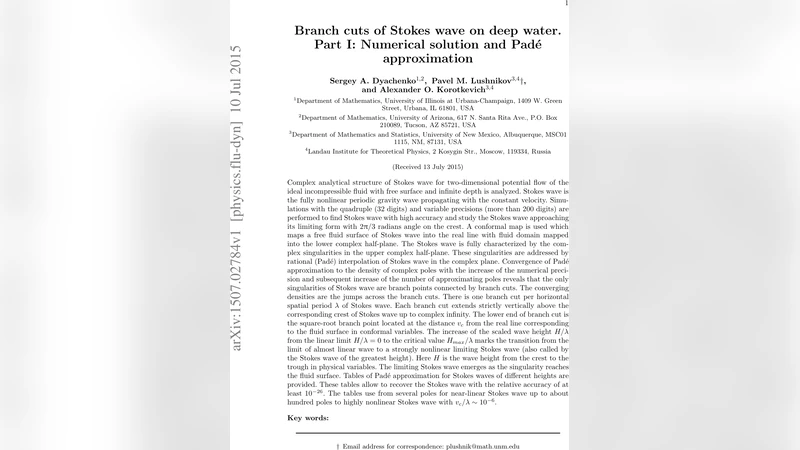
Complex analytical structure of Stokes wave for two-dimensional potential flow of the ideal incompressible fluid with free surface and infinite depth is analyzed. Stokes wave is the fully nonlinear periodic gravity wave propagating with the constant velocity. Simulations with the quadruple and variable precisions are performed to find Stokes wave with high accuracy and study the Stokes wave approaching its limiting form with $2\pi/3$ radians angle on the crest. A conformal map is used which maps a free fluid surface of Stokes wave into the real line with fluid domain mapped into the lower complex half-plane. The Stokes wave is fully characterized by the complex singularities in the upper complex half-plane. These singularities are addressed by rational (Pad'e) interpolation of Stokes wave in the complex plane. Convergence of Pad'e approximation to the density of complex poles with the increase of the numerical precision and subsequent increase of the number of approximating poles reveals that the only singularities of Stokes wave are branch points connected by branch cuts. The converging densities are the jumps across the branch cuts. There is one branch cut per horizontal spatial period $\lambda$ of Stokes wave. Each branch cut extends strictly vertically above the corresponding crest of Stokes wave up to complex infinity. The lower end of branch cut is the square-root branch point located at the distance $v_c$ from the real line corresponding to the fluid surface in conformal variables. The limiting Stokes wave emerges as the singularity reaches the fluid surface. Tables of Pad'e approximation for Stokes waves of different heights are provided. These tables allow to recover the Stokes wave with the relative accuracy of at least $10^{-26}$. The tables use from several poles to about hundred poles for highly nonlinear Stokes wave with $v_c/\lambda\sim 10^{-6}.$
💡 Research Summary
The paper presents a comprehensive study of the analytical structure of Stokes waves—steady, periodic gravity waves propagating on the surface of an ideal, incompressible fluid of infinite depth—by examining their complex singularities. Using a conformal map that sends the free surface to the real axis and the fluid domain to the lower half of the complex plane, the authors reduce the governing Euler equations to a pair of equations for the surface elevation and the velocity potential expressed on the real line. In this representation the entire dynamics is encoded in the analytic continuation of these functions into the upper half‑plane, where singularities dictate the global behavior of the wave.
High‑precision numerical simulations are carried out with both quadruple‑precision (≈32 decimal digits) and arbitrary‑precision arithmetic (exceeding 200 digits). By gradually increasing the wave height (H) toward the limiting Stokes wave, the authors track the closest singularity to the real axis, whose vertical distance (v_c) obeys the scaling law (v_c\propto (H_{\max}-H)^{\delta}) with (\delta\approx1.48). This confirms earlier theoretical predictions that the limiting wave corresponds to the singularity reaching the free surface, producing the classic 2π/3 radian (120°) crest angle.
To uncover the nature of the singularities, the authors employ Padé approximation in a second conformal variable (\zeta) that maps a single spatial period onto the whole real line. The Padé approximants are constructed using the Alpert‑Greengard‑Hagstrom (AGH) algorithm, which yields a rational function with poles that faithfully represent the underlying analytic structure without spurious zeros or poles. As the number of poles (N) increases, the distribution of poles converges to a continuous density along a vertical line above each crest. This density is precisely the jump of the function across a branch cut, indicating that the singularity is a square‑root branch point at the lower end of the cut.
The key findings are:
-
Single Branch Cut per Period – For each spatial period (\lambda) there exists exactly one vertical branch cut extending from the free surface into the complex plane. Its lower endpoint is a square‑root branch point located at ((u=n\lambda, v=v_c)) where (n) is an integer.
-
Scaling of the Branch‑point Distance – The distance (v_c) decreases as the wave height approaches its maximal value, following the power law mentioned above. In the limiting case (v_c\to0), the branch point merges with the free surface, reproducing the 2π/3 crest angle.
-
Absence of Additional Singularities – Numerical evidence shows that no other singularities (poles, essential singularities, or additional cuts) exist within the finite complex plane; the entire analytic structure is captured by the single branch cut per period.
-
High‑Accuracy Reconstruction – The authors provide tables of Padé poles for a wide range of wave heights, from near‑linear waves (few poles) to highly nonlinear waves (up to a hundred poles) where (v_c/\lambda\sim10^{-6}). Using these tables, the Stokes wave can be reconstructed with a relative error better than (10^{-26}).
The paper is organized as follows: Section 2 derives the conformal‑map formulation and reduces the Euler equations to a compact system on the real line. Section 3 details the numerical scheme, precision handling, and the extraction of the singularity location. Section 4 introduces the second conformal variable (\zeta) and the Padé‑AGH methodology, demonstrating convergence to the branch cut. Section 5 connects the jump across the cut in (\zeta) to the periodic array of cuts in the original (w) plane and shows how to recover the square‑root behavior analytically. Section 6 discusses the implications for wave breaking, whitecapping, and the formation of rogue waves, emphasizing that the slow approach of the singularity to the surface may act as a precursor to these phenomena. Appendices provide derivations of the basic equations, a concise description of the AGH algorithm, and the format of the Padé tables.
Overall, the work establishes that the complex singularity structure of Stokes waves is remarkably simple: a single square‑root branch point per period, connected to infinity by a vertical branch cut. By combining ultra‑high‑precision numerics with rational approximation techniques, the authors deliver a powerful toolbox for future analytical and computational investigations of nonlinear water waves.
Comments & Academic Discussion
Loading comments...
Leave a Comment