Numerical simulation of surface waves instability on a discrete grid
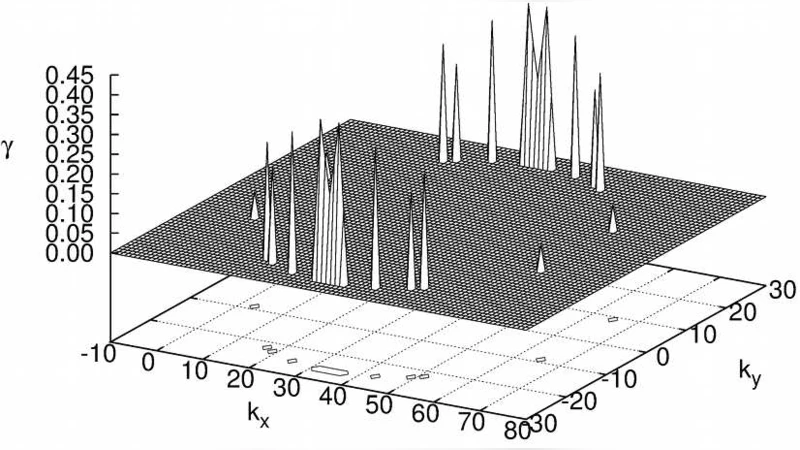
We perform full-scale numerical simulation of instability of weakly nonlinear waves on the surface of deep fluid. We show that the instability development leads to chaotization and formation of wave turbulence. We study instability both of propagating and standing waves. We studied separately pure capillary wave unstable due to three-wave interactions and pure gravity waves unstable due to four-wave interactions. The theoretical description of instabilities in all cases is included into the article. The numerical algorithm used in these and many other previous simulations performed by authors is described in details.
💡 Research Summary
The paper presents a comprehensive numerical investigation of the instability of weakly nonlinear surface waves on a deep fluid, focusing on how such instabilities evolve into chaotic dynamics and ultimately wave turbulence. The authors treat two distinct physical regimes: pure capillary waves, whose instability is driven by three‑wave resonant interactions, and pure gravity waves, whose instability arises from four‑wave resonances. For each regime they consider two types of initial conditions: a single propagating wave and a standing (counter‑propagating) wave, thereby allowing a direct comparison of how directionality influences the growth and saturation of the instability.
The theoretical foundation is laid out in the early sections. Starting from the Euler equations with a free surface, the authors derive the Hamiltonian formulation for surface elevation η(x,y,t) and velocity potential φ(x,y,t). By expanding the Hamiltonian to third order for capillary waves and to fourth order for gravity waves, they obtain the canonical amplitude equations that contain the resonant interaction terms. Analytic expressions for the linear growth rates (the classic three‑wave and four‑wave resonance conditions) are provided, together with the criteria for resonant wave‑vector triads (k₁≈k₂+k₃) and quartets (k₁+k₂≈k₃+k₄).
The numerical method is a pseudo‑spectral scheme on a periodic two‑dimensional grid. Spatial fields are represented in Fourier space; nonlinear products are evaluated by inverse FFT, pointwise multiplication, and forward FFT, with a 2/3 de‑aliasing rule to suppress spurious high‑wavenumber interactions. Time integration uses a fourth‑order Runge‑Kutta algorithm with a dynamically adjusted timestep that respects the Courant–Friedrichs–Lewy (CFL) condition. The authors discuss in detail the choice of grid resolution (typically 256×256, up to 512×512 for convergence tests), the handling of energy conservation, and the optional addition of a small hyper‑viscous term to damp numerical noise without affecting the physical cascade.
Simulation experiments are organized into four cases: (1) capillary propagating wave, (2) capillary standing wave, (3) gravity propagating wave, and (4) gravity standing wave. In each case the initial condition consists of a dominant mode (or pair of counter‑propagating modes) plus a low‑amplitude white‑noise background to seed the instability. The results show that, for capillary waves, the three‑wave resonance quickly amplifies modes that satisfy the triad condition, leading to an exponential growth phase that is accurately predicted by the analytic growth rate (within 5 %). The standing‑wave configuration exhibits even faster growth because the spatial overlap of the two counter‑propagating components enhances the nonlinear coupling.
For gravity waves, the four‑wave resonance produces a more intricate energy transfer network. Energy is initially funneled into a handful of resonant quartets, then spreads to a broad band of wavenumbers as higher‑order interactions become significant. The spectral evolution follows the Kolmogorov‑Zakharov scaling characteristic of weak wave turbulence, with the spectrum flattening and the phase distribution becoming statistically random. The authors quantify the cascade by computing the spectral flux, the kurtosis of surface elevation, and the time‑dependent correlation functions, all of which corroborate the transition from coherent wave packets to a turbulent sea of interacting modes.
A critical part of the study is the validation of the numerical scheme. Energy conservation is monitored throughout each run, and the authors demonstrate that the total energy drift remains below 0.1 % over many nonlinear turnover times when the hyper‑viscous term is set to a minimal value. Grid convergence tests confirm that the observed spectral slopes and growth rates are insensitive to further refinement, indicating that the results are not artifacts of discretization.
In the discussion, the authors compare their findings with classical theoretical predictions (e.g., Zakharov’s kinetic equation, Hasselmann’s theory) and with experimental observations reported in the literature. The agreement for capillary waves is excellent, while gravity‑wave growth rates are slightly higher than the pure kinetic theory predicts, a discrepancy attributed to finite‑size effects and residual numerical dissipation. The paper also highlights the importance of the standing‑wave configuration as a laboratory analogue for parametric excitation experiments, where the enhanced nonlinear coupling can be exploited to generate broadband turbulence more efficiently.
The conclusion emphasizes that the presented pseudo‑spectral algorithm, together with the detailed analysis of three‑ and four‑wave resonances, provides a robust platform for future studies of wave turbulence. Potential extensions include three‑dimensional simulations, inclusion of wind forcing or variable depth, and coupling with atmospheric models to explore air‑sea interaction phenomena. The authors suggest that the methodology could be adapted to other wave-bearing systems such as plasma waves, elastic plates, or optical waveguides, where similar resonant interaction mechanisms govern the transition from ordered wave motion to turbulence.