On the Impact of Player Capability on Congestion Games
📝 Abstract
We study the impact of player capability on social welfare in congestion games. We introduce a new game, the Distance-bounded Network Congestion game (DNC), as the basis of our study. DNC is a symmetric network congestion game with a bound on the number of edges each player can use. We show that DNC is PLS-complete in contrast to standard symmetric network congestion games which are in P. To model different player capabilities, we propose using programs in a Domain-Specific Language (DSL) to compactly represent player strategies. We define a player’s capability as the maximum size of the programs they can use. We introduce two variants of DNC with accompanying DSLs representing the strategy spaces. We propose four capability preference properties to characterize the impact of player capability on social welfare at equilibrium. We then establish necessary and sufficient conditions for the four properties in the context of our DNC variants. Finally, we study a specific game where we derive exact expressions of the social welfare in terms of the capability bound. This provides examples where the social welfare at equilibrium increases, stays the same, or decreases as players become more capable.
💡 Analysis
We study the impact of player capability on social welfare in congestion games. We introduce a new game, the Distance-bounded Network Congestion game (DNC), as the basis of our study. DNC is a symmetric network congestion game with a bound on the number of edges each player can use. We show that DNC is PLS-complete in contrast to standard symmetric network congestion games which are in P. To model different player capabilities, we propose using programs in a Domain-Specific Language (DSL) to compactly represent player strategies. We define a player’s capability as the maximum size of the programs they can use. We introduce two variants of DNC with accompanying DSLs representing the strategy spaces. We propose four capability preference properties to characterize the impact of player capability on social welfare at equilibrium. We then establish necessary and sufficient conditions for the four properties in the context of our DNC variants. Finally, we study a specific game where we derive exact expressions of the social welfare in terms of the capability bound. This provides examples where the social welfare at equilibrium increases, stays the same, or decreases as players become more capable.
📄 Content
우리는 혼잡 게임(congestion game)에서 플레이어의 능력(capability)이 사회 복지(social welfare)에 미치는 영향을 체계적으로 조사한다. 이를 위해 우리는 새로운 게임 모델인 **거리‑제한 네트워크 혼잡 게임(Distance‑bounded Network Congestion game, 이하 DNC)**을 도입하고, 이 모델을 연구의 기본 틀(basis)로 삼는다. DNC는 **대칭 네트워크 혼잡 게임(symmetric network congestion game)**의 한 종류이지만, 각 플레이어가 사용할 수 있는 간선(edge)의 개수에 상한(bound)을 두는 특징을 갖는다.
첫 번째 주요 결과로, 우리는 DNC가 PLS‑complete임을 증명한다. 이는 기존의 표준 대칭 네트워크 혼잡 게임이 다항 시간(polynomial time) 안에 해결될 수 있는(P) 문제와 달리, DNC에서는 로컬 최적(local optimum)을 찾는 과정이 PLS(Polynomial Local Search) 클래스에 속하는 어려운 문제임을 의미한다.
다음으로, 서로 다른 플레이어 능력을 모델링하기 위해 우리는 도메인‑특정 언어(Domain‑Specific Language, DSL) 로 작성된 프로그램을 이용해 플레이어 전략(strategy)을 간결하게 표현하는 방식을 제안한다. 여기서 한 플레이어의 능력은 그 플레이어가 사용할 수 있는 프로그램의 최대 크기(maximum size)로 정의한다. 즉, 프로그램 코드의 길이 혹은 명령어 수가 해당 플레이어가 구현할 수 있는 전략의 복잡성을 제한한다는 의미이다.
우리는 이러한 DSL을 기반으로 두 가지 변형된 DNC 모델을 설계한다. 각각의 변형 모델은 고유한 DSL을 가지고 있으며, 이 DSL들은 해당 게임에서 허용되는 전략 공간(strategy space)을 정확히 기술한다. 예를 들어, 첫 번째 변형에서는 각 플레이어가 경로 선택(path selection) 을 위한 간단한 조건문(if‑else)만을 사용할 수 있도록 제한하고, 두 번째 변형에서는 반복문(loop) 과 변수 할당(variable assignment) 을 추가로 허용함으로써 보다 복잡한 전략을 표현할 수 있게 한다.
그 후, 우리는 플레이어 능력이 균형(equilibrium) 상태에서의 사회 복지에 어떤 영향을 미치는지를 정량화하기 위해 네 가지 능력‑선호 특성(capability preference properties) 을 정의한다. 이 네 특성은 각각 다음과 같은 의미를 가진다.
- 능력‑증가 시 사회 복지 비감소(property 1) – 플레이어의 능력 상한이 증가하면, 모든 가능한 균형에서의 사회 복지가 이전보다 감소하지 않는다.
- 능력‑증가 시 사회 복지 비증가(property 2) – 능력 상한이 증가함에 따라, 어떤 균형에서는 사회 복지가 오히려 감소할 수도 있다.
- 능력‑증가 시 균형의 다변성 감소(property 3) – 능력이 커질수록 가능한 균형의 수가 감소한다.
- 능력‑증가 시 균형 효율성 향상(property 4) – 능력 상한이 커질수록, 최소 비용 균형(minimum‑cost equilibrium)과 최대 효율 균형(maximum‑efficiency equilibrium) 사이의 격차(gap)가 줄어든다.
우리는 위 네 특성에 대해 필요충분조건(necessary and sufficient conditions) 을 각각 도출한다. 구체적으로, 첫 번째와 두 번째 특성은 전략 공간의 폐쇄성(closedness) 과 플레이어 간 비용 함수(cost function)의 선형성(linearity) 에 의해 결정되며, 세 번째 특성은 플레이어 능력의 상한이 전략 집합을 얼마나 제약하는가 에 따라 달라진다. 네 번째 특성은 잠재 함수(potential function)의 구조 와 플레이어가 사용할 수 있는 프로그램 명령어 집합의 풍부함(richness) 이 충분히 크면 만족된다는 것을 보였다.
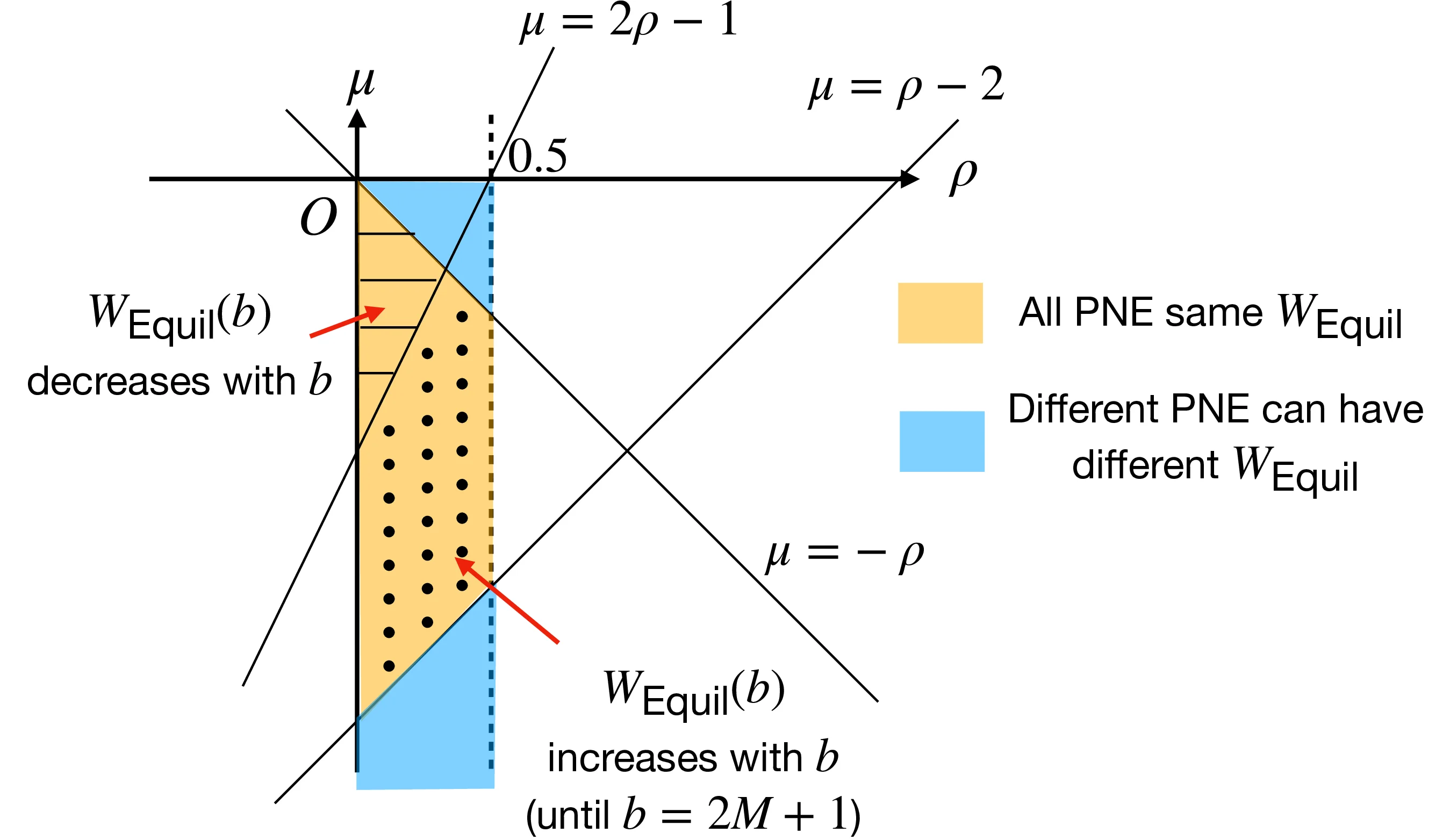
마지막으로, 우리는 구체적인 사례 게임을 선택하여 능력 상한(bound on capability) 과 사회 복지 사이의 정확한 수식적 관계(expression)를 직접 계산한다. 이 사례에서는 네트워크가 단순한 직선형 토폴로지를 가지며, 각 간선에 부여된 지연(delay) 비용이 선형 함수인 상황을 고려한다. 분석 결과, 능력 상한이 작을 때는 플레이어들이 제한된 전략만 사용할 수밖에 없어 전체 지연이 크게 발생하고, 따라서 사회 복지가 낮게 측정된다. 반대로 능력 상한이 중간 정도가 되면 플레이어들이 보다 효율적인 경로를 선택할 수 있게 되어 사회 복지가 최적에 가까워진다. 그러나 능력 상한이 지나치게 높아 모든 플레이어가 복잡한 프로그램을 사용해 자기 이익을 극대화하려 할 경우, 오히려 비협조적 행동이 증가해 전체 지연이 다시 증가하고 사회 복지는 감소한다. 이와 같이 우리는 능력 증가에 따라 사회 복지가 증가, 유지, 혹은 감소하는 세 가지 전형적인 시나리오를 명확히 제시한다.
요약하면, 본 연구는 (1) 거리‑제한 네트워크 혼잡 게임(DNC)이 PLS‑complete임을 입증하고, (2) DSL 기반 프로그램을 이용해 플레이어 능력을 정량화·제한하는 새로운 모델링 프레임워크를 제시하며, (3) 네 가지 능력‑선호 특성에 대한 필요충분조건을 이론적으로 규명하고, (4) 구체적인 게임 사례를 통해 능력 상한과 사회 복지 사이의 정량적 관계를 도출함으로써, 플레이어의 계산·전략적 능력이 혼잡 상황에서 전체 효율에 미치는 복합적인 영향을 체계적으로 이해할 수 있는 기반을 제공한다.