Fixed-time Control under Spatiotemporal and Input Constraints: A Quadratic Program Based Approach
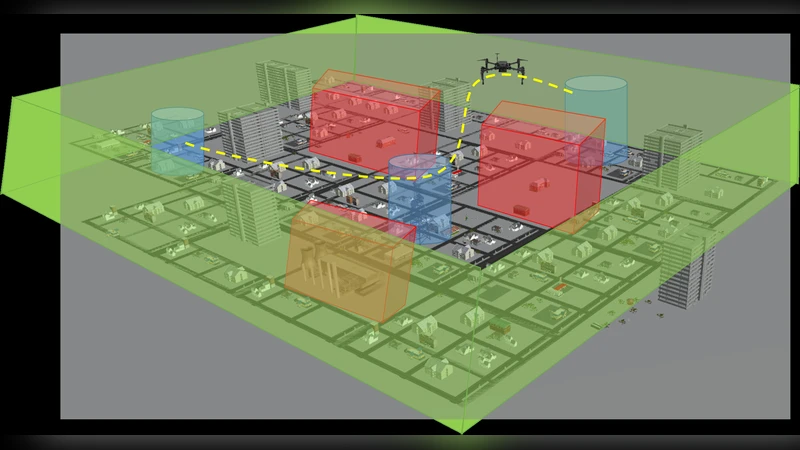
In this paper, we present a control synthesis framework for a general class of nonlinear, control-affine systems under spatiotemporal and input constraints. First, we study the problem of fixed-time convergence in the presence of input constraints. The relation between the domain of attraction for fixed-time stability with respect to input constraints and the required time of convergence is established. It is shown that increasing the control authority or the required time of convergence can expand the domain of attraction for fixed-time stability. Then, we consider the problem of finding a control input that confines the closed-loop system trajectories in a safe set and steers them to a goal set within a fixed time. To this end, we present a Quadratic Program (QP) formulation to compute the corresponding control input. We use slack variables to guarantee feasibility of the proposed QP under input constraints. Furthermore, when strict complementary slackness holds, we show that the solution of the QP is a continuous function of the system states, and establish uniqueness of closed-loop solutions to guarantee forward invariance using Nagumo’s theorem. We present two case studies, an example of adaptive cruise control problem and an instance of a two-robot motion planning problem, to corroborate our proposed methods.
💡 Research Summary
This paper addresses the synthesis of controllers for a broad class of nonlinear control‑affine systems subject to both input constraints and spatiotemporal specifications. The authors first investigate fixed‑time stability (FxTS) in the presence of bounded control authority. By employing recent Lyapunov‑based FxTS conditions, they establish a quantitative relationship between the domain of attraction (DoA), the magnitude of the input bounds, and the prescribed convergence time. The analysis shows that enlarging the admissible control range or relaxing the required convergence time expands the DoA, thereby providing designers with explicit trade‑offs between actuator limits and timing requirements.
Building on this insight, the core contribution is a quadratic program (QP) that simultaneously enforces (i) forward invariance of a safe set, (ii) convergence of the state to a goal set within a user‑defined fixed time, and (iii) adherence to input saturation limits. Safety is guaranteed through Zeroing Control Barrier Functions (ZCBFs), while convergence is encoded via a Fixed‑Time Control Lyapunov Function (FxT‑CLF) that satisfies a double‑power inequality of the form
(\inf_{u\in U}{L_fV+L_gV u}\le -\alpha_1 V^{\gamma_1}-\alpha_2 V^{\gamma_2})
with (\gamma_{1,2}=1\pm 1/\mu) and (\mu>1). The resulting convergence time is bounded by (\mu\pi/(2\sqrt{\alpha_1\alpha_2})), which can be made smaller than the user‑specified deadline.
To ensure feasibility of the QP under possibly conflicting constraints, the authors introduce non‑negative slack variables for both the safety and convergence inequalities. By penalizing these slacks heavily in the objective, the original constraints are respected whenever possible, while the slacks provide a systematic way to relax them when the input limits would otherwise render the problem infeasible. The Karush‑Kuhn‑Tucker (KKT) conditions are used to derive closed‑form expressions for the optimal slacks, particularly highlighting how they activate when the control input saturates.
A significant theoretical development is the proof of continuity of the optimal control law with respect to the state, under the assumption of strict complementary slackness. This continuity, together with the uniqueness of the closed‑loop trajectories, enables the application of Nagumo’s theorem to rigorously certify forward invariance of the safe set. Consequently, the proposed controller guarantees that all trajectories starting in a computed fixed‑time domain of attraction remain inside the safe set for all time and reach the goal set within the prescribed deadline, despite input saturation.
The methodology is validated through two case studies. The first involves an adaptive cruise‑control scenario where a vehicle must attain a desired speed within a fixed horizon while respecting acceleration limits and maintaining a safe following distance. The second case studies a two‑robot motion‑planning problem: each robot must avoid collision zones (the safe set) and visit designated waypoints (the goal set) in a prescribed sequence and within fixed times. Simulations demonstrate that the QP always yields a feasible control input, the slacks remain zero in nominal operation, and the system respects both safety and timing constraints even when the actuators are saturated.
Compared with prior CLF‑CBF QP approaches, the present work uniquely integrates input constraints into the fixed‑time framework, provides explicit feasibility guarantees, and establishes stronger regularity properties of the resulting control law. The authors suggest future extensions to multi‑agent networks, robustness against model uncertainties, and real‑time implementation optimizations.
Comments & Academic Discussion
Loading comments...
Leave a Comment