Enabling High-Performance and Energy-Efficient Hybrid Transactional/Analytical Databases with Hardware/Software Cooperation
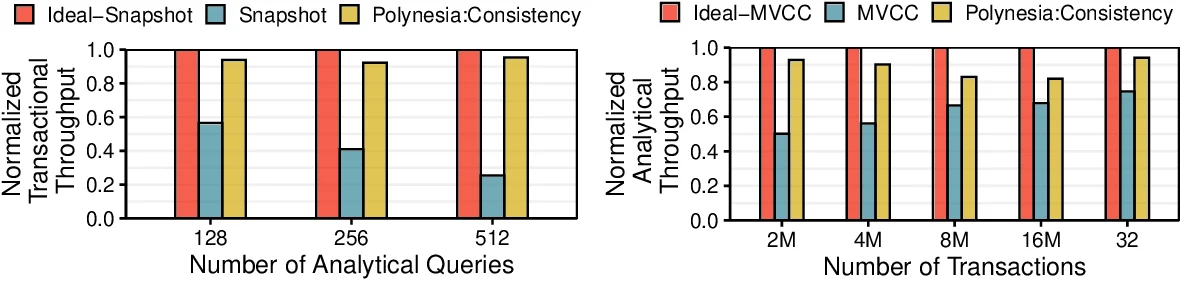
A growth in data volume, combined with increasing demand for real-time analysis (using the most recent data), has resulted in the emergence of database systems that concurrently support transactions and data analytics. These hybrid transactional and analytical processing (HTAP) database systems can support real-time data analysis without the high costs of synchronizing across separate single-purpose databases. Unfortunately, for many applications that perform a high rate of data updates, state-of-the-art HTAP systems incur significant losses in transactional (up to 74.6%) and/or analytical (up to 49.8%) throughput compared to performing only transactional or only analytical queries in isolation, due to (1) data movement between the CPU and memory, (2) data update propagation from transactional to analytical workloads, and (3) the cost to maintain a consistent view of data across the system. We propose Polynesia, a hardware-software co-designed system for in-memory HTAP databases that avoids the large throughput losses of traditional HTAP systems. Polynesia (1) divides the HTAP system into transactional and analytical processing islands, (2) implements new custom hardware that unlocks software optimizations to reduce the costs of update propagation and consistency, and (3) exploits processing-in-memory for the analytical islands to alleviate data movement overheads. Our evaluation shows that Polynesia outperforms three state-of-the-art HTAP systems, with average transactional/analytical throughput improvements of 1.7x/3.7x, and reduces energy consumption by 48% over the prior lowest-energy HTAP system.
💡 Research Summary
The paper addresses the fundamental performance and energy challenges of hybrid transactional/analytical processing (HTAP) databases, which must deliver fresh data for real‑time analytics while sustaining high transactional throughput. Existing HTAP designs—single‑instance systems that share a single data copy and multi‑instance systems that replicate data—suffer from severe throughput losses (up to 74.6 % for transactions and 49.8 % for analytics) due to costly data movement, update propagation, and consistency mechanisms. To overcome these limitations, the authors introduce Polynesia, a hardware‑software co‑designed architecture that partitions the HTAP workload into two isolated “islands”: a transactional island and an analytical island.
The transactional island leverages conventional multicore CPUs with multi‑level caches and a row‑oriented (NSM) data layout, optimizing for cache‑friendly, low‑latency transaction processing. The analytical island, in contrast, employs processing‑in‑memory (PIM) cores embedded in the logic layer of 3D‑stacked DRAM, using a column‑oriented (DSM) layout to execute large‑scale analytical queries close to the data, thereby eliminating the dominant memory‑bandwidth bottleneck.
Polynesia further introduces custom hardware accelerators that streamline update propagation and consistency enforcement. Instead of costly snapshot copies or MVCC version‑chain traversals, the accelerators aggregate transaction logs, convert updates into the analytical island’s format, and stream them directly to PIM cores. This design guarantees data freshness for analytics while keeping the overhead of maintaining a consistent view low.
Data placement and runtime scheduling are also co‑designed with the islands. Transactional data remains in CPU‑friendly memory regions, whereas analytical data is placed in memory regions optimized for PIM access. The scheduler dynamically assigns analytical tasks to PIM cores based on workload characteristics, while transactional threads continue to run on the CPU, minimizing interference and maximizing overall memory bandwidth utilization.
Experimental evaluation compares Polynesia against three state‑of‑the‑art HTAP systems modeled after Hyper, AnkerDB, and Batch‑DB. Across a suite of benchmarks, Polynesia achieves an average 1.70× improvement in transactional throughput and a 3.74× improvement in analytical throughput. Energy consumption is reduced by 48 % relative to the most energy‑efficient baseline. These results demonstrate that island‑based partitioning combined with specialized accelerators and PIM can simultaneously deliver high performance, data freshness, and energy efficiency in HTAP environments.
The paper acknowledges limitations, notably the reliance on emerging 3D‑stacked DRAM and PIM hardware, which may increase upfront costs, and the added complexity of managing replicated islands and their synchronization. Future work is suggested in exploring cost‑effective memory technologies, dynamic reconfiguration of islands, and extending the architecture to other workloads such as streaming analytics and machine‑learning pipelines.
Comments & Academic Discussion
Loading comments...
Leave a Comment