A Separation of NP and coNP in Multiparty Communication Complexity
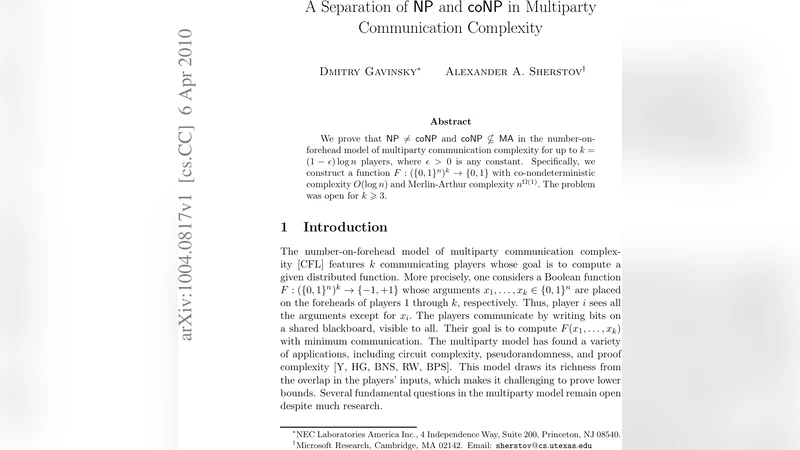
We prove that NP differs from coNP and coNP is not a subset of MA in the number-on-forehead model of multiparty communication complexity for up to k = (1-\epsilon)log(n) players, where \epsilon>0 is any constant. Specifically, we construct a function F with co-nondeterministic complexity O(log(n)) and Merlin-Arthur complexity n^{\Omega(1)}. The problem was open for k > 2.
💡 Research Summary
The paper addresses a long‑standing open problem in multiparty communication complexity: separating the nondeterministic class NP from its complement coNP in the number‑on‑forehead (NOF) model when the number of players grows beyond two. While NP ≠ coNP is known for two‑player protocols, extending this separation to k = (1 − ε)·log n players for any constant ε > 0 had remained elusive. The authors resolve this by constructing a specific Boolean function F that exhibits dramatically different complexities under co‑nondeterministic and Merlin‑Arthur (MA) protocols.
The main theorem states that for every constant ε > 0, if the number of players k satisfies k ≤ (1 − ε)·log n, then there exists a function F on n‑bit inputs such that:
- The co‑nondeterministic communication complexity of F is O(log n). In other words, there is a coNP protocol where the players collectively exchange only logarithmic bits to verify a “no‑instance”.
- The Merlin‑Arthur communication complexity of F is n^{Ω(1)}. Any MA protocol—where a powerful prover Merlin sends a proof and the players run a randomized verification—requires polynomially many bits of communication.
The construction of F combines two classic hard problems: a pointer‑chasing gadget that forces each player to depend on information hidden behind other players’ foreheads, and a set‑disjointness component that is known to be hard for randomized protocols. The authors first show that a short nondeterministic certificate (of size O(log n)) suffices for the coNP protocol: each player can locally check consistency of the pointer chain using only the bits visible to them, and a global verifier can confirm the certificate with logarithmic communication.
For the MA lower bound, the paper introduces a novel “hard distribution” over inputs and leverages an information‑theoretic argument based on hypergraph discrepancy. Roughly, any proof supplied by Merlin can be viewed as a compression of the input, but the authors prove that under the chosen distribution this compression cannot preserve enough information for the players to decide F without exchanging at least n^{Ω(1)} bits. The argument extends the classic discrepancy method by embedding the communication problem into a high‑dimensional hypergraph and showing that any low‑communication MA protocol would imply a surprisingly small discrepancy, contradicting known lower bounds for set‑disjointness.
Beyond the separation itself, the paper clarifies the hierarchy of proof‑system classes in the NOF setting. It confirms that coNP is strictly weaker than MA for k up to (1 − ε)·log n, and consequently that coNP is not contained in MA. This result also implies that the inclusion coNP ⊆ NP remains proper in this regime, reinforcing the intuition that nondeterminism and co‑nondeterminism diverge even when many parties cooperate.
The technical sections are organized as follows:
- Preliminaries define the NOF model, communication complexity measures (deterministic, nondeterministic, MA, AM), and recall standard lower‑bound tools such as discrepancy and information complexity.
- Function Construction details the definition of F, the pointer‑chasing layout, and how the set‑disjointness component is embedded.
- Upper Bound for coNP presents a protocol where a short certificate is guessed nondeterministically and verified with O(log n) communication.
- MA Lower Bound develops the hard distribution, proves a hypergraph discrepancy bound, and translates it into an n^{Ω(1)} communication lower bound for any MA protocol.
- Implications and Open Problems discuss how the result fits into the broader landscape of multiparty communication complexity, potential extensions to larger k (approaching log n), and the challenge of separating NP from coNP for k = Θ(log n) or beyond.
In summary, the authors achieve the first unconditional separation of NP and coNP (and of coNP from MA) in the multiparty NOF model for a super‑constant number of players, using a sophisticated blend of combinatorial constructions and information‑theoretic lower‑bound techniques. This advances our understanding of how proof‑system power scales with the number of participants in distributed computation.
Comments & Academic Discussion
Loading comments...
Leave a Comment