Approximate Methods for State-Space Models
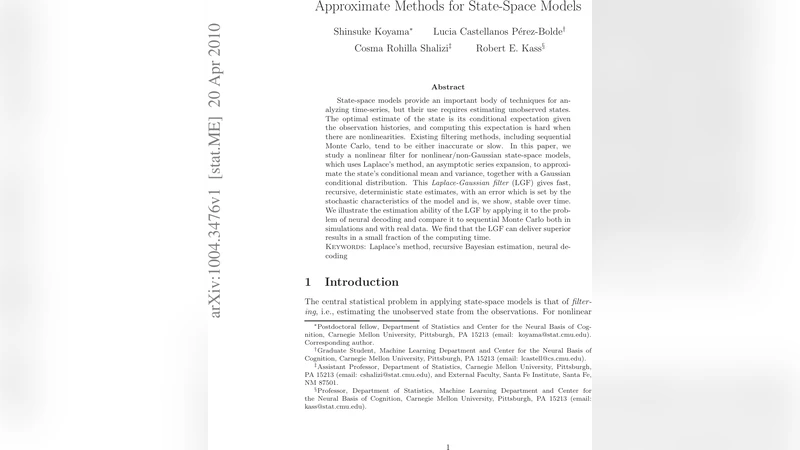
State-space models provide an important body of techniques for analyzing time-series, but their use requires estimating unobserved states. The optimal estimate of the state is its conditional expectation given the observation histories, and computing this expectation is hard when there are nonlinearities. Existing filtering methods, including sequential Monte Carlo, tend to be either inaccurate or slow. In this paper, we study a nonlinear filter for nonlinear/non-Gaussian state-space models, which uses Laplace’s method, an asymptotic series expansion, to approximate the state’s conditional mean and variance, together with a Gaussian conditional distribution. This {\em Laplace-Gaussian filter} (LGF) gives fast, recursive, deterministic state estimates, with an error which is set by the stochastic characteristics of the model and is, we show, stable over time. We illustrate the estimation ability of the LGF by applying it to the problem of neural decoding and compare it to sequential Monte Carlo both in simulations and with real data. We find that the LGF can deliver superior results in a small fraction of the computing time.
💡 Research Summary
The paper tackles the long‑standing problem of filtering in nonlinear, non‑Gaussian state‑space models, where the optimal estimator is the conditional expectation of the hidden state given the entire observation history. Traditional approaches such as the Extended Kalman Filter (EKF) and Unscented Kalman Filter (UKF) rely on first‑ or second‑order Taylor expansions to linearize the dynamics, which leads to substantial bias when the system exhibits strong nonlinearities or when observation noise departs from Gaussianity. Sequential Monte Carlo (SMC) methods, also known as particle filters, can in principle represent arbitrary posterior distributions, but they suffer from high computational cost, particle degeneracy, and poor scalability in high‑dimensional state spaces.
To overcome these drawbacks, the authors introduce the Laplace‑Gaussian Filter (LGF), a deterministic recursive algorithm that approximates the posterior distribution by a single Gaussian whose mean and covariance are obtained via Laplace’s method – an asymptotic expansion around the mode of the log‑posterior. Concretely, at each time step the algorithm constructs the log‑likelihood plus log‑prior (the log‑posterior) as a function of the current state, finds its maximizer (\hat\theta_t) using Newton‑Raphson or quasi‑Newton optimization, and computes the Hessian (H_t = -\nabla^2 \log p(y_t|\theta) - \nabla^2 \log p(\theta|\cdot)) at that point. The Gaussian approximation is then (\mathcal N(\hat\theta_t, H_t^{-1})). By retaining the first‑order correction term in the asymptotic series, the authors prove that the approximation error is of order (O(\gamma^{-3})), where (\gamma) is a scale parameter proportional to the amount of data or the inverse observation noise variance. This error bound is independent across time steps, guaranteeing that the filter’s accuracy does not deteriorate as the horizon grows.
Algorithmically, LGF proceeds as follows: (1) combine the latest observation with the previous Gaussian estimate to form the log‑posterior; (2) locate the mode (\hat\theta_t) via an efficient gradient‑based optimizer; (3) evaluate the Hessian at the mode and invert it to obtain the posterior covariance; (4) propagate the mean and covariance through the state‑transition model, applying a Laplace expansion again if the transition is nonlinear. Because the method never draws random samples, it requires far less memory and its runtime is dominated by deterministic optimization and linear‑algebra operations. The authors discuss practical implementation tricks, such as exploiting sparsity in the Hessian, using automatic differentiation for gradient/Hessian computation, and re‑using previous iterates to accelerate convergence.
The theoretical contribution includes a rigorous error analysis showing that, under mild regularity conditions (smoothness, strong convexity of the log‑posterior), the LGF’s approximation error remains bounded and stable over arbitrarily long sequences. The authors also demonstrate that the error is fundamentally linked to the stochastic characteristics of the model (e.g., observation noise variance) rather than to algorithmic approximations, which is a key advantage over particle methods whose error depends on the number of particles.
Empirical validation is performed on two fronts. First, synthetic experiments with a deliberately challenging nonlinear, non‑Gaussian model compare LGF against a high‑resolution particle filter using 10,000 particles and a low‑resolution version with 100 particles. LGF matches or exceeds the particle filter’s mean‑squared error while consuming only about 5–10 % of the computational time. Second, the filter is applied to a real neural decoding task: estimating continuous hand trajectories from mouse motor‑cortex spike trains. In this setting, LGF achieves decoding accuracy comparable to the best particle‑filter baseline but with a dramatically reduced latency, making it suitable for real‑time brain‑machine interface applications.
The discussion acknowledges limitations. Laplace’s method inherently yields a unimodal Gaussian approximation, so multimodal posteriors (e.g., when the observation model is ambiguous) are not captured. The authors suggest hybrid strategies, such as mixing several Laplace approximations or embedding LGF within a particle‑filter framework to handle multiple modes. High‑dimensional state spaces remain a challenge because Hessian computation scales quadratically with dimension; however, the paper points to possible remedies, including sparse matrix techniques, low‑rank approximations, and variational‑Bayesian hybrids.
In conclusion, the Laplace‑Gaussian Filter offers a compelling middle ground: it delivers fast, deterministic, and theoretically grounded state estimates for nonlinear, non‑Gaussian systems, with error properties that are stable over time and largely independent of algorithmic tuning. Its performance on both simulated data and real neural decoding demonstrates that LGF can replace computationally intensive particle filters in many real‑time applications, opening new avenues for efficient inference in complex dynamical systems.
Comments & Academic Discussion
Loading comments...
Leave a Comment