A Frequency-Agnostic RIS-based solution to control the Smart Radio Propagation Environment
The disruptive reconfigurable intelligent surface (RIS) technology is steadily gaining relevance as a key element in future 6G networks. However, a one-size-fits-all RIS hardware design is yet to be defined due to many practical considerations. A major roadblock for currently available RISs is their inability to concurrently operate at multiple carrier frequencies, which would lead to redundant installations to support multiple radio access technologies (RATs). In this paper, we introduce FABRIS, a novel and practical multi-frequency RIS design. FABRIS is able to dynamically operate across different radio frequencies (RFs) by means of frequency-tunable antennas as unit cells with virtually no performance degradation when conventional approaches to RIS design and optimization fail. Remarkably, our design preserves a sufficiently narrow beamwidth as to avoid generating signal leakage in unwanted directions and a sufficiently high antenna efficiency in terms of scattering parameters. Indeed, FABRIS selects the RIS configuration that maximizes the signal at the intended target user equipment (UE) while minimizing leakage to non-intended neighboring UEs. Numerical results and full-wave simulations validate our proposed approach against a naive implementation that does not consider signal leakage resulting from multi-frequency antenna arrays.
💡 Research Summary
The paper addresses a critical limitation of current reconfigurable intelligent surfaces (RIS): the inability to operate simultaneously on multiple carrier frequencies, which forces network operators to deploy separate RIS panels for each radio access technology (RAT) and consequently increases both capital and operational expenditures. To overcome this, the authors propose FABRIS (Frequency‑Agnostic Behavior RIS), a practical multi‑frequency RIS architecture that can switch in real time between two millimeter‑wave bands (21.28 GHz and 27.96 GHz) without performance loss.
Each RIS element consists of two patch sub‑antennas stacked vertically. The inner sub‑antenna resonates at the higher frequency (27.96 GHz) while the outer sub‑antenna resonates at the lower frequency (21.28 GHz). A PIN diode connects the two sub‑antennas: when the diode is forward‑biased (ON) the patches are electrically linked, allowing both frequencies to be active; when reverse‑biased (OFF) the outer patch is terminated in a matched load, absorbing incident energy and effectively disabling that element. By selectively turning elements on or off, the effective inter‑element spacing can be increased, mitigating mutual coupling (for d < λ/2) and suppressing grating lobes (for d > λ/2) that would otherwise arise when the same physical array is used across disparate wavelengths.
The system model comprises a single‑antenna base station, a single‑antenna user equipment (UE), and an N × N RIS. Channels are modeled under line‑of‑sight conditions, with the array response expressed as a function of the operating wavelength λ. The received signal at the UE is y = (hᴴA(α)Φg + h_d)s + n, where Φ contains the per‑element phase shifts and A(α) is a diagonal matrix representing the binary activation profile α∈{0,1}ⁿ.
The authors formulate a joint optimization problem that maximizes the signal‑to‑leakage‑and‑noise ratio (SLNR) for a target UE while minimizing interference to neighboring UEs. Because the problem is non‑convex and involves binary variables, they adopt an alternating approach: the phase matrix Φ is set analytically to align the RIS‑reflected wave with the direct BS‑UE channel, and the activation vector α is optimized via a relaxed semidefinite programming (SDP) formulation. The binary constraint is relaxed to a continuous interval, the rank‑one matrix V = ααᵀ is introduced, and SDR together with a bisection search yields a feasible V. Gaussian randomization and quantization finally produce a binary α that approximates the optimal solution. This procedure effectively reshapes the RIS aperture, concentrating energy toward the intended UE and attenuating leakage toward others.
On the hardware side, discrete phase shifts are realized with microstrip transmission lines whose lengths are frequency‑dependent (l = φ·v_f/(2πf)). Two separate lines per element are required for the two operating frequencies, though the authors note that if the frequencies are integer multiples of each other, a single line could provide the necessary phase shift for both bands, reducing circuit complexity.
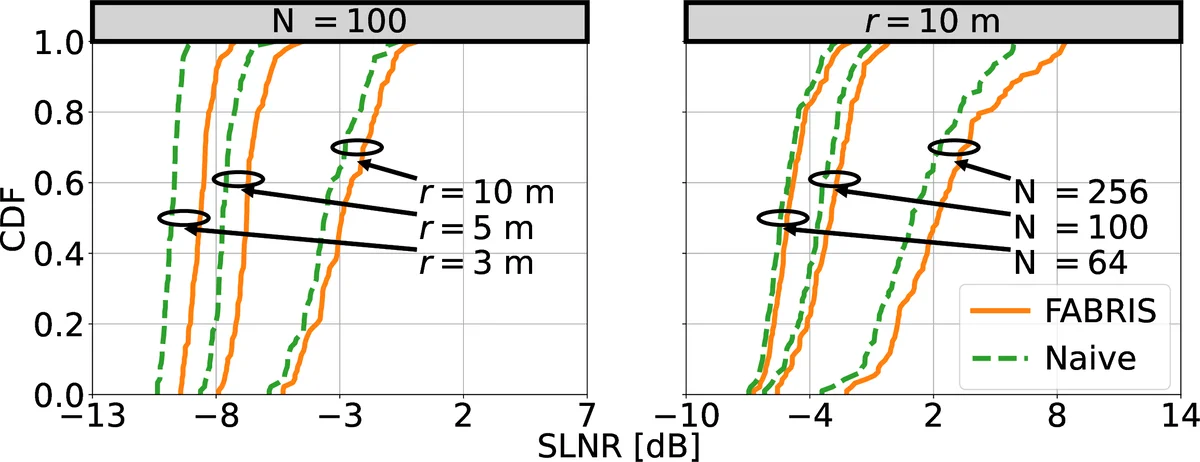
Full‑wave electromagnetic simulations in CST Studio Suite validate the design. S₁₁ measurements of a single element show deep minima (≈ ‑34 dB) at the intended frequencies for both diode states, confirming good matching. The outer patch’s OFF state exhibits higher S₁₁ elsewhere, indicating effective absorption. A 10 × 10 array simulation with an inter‑element spacing of d = 0.56 λ₁ (λ₁ corresponding to 27.96 GHz) demonstrates that, despite the spacing being sub‑half‑wavelength at the lower band, the activation‑based optimization suppresses mutual coupling and maintains a clean main lobe while reducing side‑lobe leakage. Compared with a naive scheme that activates all elements regardless of frequency, the proposed method yields a substantially higher SLNR, confirming its advantage in multi‑frequency environments.
In summary, FABRIS introduces a novel RIS paradigm that combines frequency‑tunable patch antennas with dynamic element deactivation, enabling real‑time selection of operating bands, mitigation of array‑induced artifacts, and simultaneous control of signal strength and leakage. This work paves the way for cost‑effective, multi‑RAT RIS deployments in future 6G networks and opens several avenues for further research, including multi‑antenna base stations, robust channel estimation under fast switching, and large‑scale network optimization.
Comments & Academic Discussion
Loading comments...
Leave a Comment