On the Frame Error Rate of Transmission Schemes on Quasi-Static Fading Channels
It is known that the frame error rate of turbo codes on quasi-static fading channels can be accurately approximated using the convergence threshold of the corresponding iterative decoder. This paper considers quasi-static fading channels and demonstr…
Authors: Ioannis Chatzigeorgiou, Ian J. Wassell, Rol
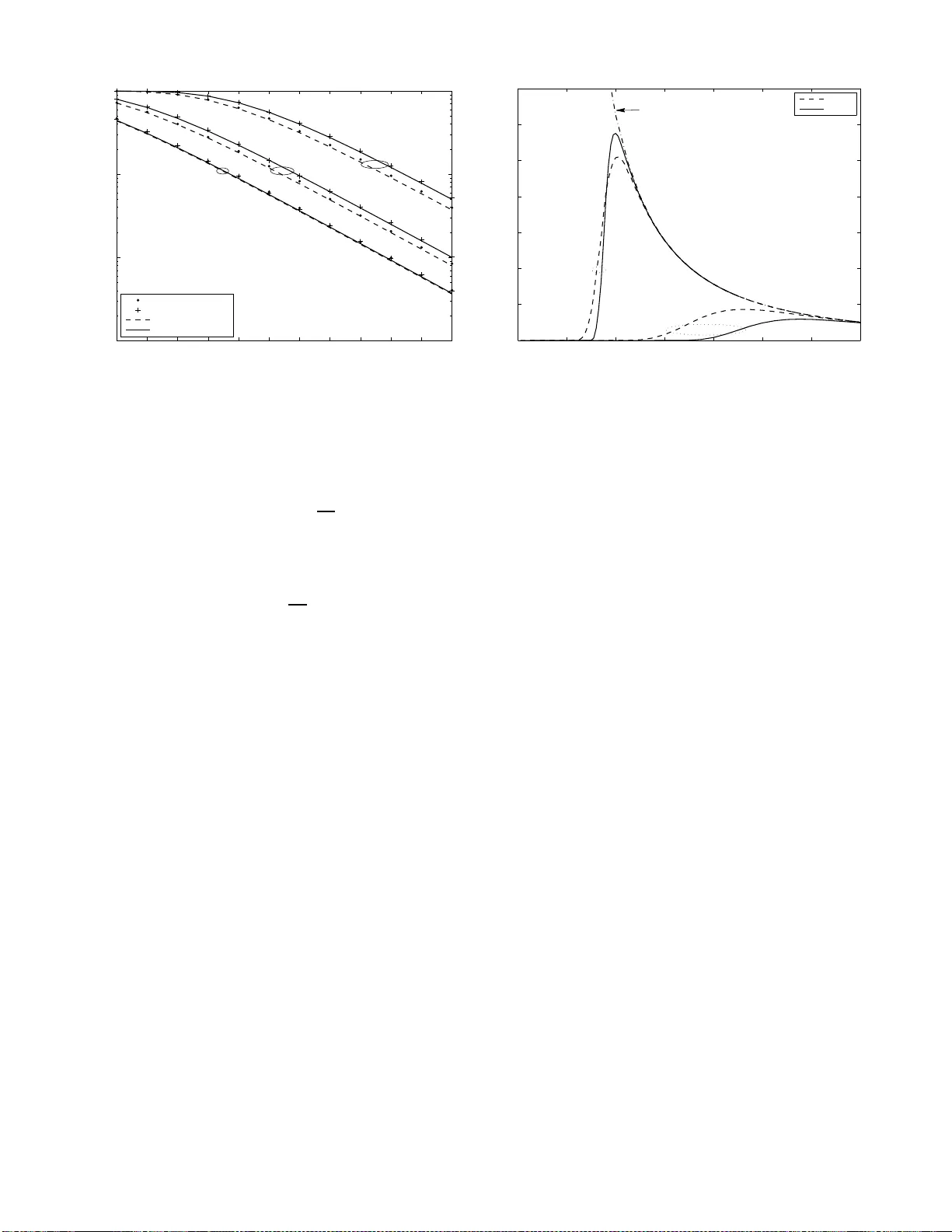
On the Frame Error Rate o f T ransmission Schemes on Qu asi-Static Fading Channels Ioannis Chatzigeorgiou, I an J. W assell Digital T echnology Group, Computer Labor atory University of Cambridge, Un ited King dom Email: { ic2 31, ijw24 } @cam.ac.uk Rolando Carrasco School of EE & Comp. Engin eering University of Newcastle, United Kin gdom Email: r .carrasco @ncl.ac.uk Abstract — It is known that the frame error rate of turbo codes on q uasi-static fading channels can be accurately approximated using the con ver gence th reshold of the corresponding iterative decoder . This p aper considers quasi-static fading ch annels and demonstrates that non-iterativ e schemes can also be character - ized b y a similar threshold based on which their frame error rate can b e readily estimated. In particular , we show that this thresh- old is a functi on of the pro bability of successful frame detection in additive whit e Gaussian n oise, normalized b y the squared in- stantaneous signal-to-noise ratio. W e appl y ou r approach to un - coded bi nary phase shift keying, con volutional coding and turbo coding and demonstrate that the app roximate d frame err or rate is wi thin 0.4 dB of the simu lation results. Finally , we introduce perfo rmance evaluation p lots to explore the impact of t he frame size on the performa nce of the schemes u nder inv estigation. I . I N T R O D U C T I O N The performan ce analysis of transmission schemes o n q uasi- static fading chann els con stitutes an importan t pro blem owning to the fact th at this ch annel model char acterizes practical set- tings that exper ience extremely slo w fading cond itions, such as fixed wireless access systems [1]. In th is context, bou nding technique s for the error rate of various transmission schemes have been p roposed ; such sch emes includ e b lock codes [ 2], conv o lutional codes [3], [4], tu rbo co des [ 5], space-time tr ellis codes [ 6], [ 7] an d serially concaten ated codes [5], [8 ]. El Gamal and Ham mons [9] have p roposed an analytical ap- proxim ation to the frame error rate ( FER) of iterative schemes, such as turbo codes, o n quasi-static fading chan nels; this tigh t approx imation is made p ossible owning to a simp le cha racter- ization of an iterativ e decod er . I n this p aper, we will dem on- strate that no n-iterative schem es, bo th u ncoded an d coded , can also be characterized in a similar man ner, hen ce their FER perfor mance can be estimated using the same appro ximation technique . The rest of the paper is o rganized as fo llows. The qu asi- static c hannel m odel as well as the stand ard techn ique to com - pute the FER performance o f a schem e on that chann el a re briefly de scribed in Section II. In Sections III-V, we derive expressions ba sed on which a threshold value, char acteristic of the system, can be deter mined that allows the com putation of a simple y et accurate appro ximation to the FER. Numer ical results are pr esented in Section VI, whilst a me thod to pr oduce perfor mance ev aluation plots is discussed in VII . Finally , the main con clusions of o ur work a re summar ized in Sectio n VI II. I I . S Y S T E M M O D E L If x is a fr ame of symbols tra nsmitted over a quasi-static fading channel at a particular time in stant an d y is the r eceive frame, the input-outp ut relation ship of th e chann el is given by y = h x + n . (1) The instan taneous fading co efficient h is a zer o-mean , circu - larly sy mmetric co mplex Gaussian ra ndom variable with v ari- ance σ 2 = 1 , whilst n is a sequence o f zero -mean, mutu ally indepen dent, circula rly symmetric complex Gau ssian rand om variables with v ariance N 0 . Note that h is constant f or the du- ration of the transmit frame but ch anges indepen dently fro m frame to fram e. The quality of a quasi-static fading channe l is character- ized b y its correspo nding a verage receive signal-to- noise ratio (SNR). In particular, if E s is the energy per transmit symbol and γ = | h | 2 E s / N 0 is the instantaneo us receive SNR, the av- erage SNR, γ , at the inp ut of the receiver is given by γ = E [ γ ] = E h | h | 2 i ( E s / N 0 ) = σ 2 ( E s / N 0 ) = E s / N 0 , (2) where E [ . ] den otes the expectation op erator . The average FER on a quasi-static fading channel, deno ted as P Q e ( ¯ γ ) , can b e co mputed by integrating the FER in a dditive white Gaussian noise ( A WGN), rep resented by P G e ( γ ) , over the fading distribution [10] P Q e ( ¯ γ ) = Z ∞ 0 P G e ( γ ) p ¯ γ ( γ ) dγ . (3) Now , the fading magn itude | h | has a Rayleigh d istribution, so that the instan taneous value of γ is chi-squa red distrib uted with two degrees of freed om [10], i.e., p ¯ γ ( γ ) = (1 / ¯ γ ) e − γ / ¯ γ , for γ ≥ 0 . (4) Although (3) is an exact expression fo r P Q e ( ¯ γ ) , its ev al- uation c ould p rove difficult dep ending upo n the transmission technique un der co nsideration. In the following section we de- scribe a simple appr oach that is often used to bou nd the FER perfor mance of a commu nication scheme. I I I . A P P RO X I M AT I O N T O T H E F R A M E E R RO R R A T E Giv en an arbitrary SNR threshold γ w , we can rewrite the ex- pression for the a verage FER on a qu asi-static fadin g c hannel as fo llows P Q e ( ¯ γ ) = P ( error | γ ≤ γ w ) P ( γ ≤ γ w ) + P ( error | γ > γ w ) P ( γ > γ w ) . (5) The SNR threshold γ w , which we refer to as the waterfall thr eshold , is used to divide the rang e o f SNR values into a low-SNR region and a high-SNR region. A co mmon a pproac h to simplify (5) is to use a tr ivial bound of the for m P ( error | γ ≤ γ w ) ≤ 1 (6) for the low-SNR region and a conventional un ion bound for the high -SNR region. Th is appro ach has b een used to bound the p erform ance of many transmission schemes on quasi-static fading ch annels, in cluding con volutional cod es [ 4] and turbo codes [5]. Ne vertheless, the value of γ w needs to be cho sen approp riately to ma ke th e bound as tight as possible. The op- timization proce ss pr esented in [4], [5] and [8 ] produ ced quite tight bo unds but sh owed that there is room for improvement. T ur bo codes hav e also been considered in [9] and [11]; the authors fu rther simplified (5) by assuming th at P ( error | γ ≤ γ w ) ≈ 1 and P ( error | γ > γ w ) ≈ 0 . (7) Substituting (7) into (5) giv es an appro ximation to th e FER, denoted as ˜ P Q e ( ¯ γ , γ w ) . I n par ticular, P Q e ( ¯ γ ) ≃ P ( γ ≤ γ w ) = Z γ w 0 p ¯ γ ( γ ) dγ = 1 − e − γ w / ¯ γ , ˜ P Q e ( ¯ γ , γ w ) . (8) It h as b een shown in [9] that ˜ P Q e ( ¯ γ , γ w ) very accurately de- scribes the actu al FE R o f a tu rbo co de u sing a long interleaver on a q uasi-static fading chann el, if the waterfall threshold γ w is set to be eq ual to the d ecoder co n vergence threshold γ th . The con vergenc e threshold of iterative schem es, such as turb o codes, can be determ ined u sing extrinsic info rmation (EXIT) chart an alysis [ 12]. Motiv a ted by th e work o f Bouzek ri and Miller [4], [5 ], El Gamal and Hammons [9] and Rodrigues et al. [11], we assume that for any transmission scheme, whose conditiona l FER can be reaso nably described b y (7), there is a value of γ w for which the a verage FER, P Q e ( ¯ γ ) , can b e accu rately appro xi- mated by ˜ P Q e ( ¯ γ , γ w ) . Based on that assumption, we derive an exact expr ession for the waterfall threshold in the following section. I V . E V A L UAT I O N O F T H E W A T E R FA L L T H R E S H O L D Let ε denote the abso lute d ifference between the actual frame error probability P Q e ( ¯ γ ) and the app roxima ted fram e error pr obability ˜ P Q e ( ¯ γ , γ w ) , i.e ., ε = P Q e ( ¯ γ ) − ˜ P Q e ( ¯ γ , γ w ) , (9) where ¯ γ can b e any nonnegative r eal num ber . In the pr evious section we indicated that we expec t the app roximated FER of a transmission scheme o n a quasi-static fading channel to closely represent the actual FER for a very wid e range of ¯ γ values, provided that an approp riate value for the waterfall threshold is chosen. Conseque ntly , if ˜ P Q e ( ¯ γ , γ w ) perfe ctly coin cides with P Q e ( ¯ γ ) , expression (9) simplifies to ε = P Q e ( ¯ γ ) − ˜ P Q e ( ¯ γ , γ w ) = 0 . (10) In this section we d erive an expre ssion for the waterfall thresh- old γ w under the a ssumption that ε = 0 , while in Sec tion VI we compar e our analytic approach to simulation results in order to test the validity of o ur assum ption. W e set λ = 1 / ¯ γ and express P Q e ( ¯ γ ) and ˜ P Q e ( ¯ γ , γ w ) as function s of λ , i.e., P Q e ( λ ) and ˜ P Q e ( λ, γ w ) respectively . Th e change o f variable will not have any effect on ε , hen ce ε = P Q e ( λ ) − ˜ P Q e ( λ, γ w ) = 0 , (11) for all values of λ ≥ 0 . Equi valently , the area und er the graph of P Q e ( λ ) shou ld be equal to the area un der ˜ P Q e ( λ, γ w ) , for λ ∈ [0 . . . Λ ] , wher e Λ → ∞ . Con sequently , we can write lim Λ →∞ ( Z Λ 0 P Q e ( λ ) dλ − Z Λ 0 ˜ P Q e ( λ, γ w ) dλ ) = 0 . (12) Using (3) and (4), we exp and the first integral in (12) into Z Λ 0 P Q e ( λ ) dλ = Z Λ 0 Z ∞ 0 P G e ( γ ) p λ ( γ ) dγ dλ = Z ∞ 0 P G e ( γ ) Z Λ 0 λe − λγ dλdγ . (13) The frame error prob ability of a tran smission scheme over an A WGN channel can also b e expressed as P G e ( γ ) = 1 − P G d ( γ ) , where P G d ( γ ) is the probability of successful fr ame detection. Consequently , we can rewrite (13) as Z Λ 0 P Q e ( λ ) dλ = Z ∞ 0 Z Λ 0 λe − λγ dλdγ − − Z ∞ 0 P G d ( γ ) Z Λ 0 λe − λγ dλdγ . (14) T aking in to account tha t [13] Z Λ 0 λe − λγ dλ = 1 γ 2 − e − Λ γ γ 2 (1 + Λ γ ) (15) and Z ∞ 0 Z Λ 0 λe − λγ dλdγ = Λ , (16) the first in tegral in ( 12) assumes the form Z Λ 0 P Q e ( λ ) dλ = Λ − Z ∞ 0 P G d ( γ ) γ 2 dγ + + Z ∞ 0 P G d ( γ ) e − Λ γ γ 2 (1 + Λ γ ) dγ . (17) The seco nd in tegral in ( 12) can be ev aluated as follows − Z Λ 0 ˜ P Q e ( λ, γ w ) dλ = − Z Λ 0 1 − e − λγ w dλ = − Λ − e − Λ γ w γ w + 1 γ w . (18) If we su bstitute (17) and (18) into (12), we observe that terms Λ an d − Λ cancel each other out. Furtherm ore, if we take the limit a s Λ → ∞ , all terms conta ining e − Λ are eliminated since e − Λ → 0 . The remain ing terms give − Z ∞ 0 P G d ( γ ) γ 2 dγ + 1 γ w = 0 , (19) which is equ iv alen t to γ w = Z ∞ 0 P G d ( γ ) γ 2 dγ − 1 . (20) W e have thus shown that, under assum ption (10), th e waterfall threshold is inversely pr oportio nal to the area un der a curve, which is defined by the prob ability of successful f rame detec - tion in A WGN n ormalized by the squared instantaneou s SNR. Dependin g on the expression for the detectio n pr obability P G d ( γ ) , a closed-form solu tion for γ w for a particular transmis- sion tech nique may not exist. In th at case, γ w can b e ev aluated either via num erical in tegration if there is an exact representa- tion of P G d ( γ ) or via Monte Carlo simu lation if P G d ( γ ) canno t be accurately ev aluated. In the following section we revisit (20) to ob tain a more prac tical exp ression for γ w when Monte Carlo simulation is req uired. V . P R A C T I C A L C O M P U TA T I O N O F T H E W AT E R FA L L T H R E S H O L D Let γ ′ be the actual SNR v alue f or which P G d ( γ ) = 0 if γ < γ ′ but P G d ( γ ) > 0 o therwise. Based on the definition of γ ′ , we ca n rewrite (20) as follows γ w = Z ∞ γ ′ P G d ( γ ) γ 2 dγ − 1 (21) or , equ iv alen tly , γ w = 1 γ ′ − Z ∞ γ ′ P G e ( γ ) γ 2 dγ − 1 . (22) It becomes e vident in Fig. 1 that as γ grows, function P G d ( γ ) /γ 2 gradua lly app roaches 1 / γ 2 , which slowly con- verges towards ze ro. The advantage o f (22) over (20) is that P G e ( γ ) /γ 2 conv erges to zero much faster than P G d ( γ ) /γ 2 , hence an accurate value for γ w can b e obtain ed by c onsidering only a lim ited low-SNR ran ge of integration. Let us now co nsider the case when Mo nte Carlo simulation is used to measure the FER perfor mance o f a transmission scheme in A WGN. W e assume that the SNR values γ i , with i = 1 , 2 , . . . , N , are equally spaced a nd or dered, while the FER is P G e ( γ i ) = 1 for i < k b ut P G e ( γ i ) < 1 o therwise. Elabo rating 0 0.2 0.4 0.6 0.8 1 1.2 1.4 1.6 1.8 2 0 0.2 0.4 0.6 0.8 1 1.2 1.4 1.6 1.8 2 Probability in AWGN normalized by γ 2 γ P G d ( γ )/ γ 2 P G e ( γ )/ γ 2 1/ γ 2 Fig. 1. Normalized probabiliti es in A WGN. In this example, we hav e con- sidered an input frame length of 512 bits and a system using a recursi ve con volution al code with generator polynomial s (1,17/15 ) in octal form. on (22), we can obtain the fo llowing equivalent expression for discrete SNR values γ w = 1 γ k − γ k − γ k − 1 2 − N X i = k P G e ( γ i ) γ 2 i − 1 = 2 γ k − 1 + γ k − N X i = k P G e ( γ i ) γ 2 i ! − 1 . (23) Substituting (23) into ( 8) gives us an app roximatio n of the av- erage FER of the tran smission scheme o n a q uasi-static fading channel. Note that the comp lexity of the thr eshold-b ased FER com - putation u sing ( 8) an d eith er ( 20) o r (2 3) is marked ly less th an that of the exact FER co mputation based o n (3), as w e will now d emonstrate. Let u s consider the case when the frame er- ror probability in A WGN, P G e ( γ ) , is known f or N values of γ and o ur objective is to comp ute the FER for a quasi-static fad- ing ch annel, P Q e ( ¯ γ ) , for M values of ¯ γ . The threshold -based approa ch inv olves the ev aluation of th e waterfall threshold, which has a comp utational comp lexity pr oportio nal to N , fol- lowed by the c alculation o f the FER ap proxim ation, which has a com putation al com plexity p ropor tional to M . Consequen tly , the overall complexity of the thresho ld-based FER computa- tion is o f ord er O ( N + M ) . I n con trast, compu tation o f the exact FER r equires N multiplication s for each value of ¯ γ , resulting in a comp lexity order o f O ( N M ) . V I . N U M E R I C A L R E S U LT S In this section we comp are an alytical to simulation re sults for transmission o ver qu asi-static fading ch annels. W e c onsider both unco ded and code d binary phase shift keying (BPSK); coded transmission uses either a rate 1/2 recur si ve systematic conv o lutional code with o ctal g enerator polyn omials (1, 17/15) or a rate 1/3 tu rbo code wit h generator polynomials (1,5/7,5/7). The inp ut fr ame length L is either 2 56 b its or 102 4 bits. −2 0 2 4 6 8 10 12 14 16 18 20 10 −3 10 −2 10 −1 10 0 Frame Error Probability Average SNR (dB) Simulation, L=256 Simulation, L=1024 FER Approx., L=256 FER Approx., L=1024 Uncoded BPSK Convolutional code Turbo code Fig. 2. Frame error rate performance of va rious transmission s chemes on a quasi-sta tic f ading channe l for input frame lengt hs of 256 and 1024 bits. The waterfall thresho ld o f u ncoded BPSK was co mputed numerically using (20), where the proba bility of successful frame detection is cap tured by [14] P G d ( γ ) = 1 − Q p 2 γ L . (24) Here, Q ( x ) is the tail in tegral of a stand ard Gaussian den sity with zero m ean and unit variance, defined a s Q ( x ) = Z ∞ x 1 / √ 2 π e − u 2 / 2 du. (25) The thresho ld γ w was fo und to b e 5 .782 dB for L = 25 6 an d 7.083 d B fo r L = 102 4 . In the case of coded tran smission, the probab ility of erro - neous frame detectio n in A WGN was obtain ed runnin g Monte Carlo simulations for a limited rang e of low SNR values ( e.g., γ ∈ (0 , 1] fo r turb o codin g) and a small numb er of channel realizations (a few thou sands at mo st). Th e waterfall thresho ld was then calculated using (23). In p articular, when con volu- tional coding is employe d it was found th at γ w = − 0 . 9 83 dB for L = 256 , while γ w = 0 . 02 3 dB f or L = 1024 . When turbo coding is used, howe ver, the frame length appears to have minimal impact on the waterfall threshold; its value was found to be γ w = − 4 . 401 dB wh en L = 256 and γ w = − 4 . 312 dB whe n L = 1 024 . Hence , we exp ect that the input frame length will not significan tly affect th e FER perfo rmance o f the turbo co de. Once the waterf all thr eshold of a scheme has been com- puted, we substitute it into (8) to obtain an ana lytical expres- sion for the approximated average FER for th e quasi-static fad- ing chan nel. T he curves of the approximated FER expressions for th e systems under investigation are co mpared to simula- tion r esults in Fig. 2. Observe th at the analytic technique very closely a pprox imates (within 0 .4 dB) the simulation results in the various scenarios. Henc e, both cod ed and uncod ed, itera- ti ve and n on-iterative systems can indeed be character ized by waterfall th resholds b ased on which tig ht app roximatio ns for 0 0.2 0.4 0.6 0.8 1 1.2 1.4 0 1 2 3 4 5 6 7 Probability of successful frame detection in AWGN normalized by γ 2 γ L=256 L=1024 1/ γ 2 Convolutional code Turbo code Fig. 3. Performance plots for the con vol utional and turbo codes under con- siderati on. their fr ame er ror probability can be derived. I t is also inter- esting to note that, as expected , the FER perf ormanc e of the turbo co de remains unaffected by the in put f rame length , or equiv alently th e in terleaver size. The sam e behavior has also been r eported in [5] , [11 ]. Based o n the comparison between a nalytical a nd simu lation results, we con clude that the tec hnique pr esented in this p aper accurately estimates the FER performance of BPSK transmis- sion schemes over quasi-static fading ch annels. Similar r esults can be ea sily obtain ed using the same appro ach for high er order mo dulation s. V I I . D I S C U S S I O N O N P E R F O R M A N C E E V A L UAT I O N An insight in to the re lati ve perform ance of two or more transmission schem es on quasi-static fading channels can also be obtained by plotting th eir normalize d proba bilities of suc- cessful f rame detection in A WGN, i.e, P G d ( γ ) /γ 2 , an d com- paring the areas under the correspon ding curves. In particula r , the larger an ar ea is, th e smaller is γ w and, con sequently , the better the FER of the scheme under consideration is expected to be, acc ording to (8) and (2 0). The no rmalized prob abilities P G d ( γ ) /γ 2 of the coded BPSK schemes that we considere d in the p revious section, namely the rate 1/2 conv olu tional code and the rate 1/3 turbo code, have been plotted in Fig. 3. W e o bserve that as the inp ut frame length of the conv olutiona l cod e increases, the area un der the normalized p robability gr aph red uces an d, as we ha ve alread y seen in Fig. 2, the FER p erform ance o f the con volutionally coded schem e degrades. As anticipated, the ar ea under the normalized prob ability curve of the turb o code is clearly larger than that o f the co n volutional co de, henc e the for mer scheme yields better FER perf orman ce o n quasi-static fading chan nels. Most im portantly howev er note th at, in the case of th e tu rbo code, as the le ngth of the inpu t frame in creases, the shape of the curve changes such that its peak shifts lef tward b ut at the same time, m oves upward. For L large, it is expected that the peak will rea ch its ma ximum value, which is a point on 1 / γ 2 ; 0.2 0.25 0.3 0.35 0.4 0.45 0.5 0.55 0.6 0 1 2 3 4 5 6 7 8 Probability of successful frame detection in AWGN normalized by γ 2 γ L=256 L=512 L=1024 L=2048 L →∞ 1/ γ 2 γ th Fig. 4. Performance plots of a turbo code with generator poly nomials (1,5/7,5/7), for various inte rlea ver sizes. notice that the curve 1 / γ 2 correspo nds to the ideal case where P G d ( γ ) = 1 for all values of γ . This trend is m ore cle arly illustrate d in Fig . 4, wher e th e normalized pr obability of the turb o code h as been p lotted for various input fr ame leng ths or, equiv alen tly , interleaver sizes. In a ll cases, th e exact log-MAP algorithm was used, while all probab ilities were measured after 8 decod ing iterations. W e can inf er fr om Fig. 4 that the proba bility of su ccessful frame detection of the turbo co de b ecomes a step fun ction when very large interleavers are used, i.e., L → ∞ . In particular, P G d ( γ ) = 0 fo r γ < γ th whereas P G d ( γ ) = 1 fo r γ ≥ γ th ; note that γ th correspo nds to the conv ergence threshold of the iterativ e decoder [9] . Using (20), we can ob tain the waterfall threshold o f the tur bo code for L → ∞ , as follows γ w = Z ∞ γ th 1 γ 2 dγ − 1 = γ th . (26) Therefo re, our approach is in comp lete agreement with the findings o f El Gamal and Hammon s [9], i.e., the ap proxim ated FER expression is an accurate representation of the actual FER of a turbo code using a long interleaver o n a quasi-static fading channel, if the waterfall threshold is set to be equ al to the conv ergence threshold of the iterative decoder . V I I I . C O N C L U S I O N S In this paper, we have consider ed v arious transmission schemes, both uncode d and coded , iterative or n on-iterative, over qu asi-static fadin g channels and w e have de monstrated that a waterfall threshold can be used to characterize th em. W e have provid ed an exact inter pretation of the waterfall thresh- old, based on which an ac curate ap proxim ation o f the frame error rate can b e obtained. Finally , we have an alytically con- firmed that our app roach is in agreem ent with the literature, when tur bo codes are considere d; in particular, we have shown that the waterfall threshold in deed coinc ides with the conv er- gence thresh old of th e corr espondin g iterative decoder, when long interleavers a re used. A C K N O W L E D G M E N T The authors would like to acknowledge the fin ancial suppor t of the Engin eering and Physical Sciences Research Council (Grant number : EP/E012108/1 ). R E F E R E N C E S [1] H. B ¨ olcsk ei, A. J. Paulraj, K. V . S. Hari, R. U. Nabar , and W . W . Lu, “Fix ed broadband wireless access: State of the art, challeng es and future direct ions, ” IEEE Commun. Mag . , vol. 39, no. 1, pp. 1 00–108, Jan. 2001. [2] F . Babich, “On the performance of ef ficient coding technique s ove r fad- ing channels, ” IE EE T rans. W irel ess Commun. , vol. 3, no. 1, pp. 290– 299, Jan. 2004. [3] E. Malkamaki and H. Leib, “Evaluat ing the performance of con vo- lutiona l codes over block fad ing chann els, ” IEEE T rans. Inf. Theory , vol. 45, no. 5, pp. 1451–1458, Jul. 1999. [4] S. L . Miller and H. Bouzekri , “Code analysis and design for quasi-stati c fadi ng channe ls, ” in Pro c. IEEE Int. Symp. Inf. Theory , W ashington DC, USA, Jun. 2001. [5] H. Bouzekri and S. L. Mille r , “ An upper bound on turbo codes perfor- mance over quasi-static fa ding channels, ” IEEE Commun. Lett. , v ol. 7, no. 7, pp. 302–304, Jul. 2003. [6] A. Stefa nov and T . M. D uman, “Performance bounds for space-time trelli s codes, ” IEEE Tr ans. Inf. Theory , vol. 49, no. 9, pp. 2134–2140, Sep. 2003. [7] H. Bouzekri and S. L. Miller , “Distance spectra and performance bounds of space-time trel lis codes over quasi-stat ic fading channels, ” IE EE T rans. Inf . Theory , vol. 50, no. 8, pp. 1820–1831, Aug. 2004. [8] J. Hu and S. L. Miller , “Performance analysis of con volutional ly code d systems ov er quasi-sta tic fading channel s, ” IEEE T rans. W ir eless Com- mun. , vol . 5, no. 4, pp. 789–795, Apr . 2006. [9] H. E. Gamal and J. A. Roger H ammons, “ Analyzing the turbo decod er using the gaussian approximation, ” IE EE T rans. Inf. Theory , vol. 47, pp. 671–686, Feb. 2001. [10] A. Goldsmith, W ir eless Communications . Ne w Y ork: Cambridge Uni- versi ty Press, 2005. [11] M. R. D. Rodrigues, I. Chatz igeor giou, I. J. W assell, and R. Carrasco, “On the performance of turbo codes in quasi-static fadi ng channe ls, ” in Pr oc. IEE E Int. Symp. Inf. Theory , Adelaide, Australia, Sep. 2005. [12] S. ten Brink, “Con ver gence behavior of iterati vely decoded parall el con- caten ated codes, ” IEEE T rans. Commun. , vol. 49, no. 10, pp. 172 7–1737, Oct. 2001. [13] A. Jef fre y , Handbook of Mathemati cal F ormulas and Inte grals , 2nd ed. Academic Press, 2000. [14] S. Kallel , “ Analysis of a type II hybrid ARQ scheme with code com- bining, ” IEEE T rans. Commun. , vol. 38, no. 8, pp. 1133–1137, Aug. 1990.
Original Paper
Loading high-quality paper...
Comments & Academic Discussion
Loading comments...
Leave a Comment