Is the relativistic Structure of Spacetime Ontic or Epistemic?
💡 Research Summary
**
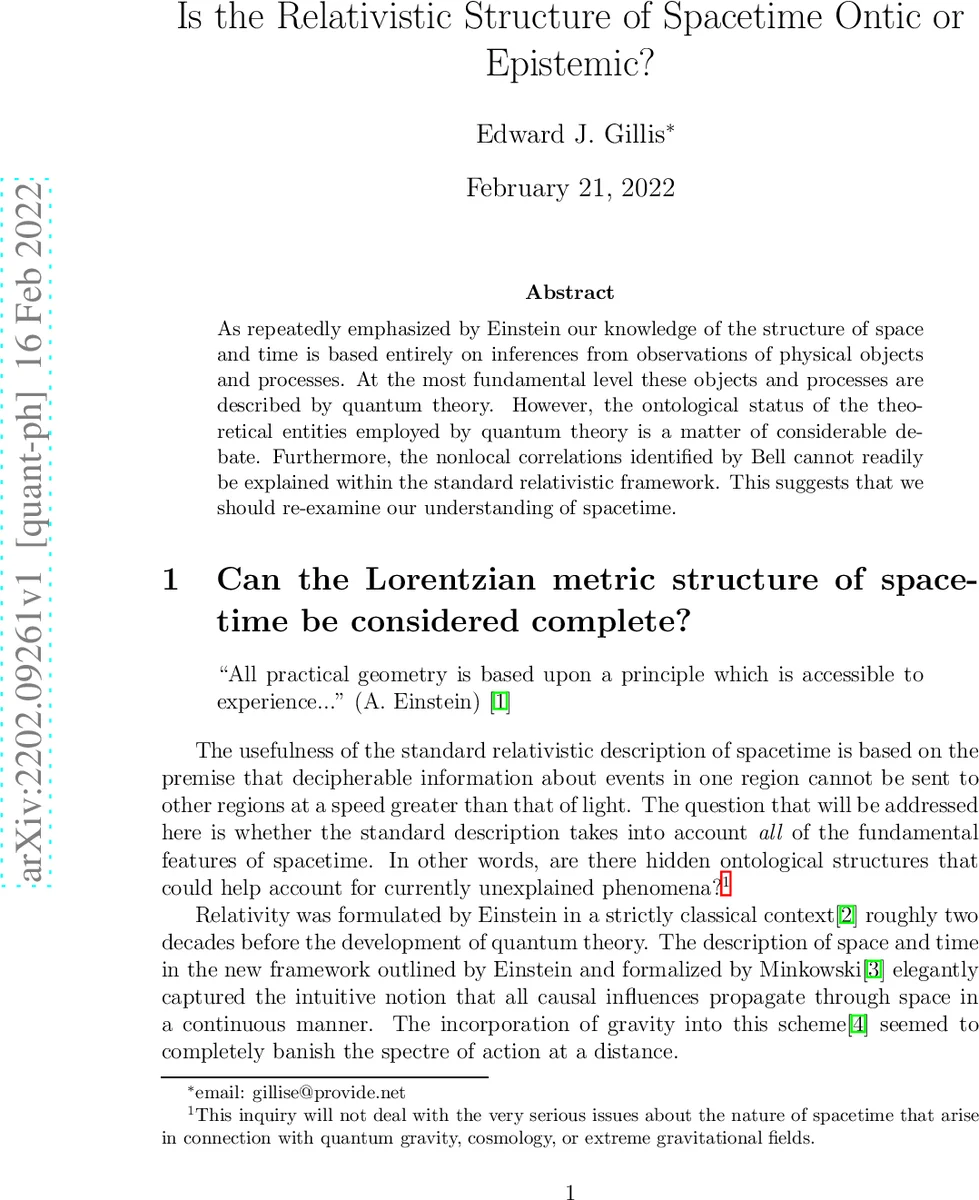
The paper asks a foundational question: is the relativistic structure of spacetime an ontic entity that exists independently of observation, or is it merely an epistemic framework that encodes our knowledge of physical processes? Starting from Einstein’s claim that practical geometry rests on empirically accessible principles, the author reminds us that the Lorentzian metric encodes the speed‑of‑light limit and thus guarantees local causality in classical physics.
The discussion then turns to quantum mechanics, where Bell’s theorem and its experimental confirmations (Aspect, etc.) demonstrate that quantum correlations violate the factorisation condition (often called “local causality”) that underlies classical relativistic reasoning. Bell’s condition (1.1) – (P(A,B|a,b,c,\lambda)=P(A|a,c,\lambda)P(B|b,c,\lambda)) – fails for entangled systems, indicating that some non‑local physical influence must be at work.
Two broad philosophical stances on spacetime are contrasted. The first, championed by Tim Maudlin, insists that a truly relativistic theory must rely exclusively on the Lorentz metric; any extra structure (such as a preferred foliation) is forbidden. From this viewpoint, the metric alone cannot account for Bell‑type non‑locality, so either the metric must be altered or new entities must be introduced.
The second stance accepts that additional spacetime structure may be required. Bohmian mechanics, for instance, needs a global foliation (or a timelike vector field) to define particle trajectories consistently with the wave function. Although the foliation can be derived from a covariant field, its existence represents a departure from a “pure” metric‑only ontology.
Gisin and collaborators are also discussed. They argue that quantum correlations may arise from “outside spacetime,” meaning that no additional spacetime structure is needed, but the price is a relinquishment of a realist picture of physical processes. Their view treats the non‑locality as a purely informational phenomenon that cannot be embedded in any spacetime story.
The paper then surveys relativistic collapse models, especially the Continuous Spontaneous Localization (CSL) approach developed by Tumulka. Tumulka’s model achieves Lorentz invariance without invoking a preferred foliation by introducing stochastic, non‑linear modifications to the Schrödinger equation. However, to avoid super‑luminal signalling, the stochastic dynamics must be carefully constrained, and the model still implicitly relies on a non‑local mechanism to produce the collapse.
A central theme throughout is the “no‑signalling faster than light” principle. All viable theories must respect this empirical constraint, yet they differ on how to reconcile it with the existence of Bell‑type non‑local correlations. The author argues that preserving the prohibition of super‑luminal signalling while explaining non‑locality forces us to admit that the Lorentz metric alone does not fully determine the causal structure of the theory. Either we augment spacetime with a foliation, adopt a non‑local dynamics (as in collapse models), or accept that the correlations are generated outside spacetime.
Consequently, the relativistic spacetime structure is better understood as an epistemic scaffold rather than a complete ontic description of reality. It provides a powerful, empirically successful framework, but it must be supplemented—by additional geometric structure, stochastic dynamics, or a radical reconceptualisation of information—to accommodate the full range of quantum phenomena.
The paper concludes by outlining future research directions: (1) constructing Lorentz‑invariant theories that incorporate extra structure without breaking empirical symmetries; (2) developing models that locate the source of non‑locality outside conventional spacetime; and (3) devising experimental tests that could discriminate between foliation‑based, collapse‑based, and “outside‑spacetime” explanations. Such work, the author suggests, will deepen our understanding of what spacetime truly is and how it meshes with the quantum world.
Comments & Academic Discussion
Loading comments...
Leave a Comment