Discrete unified gas kinetic scheme for the conservative Allen-Cahn equation
💡 Research Summary
The paper presents an improved Discrete Unified Gas Kinetic Scheme (DUGKS) for solving the conservative Allen‑Cahn equation (CACE), which is widely used in phase‑field modeling of immiscible multiphase flows. The authors first review the two main families of interface‑capturing methods—sharp‑interface and diffuse‑interface—and explain why the diffuse‑interface approach, particularly the Allen‑Cahn type, is attractive due to its second‑order nature. However, the classical Allen‑Cahn equation does not conserve mass, prompting the development of several conservative variants. The study adopts the local conservative Allen‑Cahn model proposed by Chiu and Lin, which adds an anti‑diffusive term and enforces a hyperbolic tangent profile across the interface.
The paper then discusses the limitations of lattice Boltzmann methods (LBM) for phase‑field equations, notably the fixed grid, CFL restriction, and relatively large numerical dissipation. DUGKS, a finite‑volume kinetic scheme, overcomes many of these issues by decoupling the time step from the mesh size and providing better stability for continuum flows. Nevertheless, the original DUGKS implementation for CACE suffers from a fundamental accuracy problem: the micro‑flux across cell faces is reconstructed using a linear interpolation of cell‑averaged distribution functions, which only recovers the underlying kinetic equation with first‑order accuracy. This deficiency becomes critical when the force term is present or when the collision operator’s first moment lacks a conservation property, leading to noticeable interface errors.
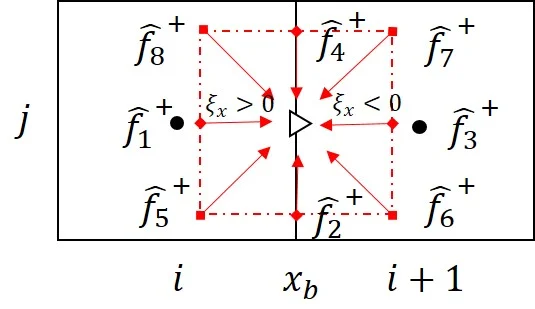
To address this, the authors perform a detailed analysis of the flux evaluation process. By integrating the kinetic equation along a characteristic line over half a time step, they show that the value of the distribution function at the cell face should be obtained from a second‑order (parabolic) reconstruction rather than a linear one. The proposed reconstruction uses neighboring cell averages to build a quadratic polynomial, yielding a face value that is accurate to second order in both space and time. The collision and source terms are treated with the trapezoidal rule, while the convection term uses the midpoint rule, preserving the overall second‑order temporal accuracy.
The improved DUGKS algorithm is then validated through three benchmark problems: (1) diagonal translation of a circular interface, (2) rotation of a Zaleska disk, and (3) deformation of a circular interface. In all cases, the new scheme exhibits significantly reduced L2 errors compared with the original DUGKS, captures the interface shape more faithfully, and maintains mass conservation even under complex motions. The results demonstrate that the numerical dissipation inherent in the original DUGKS is largely mitigated by the parabolic reconstruction, leading to sharper interface representation.
Key contributions of the work include: (i) identification of the root cause of first‑order accuracy in DUGKS for CACE, (ii) development of a parabolic reconstruction technique that restores second‑order accuracy for the micro‑flux, (iii) formulation of equilibrium distribution and source terms tailored to the conservative Allen‑Cahn model, and (iv) comprehensive numerical evidence showing superior performance over previous DUGKS implementations and comparable or better accuracy than LBM‑based approaches, without the restrictive CFL condition.
The authors acknowledge that the scheme assumes low Mach numbers (Ma ≤ 0.3) to keep the equilibrium distribution valid, and that further extensions—such as third‑order reconstructions, three‑dimensional lattices (e.g., D3Q27), and applications to high density‑ratio flows—are promising directions for future research. Overall, the paper delivers a robust, higher‑accuracy kinetic framework for conservative phase‑field simulations, advancing the state of the art in multiphase flow modeling.
Comments & Academic Discussion
Loading comments...
Leave a Comment