Attracting and Retaining OSS Contributors with a Maintainer Dashboard
Tools and artifacts produced by open source software (OSS) have been woven into the foundation of the technology industry. To keep this foundation intact, the open source community needs to actively invest in sustainable approaches to bring in new contributors and nurture existing ones. We take a first step at this by collaboratively designing a maintainer dashboard that provides recommendations on how to attract and retain open source contributors. For example, by highlighting project goals (e.g., a social good cause) to attract diverse contributors and mechanisms to acknowledge (e.g., a “rising contributor” badge) existing contributors. Next, we conduct a project-specific evaluation with maintainers to better understand use cases in which this tool will be most helpful at supporting their plans for growth. From analyzing feedback, we find recommendations to be useful at signaling projects as welcoming and providing gentle nudges for maintainers to proactively recognize emerging contributors. However, there are complexities to consider when designing recommendations such as the project current development state (e.g., deadlines, milestones, refactoring) and governance model. Finally, we distill our findings to share what the future of recommendations in open source looks like and how to make these recommendations most meaningful over time.
💡 Research Summary
The paper tackles a critical sustainability challenge in open‑source software (OSS): how to attract new contributors and keep them engaged. While prior work has focused on newcomer‑centric solutions such as mentorship platforms or documentation, this study shifts the perspective to the project maintainer, proposing a “maintainer dashboard” that delivers actionable recommendations. The authors co‑design the dashboard with Open Source Experts (OEs) to ensure alignment with existing maintainer workflows, and they implement a high‑fidelity prototype in Figma that mimics the GitHub UI.
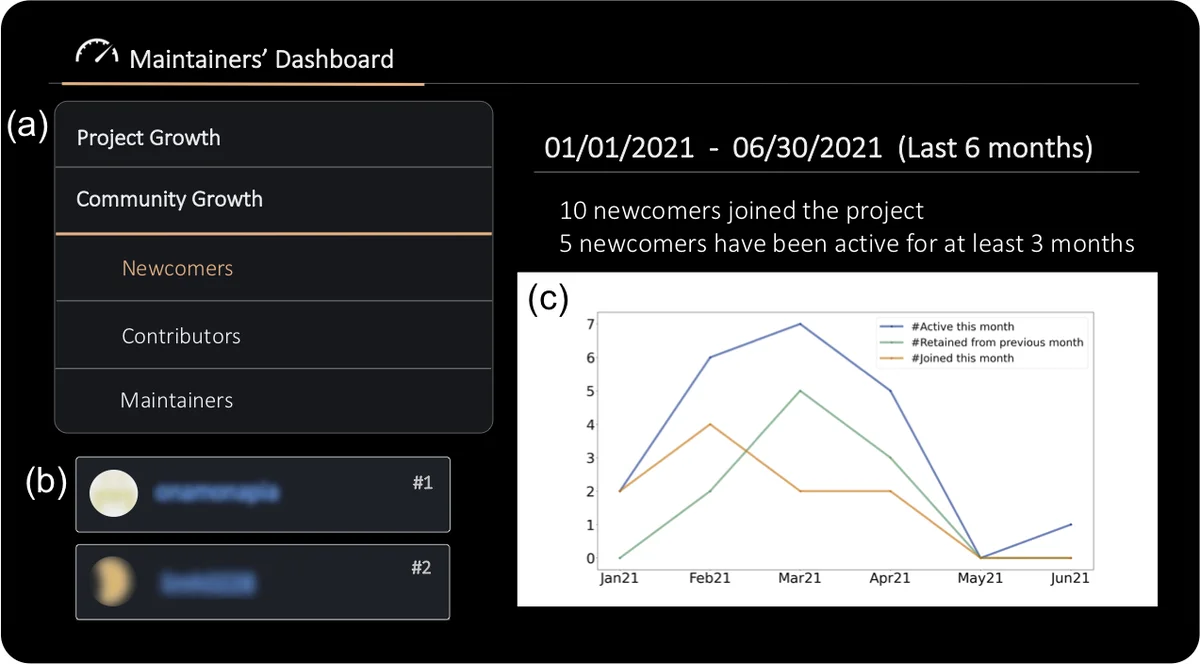
The dashboard offers two categories of recommendations. The first, “project growth,” suggests (1) adding newcomer‑friendly issue labels (e.g., “good first issue”, “first‑timers‑only”) and (2) highlighting the project’s social‑good goals through README badges or tags, leveraging prior findings that social‑impact topics attract a more diverse contributor pool. The second, “community growth,” proposes a “rising contributor” badge for newcomers who have shown consistent activity over the past six months (contributing in at least three of the last six months). The system automatically mines the last six months of commits, issues, and pull requests via the GitHub API to generate activity graphs, label‑usage statistics, and candidate badge recipients.
To evaluate usefulness, the authors conduct a project‑specific, qualitative study with eight maintainers of OSS4SG (open‑source for social good) projects. They randomly selected 71 eligible projects from a curated list of 434, filtered for recent activity, and achieved an 11.3 % response rate. Each maintainer received a customized dashboard view based on their repository’s data, followed by a 30‑45‑minute interview. Grounded‑theory coding of the transcripts revealed several key insights:
-
Issue‑label recommendation – Maintainers agreed that explicit “good first issue” labels signal a welcoming environment and act as a reminder for work they had intended but not yet performed. However, the timing of label adoption depends on the project’s development cycle; strict milestones or refactoring periods can delay implementation. Participants suggested a “remind me later” feature to surface the recommendation when the workload eases.
-
Social‑good goal tags – Adding tags that describe the project’s societal impact (e.g., “Zero Hunger”, “Humanitarian”) was seen as increasing visibility, especially for young projects, and as a lever to attract contributors from under‑represented groups. Some maintainers also noted that such tags could draw users who may not contribute but still benefit from the software.
-
Rising‑contributor badge – The badge was praised as a low‑effort mechanism to acknowledge emerging contributors, boost their credibility, and encourage continued participation. Maintainers expressed interest in integrating such recognition into GitHub’s native UI. Yet, concerns arose about fairness in mixed paid‑unpaid environments; a badge might be perceived differently if contributors are compensated elsewhere.
The study’s limitations include a small, domain‑specific sample (only OSS4SG projects) and a narrow set of recommendation types (two project‑growth items and one community‑growth item). Automatic label detection may also clash with project‑specific naming conventions, requiring customization.
Future work is outlined along three dimensions: (a) scaling the dashboard to a broader spectrum of OSS projects (different sizes, languages, governance models); (b) enriching the recommendation engine with contextual signals such as release cadence, issue backlog, and maintainer workload; and (c) exploring longitudinal effects of badge‑based recognition on contributor retention and downstream outcomes like sponsorship or hiring.
In sum, the paper delivers a concrete, empirically‑grounded tool that helps maintainers become more proactive about community health. By surfacing simple, evidence‑based actions—adding friendly issue labels, broadcasting social‑impact goals, and publicly acknowledging rising contributors—the dashboard can transform a project’s perceived openness, improve newcomer onboarding, and foster longer‑term participation, thereby addressing a core sustainability challenge in the OSS ecosystem.
Comments & Academic Discussion
Loading comments...
Leave a Comment