Complexity and Geometry of Sampling Connected Graph Partitions
In this paper, we prove intractability results about sampling from the set of partitions of a planar graph into connected components. Our proofs are motivated by a technique introduced by Jerrum, Valiant, and Vazirani. Moreover, we use gadgets inspired by their technique to provide families of graphs where the “flip walk” Markov chain used in practice for this sampling task exhibits exponentially slow mixing. Supporting our theoretical results we present some empirical evidence demonstrating the slow mixing of the flip walk on grid graphs and on real data. Inspired by connections to the statistical physics of self-avoiding walks, we investigate the sensitivity of certain popular sampling algorithms to the graph topology. Finally, we discuss a few cases where the sampling problem is tractable. Applications to political redistricting have recently brought increased attention to this problem, and we articulate open questions about this application that are highlighted by our results.
💡 Research Summary
The paper investigates the computational complexity of uniformly sampling connected graph partitions, a problem that arises naturally in applications such as political redistricting, network analysis, and computer vision. The authors focus on the set P₂(G) of all ways to split the vertex set of a graph G into two connected components, and more generally on P_k(G) for a fixed k. Their main contributions are three‑fold: (1) a series of hardness results showing that uniform sampling from P₂(G) (and from the balanced version where the two parts have equal size) is NP‑hard even when G is a planar graph, a planar triangulation with bounded vertex degree, or a series‑parallel graph; (2) a rigorous analysis of the “flip walk” Markov chain, the most widely used heuristic for generating random connected partitions, proving that for a carefully constructed family of planar graphs the chain mixes torpidly, i.e., its mixing time grows exponentially in the number of vertices; and (3) empirical validation of the theoretical findings on grid graphs and on real‑world redistricting data, together with a discussion of connections to self‑avoiding walks from statistical physics.
To establish hardness, the authors adapt the classic Jerrum‑Valiant‑Vazirani reduction: they encode a hard decision problem (e.g., Hamiltonian cycle or simple cycle existence) into the structure of P₂(G) by exploiting the duality between simple cycles in a planar graph and connected 2‑partitions of its dual. By adding “balancing gadgets” they extend the reduction to the case where the two parts must have the same cardinality. A further refinement shows that even when the input graph is a maximal planar graph with maximum degree 9, the reduction still works, implying that the intractability persists under realistic topological constraints typical of redistricting maps.
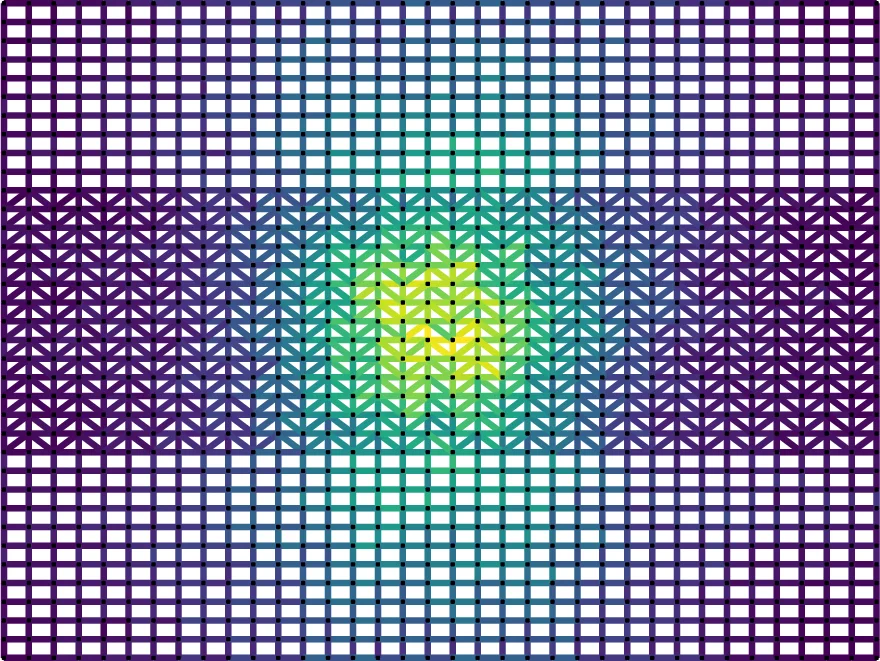
The flip walk proceeds by picking a vertex uniformly at random, proposing to move it to the opposite block, and accepting the move only if both blocks remain connected. While the chain is irreducible on 2‑connected graphs and has the uniform distribution as its stationary distribution, the authors construct a family 𝔊 of bounded‑degree planar triangulations that contain a narrow “bottleneck” separating two large regions. In such graphs, any move that changes the side of the bottleneck occurs with probability O(1/|V|), leading to a conductance Φ that is exponentially small. By Cheeger’s inequality this yields a mixing time lower bound of exp(Ω(|V|)). Consequently, the flip walk cannot be relied upon to produce near‑uniform samples in polynomial time for these instances.
The experimental section corroborates the theory. On square grids of increasing size, the total variation distance between the empirical distribution after a polynomial number of steps and the true uniform distribution remains large, confirming torpid mixing. Similar behavior is observed on the dual graphs of actual states (e.g., Kansas), demonstrating that the pathological mixing behavior is not merely a theoretical curiosity. The authors also explore the relationship between the sampling problem and the self‑avoiding walk model, showing that the distribution over P₂(G) exhibits phase‑transition‑like behavior as a function of a temperature‑like parameter, further emphasizing the sensitivity of sampling algorithms to graph topology.
On the positive side, the paper identifies tractable subclasses. For series‑parallel graphs (equivalently, graphs of treewidth 2) the authors present a dynamic‑programming algorithm that can generate exact uniform samples from P₂(G) and from the balanced subset in polynomial time. More generally, any graph of bounded treewidth admits a similar DP approach, providing a practical alternative when the flip walk is provably slow.
The work situates itself within a broader literature on the complexity of redistricting, Markov‑chain Monte Carlo methods for combinatorial sampling, and statistical‑physics models on graphs. It underscores that many heuristics currently employed in redistricting analysis lack theoretical mixing guarantees, and that careful algorithmic design—potentially leveraging structural graph properties—is essential for reliable statistical inference. The paper concludes with several open questions, including the characterization of graph families for which fast mixing is possible, the development of new Markov chains that avoid the identified bottlenecks, and the exploration of approximate sampling schemes that may be sufficient for practical redistricting audits.
Comments & Academic Discussion
Loading comments...
Leave a Comment