On semiflexible, flexible and pie algebras
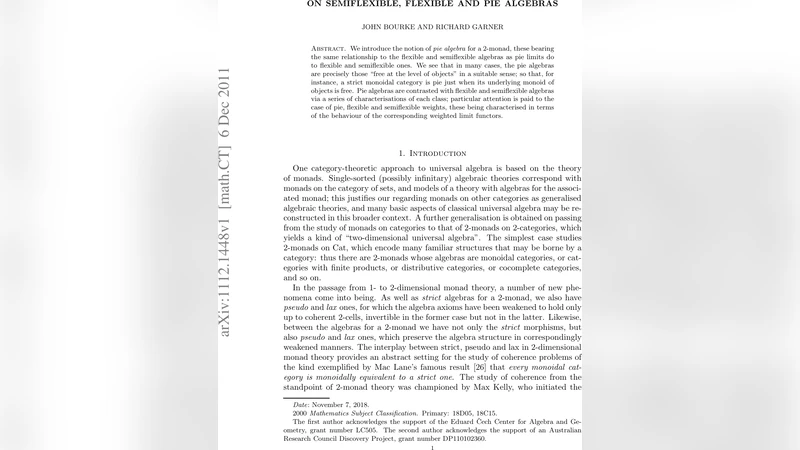
We introduce the notion of pie algebra for a 2-monad, these bearing the same relationship to the flexible and semiflexible algebras as pie limits do to flexible and semiflexible ones. We see that in many cases, the pie algebras are precisely those “free at the level of objects” in a suitable sense; so that, for instance, a strict monoidal category is pie just when its underlying monoid of objects is free. Pie algebras are contrasted with flexible and semiflexible algebras via a series of characterisations of each class; particular attention is paid to the case of pie, flexible and semiflexible weights, these being characterised in terms of the behaviour of the corresponding weighted limit functors.
💡 Research Summary
The paper introduces a new class of algebras for a 2‑monad, called “pie algebras,” and situates them between the already known flexible and semiflexible algebras. The motivation comes from an analogy with pie limits, which sit between flexible and semiflexible limits in the theory of weighted limits. The authors first recall the definitions of flexible and semiflexible algebras: flexible algebras preserve equivalences (2‑cells that are invertible up to isomorphism) while semiflexible algebras preserve all 2‑cells, but both may fail to preserve strict equalities.
A pie algebra is defined by a “free‑at‑the‑level‑of‑objects” condition. Concretely, an algebra (A) for a 2‑monad (T) is pie if the underlying object‑level structure of (A) is a free (T)‑algebra, even though the higher‑dimensional structure (the 2‑cells) may be non‑free. This captures the intuition that the algebra is generated freely from its objects, while the coherence data can be arbitrary. As a primary example, a strict monoidal category is pie precisely when its underlying monoid of objects is a free monoid. Similarly, a strict 2‑category is pie exactly when its underlying graph of objects and 1‑cells is a free 2‑graph.
The paper then provides four equivalent characterisations of each of the three classes (pie, flexible, semiflexible). The characterisations involve:
- Preservation of 2‑cells – pie algebras preserve only identities on objects, flexible algebras preserve equivalences, and semiflexible algebras preserve all 2‑cells.
- Existence of a retraction from a free algebra – a pie algebra admits a strict section of the canonical map from a free algebra, while flexible algebras admit a pseudo‑section, and semiflexible algebras admit merely a lax section.
- Behaviour of weighted limit functors – when a weight is pie, the corresponding weighted limit functor preserves all pie algebras; for flexible weights it preserves flexible algebras, and analogously for semiflexible weights.
- Properties of the weight itself – a weight is pie exactly when its category of elements is a free category on a graph, flexible when it is a free category on a reflexive graph, and semiflexible when it is an arbitrary category.
These characterisations are proved by constructing explicit 2‑adjunctions and by analysing the interaction between the monad’s Kleisli construction and the relevant 2‑categorical limits.
A substantial part of the paper is devoted to examples that illustrate the theory. For strict monoidal categories, the authors show that the free‑object condition reduces to the underlying monoid being free; consequently, many familiar monoidal categories (such as the category of finite sets under cartesian product) are flexible but not pie. For 2‑categories, the free‑object condition translates into the underlying 2‑graph being a free 2‑graph, which rarely holds in practice, explaining why pie 2‑categories are exceptional. The authors also discuss the case of the 2‑monad for bicategories, where pie algebras correspond to bicategories whose underlying graph of objects and 1‑cells is free.
The final section connects pie algebras with the theory of weighted limits. The authors prove a “pie limit preservation theorem”: if a weight is pie, then the associated weighted limit functor preserves all pie algebras, and similarly for flexible and semiflexible weights. This result generalises known preservation theorems for flexible limits and provides a unified framework for understanding how different levels of algebraic flexibility affect limit preservation.
In conclusion, the paper establishes pie algebras as a natural intermediate notion between flexible and semiflexible algebras, grounded in a free‑object intuition. It supplies multiple equivalent descriptions, demonstrates the concept through a range of concrete examples, and links the notion to weighted limit theory, thereby enriching the landscape of 2‑monad algebra and offering new tools for both categorical algebra and its applications in higher‑dimensional category theory.
Comments & Academic Discussion
Loading comments...
Leave a Comment