Signaling in Posted Price Auctions
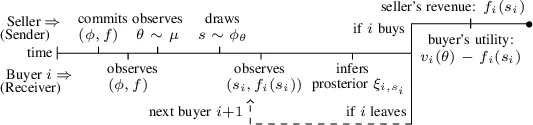
We study single-item single-unit Bayesian posted price auctions, where buyers arrive sequentially and their valuations for the item being sold depend on a random, unknown state of nature. The seller has complete knowledge of the actual state and can send signals to the buyers so as to disclose information about it. For instance, the state of nature may reflect the condition and/or some particular features of the item, which are known to the seller only. The problem faced by the seller is about how to partially disclose information about the state so as to maximize revenue. Unlike classical signaling problems, in this setting, the seller must also correlate the signals being sent to the buyers with some price proposals for them. This introduces additional challenges compared to standard settings. We consider two cases: the one where the seller can only send signals publicly visible to all buyers, and the case in which the seller can privately send a different signal to each buyer. As a first step, we prove that, in both settings, the problem of maximizing the seller’s revenue does not admit an FPTAS unless P=NP, even for basic instances with a single buyer. As a result, in the rest of the paper, we focus on designing PTASs. In order to do so, we first introduce a unifying framework encompassing both public and private signaling, whose core result is a decomposition lemma that allows focusing on a finite set of possible buyers’ posteriors. This forms the basis on which our PTASs are developed. In particular, in the public signaling setting, our PTAS employs some ad hoc techniques based on linear programming, while our PTAS for the private setting relies on the ellipsoid method to solve an exponentially-sized LP in polynomial time. In the latter case, we need a custom approximate separation oracle, which we implement with a dynamic programming approach.
💡 Research Summary
The paper investigates revenue maximization for a seller in a single‑item, single‑unit Bayesian posted‑price auction where buyers’ valuations depend on an unknown state of nature that is fully observed by the seller. The seller can influence buyers not only by setting take‑it‑or‑leave‑it prices but also by sending signals that partially disclose information about the state. Two signaling regimes are considered: public signaling, where all buyers receive the same signal, and private signaling, where each buyer may receive a distinct signal through private channels.
The authors first establish a strong hardness result: even with a single buyer, there is no fully polynomial‑time approximation scheme (FPTAS) for computing an optimal signaling‑price pair unless P = NP. This shows that the combination of signaling and price selection makes the problem fundamentally harder than classic Bayesian persuasion, where PTAS results are known. Consequently, the focus shifts to designing polynomial‑time approximation schemes (PTAS) for both public and private settings.
A central technical contribution is a “decomposition lemma” that shows any (near‑optimal) signaling scheme can be approximated using only a finite set of posteriors, called q‑uniform posteriors. A q‑uniform posterior is the uniform average of q canonical basis vectors in ℝ^d, where d is the number of possible states. The set Ξ_q of all such posteriors has size O(d^q), which is polynomial for fixed ε (by choosing q = O(1/ε)). This reduction allows the infinite‑dimensional signaling design problem to be expressed in a finite‑dimensional linear program.
In the public signaling case, the authors formulate a polynomial‑size LP whose variables are the probabilities assigned to each q‑uniform posterior in Ξ_q. The objective coefficients correspond to the expected revenue obtained when a particular posterior is induced and the seller posts the optimal price for that posterior. Computing these coefficients exactly is hard, but the paper leverages an existing algorithm for approximating optimal prices in non‑Bayesian posted‑price auctions to obtain ε‑accurate estimates. Solving the LP with these approximate coefficients yields a (1 + ε)‑approximate revenue‑maximizing public signaling scheme, thus establishing a PTAS.
The private signaling scenario is more intricate because each buyer’s marginal signaling scheme must be coordinated with the others and with the price vector. The authors construct an exponential‑size LP that captures the joint distribution over q‑uniform posteriors for all buyers together with the price function. Although the LP has exponentially many variables, it can be solved in polynomial time using the ellipsoid method, provided an efficient separation oracle is available. The paper designs a custom approximate separation oracle based on dynamic programming: given a candidate solution, the DP checks whether there exists a violated constraint by exploring combinations of posteriors and price choices across buyers. This oracle runs in polynomial time, enabling the ellipsoid algorithm to find an ε‑approximate solution to the exponential LP. Consequently, a PTAS for private signaling is obtained.
The work situates itself within the literature on Bayesian persuasion and mechanism design. Prior research has addressed signaling in second‑price auctions, providing PTAS for public signaling and showing NP‑hardness for Bayesian settings. The present paper extends these ideas to posted‑price auctions, which are more prevalent in e‑commerce platforms (e.g., travel, accommodation, retail). By handling both public and private signaling and by introducing the q‑uniform posterior framework, the authors provide a unified methodological toolkit that could be adapted to other auction formats or to settings where the seller must simultaneously disclose information and set strategic prices.
Overall, the paper makes three major contributions: (1) a hardness proof ruling out FPTAS even for a single buyer; (2) a decomposition lemma that reduces the signaling design to a finite set of structured posteriors; (3) PTAS algorithms for both public and private signaling—using LP with approximate coefficients for the former and the ellipsoid method with a DP‑based separation oracle for the latter. These results deepen our understanding of the interplay between information design and price optimization, and they offer practical algorithms for platforms that wish to leverage partial disclosure to boost revenue.
Comments & Academic Discussion
Loading comments...
Leave a Comment