A Sequential Discontinuous Galerkin Method for Two-Phase Flow in Deformable Porous Media
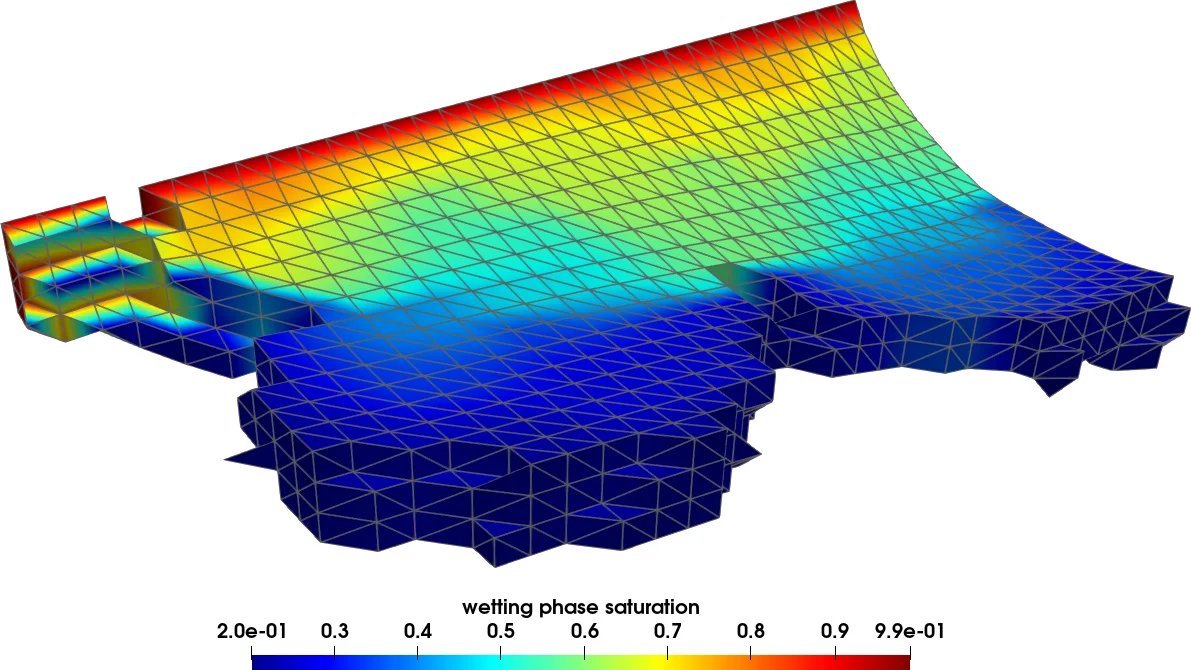
We formulate a numerical method for solving the two-phase flow poroelasticity equations. The scheme employs the interior penalty discontinuous Galerkin method and a sequential time-stepping method. The unknowns are the phase pressures and the displacement. Existence of the solution is proved. Three-dimensional numerical results show the accuracy and robustness of the proposed method.
💡 Research Summary
The paper presents a new numerical algorithm for simulating two‑phase flow coupled with poroelastic deformation in three‑dimensional porous media. Starting from the Biot‑type poroelastic model, the authors write the governing equations as two mass‑balance equations for the wetting (p_w) and non‑wetting (p_o) phase pressures together with a quasi‑static momentum balance for the solid displacement (u). The phase pressures are linked through a nonlinear capillary pressure function (Brooks‑Corey) and the relative permeabilities depend on the wetting saturation s_w. The coefficients C_i(p_o,p_w) that appear in the mass balance equations are nonlinear functions of the pressures and saturation; under realistic physical assumptions they are non‑negative, which is crucial for the stability of the proposed scheme.
Spatial discretisation is performed with an interior‑penalty discontinuous Galerkin (DG) method on a tetrahedral mesh. The DG spaces Q_h (scalar) and V_h (vector) consist of piecewise linear polynomials that are allowed to be discontinuous across element faces. Standard jump and average operators are employed, and the diffusion operators −∇·(λ∇p) are approximated by the symmetric interior‑penalty bilinear form a(·;·,·). The elastic operator −μΔu−(λ+μ)∇(∇·u) is discretised analogously by the bilinear form c(·,·). Penalty parameters σ_p and σ_u are chosen sufficiently large to guarantee coercivity of a and c. A small cut‑off operator Π is introduced to keep the saturation within
Comments & Academic Discussion
Loading comments...
Leave a Comment