Embeddings of $k$-complexes into $2k$-manifolds
We improve the bound on K"uhnel’s problem to determine the smallest $n$ such that the $k$-skeleton of an $n$-simplex $\Delta_n^{(k)}$ does not embed into a compact PL $2k$-manifold $M$ by showing that if $\Delta_n^{(k)}$ embeds into $M$, then $n\leq (2k+1)+(k+1)\beta_k(M;\mathbb Z_2)$. As a consequence we obtain improved Radon and Helly type results for set systems in such manifolds. Our main tool is a new description of an obstruction for embeddability of a $k$-complex $K$ into a compact PL $2k$-manifold $M$ via the intersection form on $M$. In our approach we need that for every map $f\colon K\to M$ the restriction to the $(k-1)$-skeleton of $K$ is nullhomotopic. In particular, this condition is satisfied in interesting cases if $K$ is $(k-1)$-connected, for example a $k$-skeleton of $n$-simplex, or if $M$ is $(k-1)$-connected. In addition, if $M$ is $(k-1)$-connected and $k\geq 3$, the obstruction is complete, meaning that a $k$-complex $K$ embeds into $M$ if and only if the obstruction vanishes. For trivial intersection forms, our obstruction coincides with the standard van Kampen obstruction. However, if the form is non-trivial, the obstruction is not linear but rather ‘quadratic’ in a sense that it vanishes if and only if certain system of quadratic diophantine equations is solvable. This may potentially be useful in attacking algorithmic decidability of embeddability of $k$-complexes into PL $2k$-manifolds.
💡 Research Summary
The paper addresses three interrelated problems concerning the embeddability of k‑dimensional simplicial complexes into compact PL 2k‑manifolds. First, it improves the classical K ühnel bound for the smallest n such that the k‑skeleton Δ⁽ᵏ⁾ₙ of an n‑simplex cannot be embedded into a given 2k‑manifold M. The authors prove that if Δ⁽ᵏ⁾ₙ almost embeds (i.e., images of disjoint k‑simplices are disjoint) into a compact (possibly with boundary) PL 2k‑manifold M, then
n ≤ (2k + 1) + (k + 1)·βₖ(M;ℤ₂).
If the ℤ₂‑intersection form Ω on Hₖ(M;ℤ₂) is alternating (Ω(h,h)=0 for all h), the bound sharpens to
n ≤ (2k + 1) + ½(k + 2)·βₖ(M;ℤ₂).
These inequalities hold without assuming that M is (k‑1)‑connected, thereby extending K ühnel’s original conjecture, which required (k‑1)‑connectivity. The proof uses a combinatorial construction: given a point set P of size r satisfying a k‑connectivity condition on the closures of small subsets, one can inductively map the vertices of Δ⁽ᵏ⁾_{r‑1} into the closures, ensuring that each k‑simplex lands inside the closure of the complementary vertex set. This yields an almost embedding that contradicts the bound, establishing the inequality.
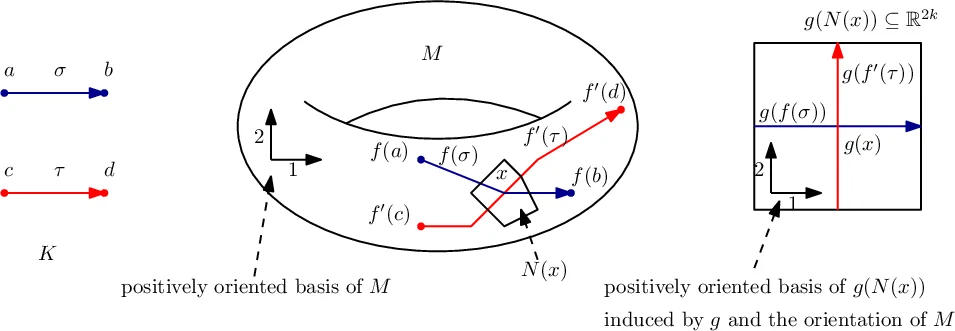
The second major contribution is a new obstruction theory for embedding a k‑complex K into a compact PL 2k‑manifold M. Building on the classical van Kampen obstruction, the authors consider the deleted product ˜K = {(σ,τ) | σ∩τ=∅} and define a 2k‑chain ϑ_f for a general‑position map f:|K|→M that records intersection numbers of f(σ) and f(τ). By imposing symmetry (or alternating symmetry) conditions on cochains, they obtain subcomplexes C_{2k}^{alt‑sym}(˜K;R) and C_{2k‑1}^{sym}(˜K;R) (R = ℤ₂ or ℤ). The resulting cohomology group H_{2k}^{alt‑sym}(˜K;R) contains a distinguished class O_K(M), the “intersection‑form obstruction”. The main theorem states that if M is (k‑1)‑connected and k≥3, then O_K(M)=0 if and only if K embeds into M. When the intersection form of M is trivial, O_K(M) coincides with the usual van Kampen obstruction; otherwise it becomes a quadratic condition: O_K(M)=0 exactly when a certain system of quadratic Diophantine equations (derived from the intersection form) has a solution. This quadratic nature suggests new algorithmic approaches to the embeddability decision problem, potentially bridging the gap between the known NP‑hardness for k=2 and the undecided status for higher k.
The third part translates the improved K ühnel bound into Radon‑type and Helly‑type theorems for manifolds. Theorem 2 asserts that for a compact PL 2k‑manifold M equipped with any closure operator cl, if a point set P of size r satisfies that cl(S) is k‑connected for every S⊂P with |S|≤k+1, then whenever r exceeds the bound from Theorem 1 (or its alternating‑form version), there exist disjoint subsets P₁,P₂⊂P with cl(P₁)∩cl(P₂)=∅. Corollary 3 gives the corresponding Helly theorem: a family of subsets of M with the property that every subfamily of size ≤k+1 has a non‑empty k‑connected intersection, and every smaller subfamily (size <r) has a non‑empty total intersection, must have an empty total intersection. These results generalize classical planar Helly and Radon theorems to arbitrary 2k‑manifolds, with the quantitative parameter r now expressed in terms of βₖ(M;ℤ₂) and the intersection form.
The paper concludes with a discussion of open problems, notably Conjecture 18, which posits a purely combinatorial linear‑algebraic condition equivalent to the K ühnel bound for PL manifolds. The authors also highlight the need for algorithmic implementations of the quadratic obstruction, the case k=2 where completeness remains open, and potential applications to graph embeddings on surfaces, projective geometry, and incidence geometry.
Overall, the work provides (1) a sharper topological bound for embedding k‑skeleta into 2k‑manifolds, (2) a novel obstruction that unifies van Kampen theory with manifold intersection forms and introduces a quadratic component, and (3) concrete combinatorial consequences in the form of strengthened Radon and Helly theorems. These contributions deepen the interplay between algebraic topology, combinatorial geometry, and computational topology.
Comments & Academic Discussion
Loading comments...
Leave a Comment