Complex systems: features, similarity and connectivity
The increasing interest in complex networks research has been a consequence of several intrinsic features of this area, such as the generality of the approach to represent and model virtually any discrete system, and the incorporation of concepts and methods deriving from many areas, from statistical physics to sociology, which are often used in an independent way. Yet, for this same reason, it would be desirable to integrate these various aspects into a more coherent and organic framework, which would imply in several benefits normally allowed by the systematization in science, including the identification of new types of problems and the cross-fertilization between fields. More specifically, the identification of the main areas to which the concepts frequently used in complex networks can be applied paves the way to adopting and applying a larger set of concepts and methods deriving from those respective areas. Among the several areas that have been used in complex networks research, pattern recognition, optimization, linear algebra, and time series analysis seem to play a more basic and recurrent role. In the present manuscript, we propose a systematic way to integrate the concepts from these diverse areas regarding complex networks research. In order to do so, we start by grouping the multidisciplinary concepts into three main groups, namely features, similarity, and network connectivity. Then we show that several of the analysis and modeling approaches to complex networks can be thought as a composition of maps between these three groups, with emphasis on nine main types of mappings, which are presented and illustrated. Such a systematization of principles and approaches also provides an opportunity to review some of the most closely related works in the literature, which is also developed in this article.
💡 Research Summary
The manuscript “Complex systems: features, similarity and connectivity” tackles a fundamental problem in the study of complex networks: the lack of a unified conceptual framework that can accommodate the multitude of methods drawn from physics, sociology, computer science, and other disciplines. The authors propose to reduce every complex system to three basic representations—features (F), similarity (S), and connectivity (C)—and to view the analytical and modeling steps as mappings between these representations.
First, the paper motivates the need for integration by highlighting how pattern recognition, optimization, linear algebra, and time‑series analysis are repeatedly used in network research, yet often in isolation. By grouping the concepts into the three pillars (F, S, C), the authors argue that any analysis can be expressed as a composition of maps, and that nine principal types of such mappings can be identified.
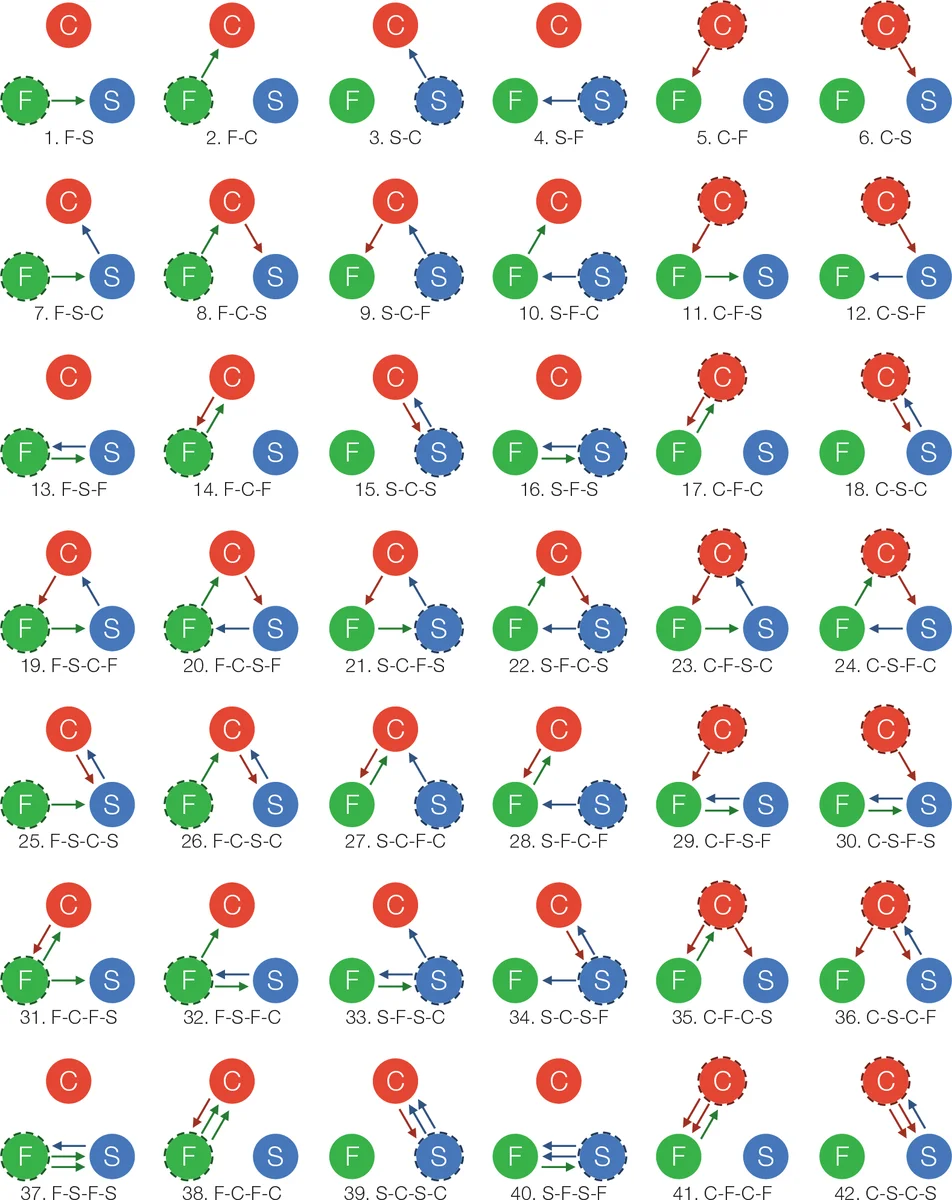
The core of the contribution is a systematic taxonomy of the six elementary transformations (F→S, S→F, F→C, C→F, S→C, C→S) and a catalog of all possible paths involving up to three transformations. Figure 4 in the paper enumerates 42 distinct paths (e.g., FSC, CFS, SFCF) and shows how each path corresponds to a class of existing models or algorithms. The authors illustrate the concept with the well‑known Waxman spatial network model: node positions constitute the feature space (F), Euclidean distances generate a similarity matrix (S), a distance‑dependent probability function creates the adjacency matrix (C), and a force‑directed layout can be seen as an additional F‑generation step. This example demonstrates how a concrete model follows an FSC path and how extra transformations can be layered on top.
To guide practitioners in selecting appropriate representations, the authors introduce eight design guidelines: (1) problem‑driven demands, (2) interactive exploration, (3) data filtering and selection, (4) compatibility with the researcher’s expertise or field, (5) compatibility with the chosen methods, (6) compatibility with software/hardware constraints, (7) complementary representations, and (8) cross‑fertilization of techniques. These guidelines translate abstract mapping choices into concrete decision‑making criteria for real projects.
The manuscript then systematically maps a broad spectrum of existing techniques onto the proposed framework. Pattern‑recognition tools such as clustering, dimensionality reduction, and feature selection are placed mainly in F↔S transformations. Optimization approaches (e.g., graph cuts, routing) occupy S↔C mappings, while linear‑algebraic methods (eigen‑decomposition, spectral clustering) often involve combined F‑S‑C pathways. Time‑series analysis contributes similarity measures (correlation, cross‑correlation) that feed directly into S‑based steps. By doing so, the authors reveal hidden commonalities among methods that are traditionally considered unrelated.
Beyond classification, the paper argues that the framework enables several scientific benefits. It clarifies the methodological landscape, making it easier to design experiments and to communicate results across disciplines. It encourages cross‑fertilization: a technique developed for feature selection in machine learning can be repurposed for similarity‑based community detection, and vice‑versa. It also provides a pedagogical scaffold for teaching complex‑network concepts, as instructors can structure curricula around the three representations and their transformations. Finally, the authors suggest that novel research directions can emerge by exploring previously unused paths in the taxonomy, potentially leading to new generative models or analysis pipelines.
In summary, this work offers a coherent, high‑level map of complex‑network research that abstracts away domain‑specific jargon while preserving the essential mathematical relationships. By framing features, similarity, and connectivity as interchangeable lenses linked by well‑defined mappings, the authors deliver a practical toolbox for researchers, educators, and engineers seeking to navigate the increasingly interdisciplinary terrain of complex systems.
Comments & Academic Discussion
Loading comments...
Leave a Comment