A users guide to the topological Tverberg conjecture
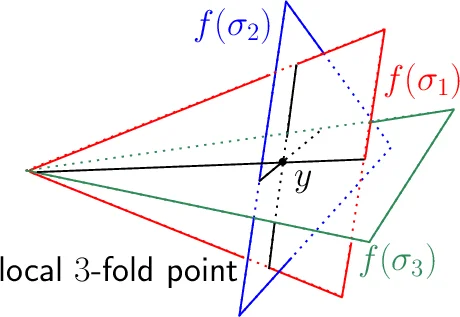
The topological Tverberg conjecture was considered a central unsolved problem of topological combinatorics. The conjecture asserts that for any integers $r,d>1$ and any continuous map $f:\Delta\to\mathbb R^d$ of the $(d+1)(r-1)$-dimensional simplex there are pairwise disjoint faces $\sigma_1,\ldots,\sigma_r\subset\Delta$ such that $f(\sigma_1)\cap \ldots \cap f(\sigma_r)\ne\emptyset$. The conjecture was proved for a prime power $r$. Recently counterexamples for other $r$ were found. Analogously, the $r$-fold van Kampen-Flores conjecture holds for a prime power $r$ but does not hold for other $r$. The arguments form a beautiful and fruitful interplay between combinatorics, algebra and topology. We present a simplified exposition accessible to non-specialists in the area. We also mention some recent developments and open problems.
💡 Research Summary
The paper “A User’s Guide to the Topological Tverberg Conjecture” offers a comprehensive, yet accessible, exposition of one of the most celebrated problems in topological combinatorics: the topological Tverberg conjecture. The conjecture asserts that for any integers r, d > 1 and any continuous map f : Δ→ℝᵈ from the (d+1)(r−1)-dimensional simplex Δ, there exist r pairwise disjoint faces σ₁,…,σᵣ⊂Δ whose images intersect, i.e., f(σ₁)∩…∩f(σᵣ)≠∅. Historically, the conjecture was proved when r is a prime power (by Bárány–Shlosman–Szűcs, Özaydin, and Volovikov) and was widely believed to hold in full generality. Recent breakthroughs, however, produced counter‑examples for all non‑prime‑power values of r, revealing a striking dichotomy.
The article is organized into four main parts. The introductory section revisits the classical Radon, Tverberg, and van Kampen‑Flores theorems in their linear forms, explaining how each can be viewed as a special case of a more general topological statement. It emphasizes the minimality of the point counts (d+1)(r−1)+1 for Tverberg and (2k+2) for van Kampen‑Flores, showing that these numbers are exactly where dimension counting forces an intersection in the generic setting.
Section 2 presents the positive side of the story. The authors give a streamlined proof of Theorem 1.3: if r is a prime power then no almost‑r‑embedding Δ^{(d+1)(r−1)}→ℝᵈ exists. The proof proceeds via the Borsuk‑Ulam theorem and the equivariant cohomology of the configuration space K_{Δ}^{×r} equipped with a ℤₚⁿ‑action. A key ingredient is the “Constraint Lemma” (Lemma 1.8), which shows that a topological Tverberg statement automatically implies the corresponding van Kampen‑Flores statement. The authors also explain the join construction, which allows one to raise both the dimension of the domain and the target simultaneously while preserving the almost‑embedding property.
Section 3 deals with the negative side. Here the paper explains how the recent counter‑examples are built. The central tool is the r‑fold Whitney trick introduced by Mabillard and Wagner, a high‑dimensional analogue of the classical Whitney trick for eliminating double points. When d≥3r+1 (later improved to d≥2r+1), this technique produces an almost‑r‑embedding of the full simplex, contradicting the conjecture. The authors give a concrete low‑dimensional example: an almost‑6‑embedding Δ^{70}→ℝ^{13}, which yields a counter‑example for r=6, d=13. By applying the join construction and the Constraint Lemma in reverse, they extend this to an almost‑r‑embedding of Δ^{(d+1)(r−1)} for any non‑prime‑power r and d≥3r+1, establishing Theorem 1.4.
Section 4 is an appendix that collects various versions of the topological Radon and van Kampen‑Flores theorems (including odd‑dimensional versions, the Conway‑Gordon‑Sachs numbers, etc.) and shows how they fit into the same framework. The authors also provide a “principles of scientific discussion” appendix, where they critically examine several recent papers, correct mis‑citations, and clarify the provenance of key lemmas such as the Constraint Lemma.
Throughout the manuscript the authors strive to make sophisticated algebraic‑topological arguments transparent. Whenever a deep theorem (e.g., Özaydin’s equivariant obstruction theory result) is invoked, they restate it in elementary language and explain how it is used, allowing readers without a background in equivariant cohomology to follow the logical flow. The paper also includes explicit diagrams, step‑by‑step constructions, and a clear roadmap of dependencies among results (e.g., Theorem 1.3 → Lemma 1.8 → Theorem 1.6).
In summary, the paper achieves three goals: (1) it provides a clean, self‑contained proof of the topological Tverberg theorem for prime‑power r; (2) it explains in detail the construction of counter‑examples for non‑prime‑power r, highlighting the role of the r‑fold Whitney trick and the join operation; (3) it situates these results within a broader landscape of topological combinatorial theorems and offers a meta‑discussion on scholarly attribution. As such, it serves both as an excellent entry point for graduate students entering the field and as a valuable reference for experts seeking a concise synthesis of the current state of the topological Tverberg conjecture.
Comments & Academic Discussion
Loading comments...
Leave a Comment