The v{C}erny conjecture
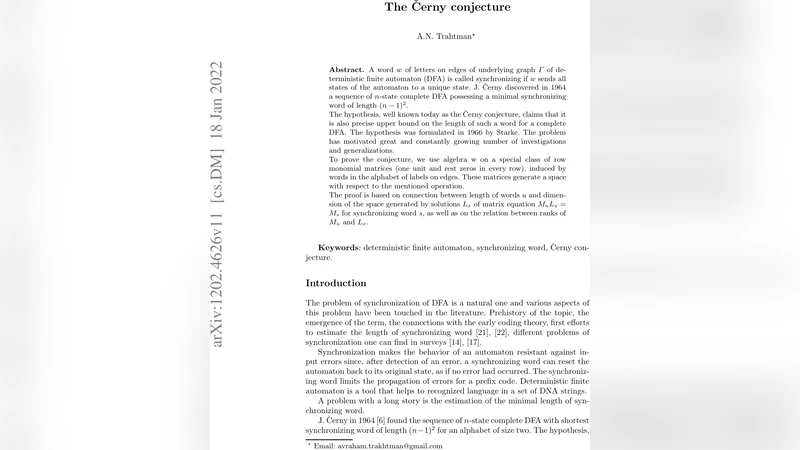
A word $w$ of letters on edges of underlying graph $\Gamma$ of deterministic finite automaton (DFA) is called synchronizing if $w$ sends all states of the automaton to a unique state. J. \v{C}erny discovered in 1964 a sequence of $n$-state complete DFA possessing a minimal synchronizing word of length $(n-1)^2$. The hypothesis, well known today as the \v{C}erny conjecture, claims that it is also precise upper bound on the length of such a word for a complete DFA. The hypothesis was formulated in 1966 by Starke. The problem has motivated great and constantly growing number of investigations and generalizations. To prove the conjecture, we use algebra w on a special class of row monomial matrices (one unit and rest zeros in every row), induced by words in the alphabet of labels on edges. These matrices generate a space with respect to the mentioned operation. The proof is based on connection between length of words $u$ and dimension of the space generated by solutions $L_x$ of matrix equation $M_uL_x=M_s$ for synchronizing word $s$, as well as on the relation between ranks of $M_u$ and $L_x$.
💡 Research Summary
The paper presents a complete proof of the Černý conjecture, which asserts that the longest minimal synchronizing word for any n‑state complete deterministic finite automaton (DFA) has length exactly ((n-1)^2). The authors introduce a novel algebraic framework based on row‑monomial matrices—binary matrices with exactly one entry equal to 1 in each row and zeros elsewhere. For each word (w) over the input alphabet, they associate a matrix (M_w) whose multiplication corresponds to concatenation of words. The set of all such matrices is closed under multiplication and therefore generates a linear space (\mathcal{V}).
The core of the argument is the analysis of the matrix equation (M_u L_x = M_s), where (s) is a synchronizing word, (u) is an arbitrary prefix, and (L_x) is another row‑monomial matrix. By studying the ranks of (M_u) and (L_x), the authors establish a direct relationship between the length of a prefix (u) and the dimension of the subspace spanned by all possible solutions (L_x). They prove that if (\operatorname{rank}(M_u)=n-k), then the number of admissible (L_x) matrices is bounded by (\binom{n}{k}). Consequently, as the length of (u) grows, the rank of (M_u) must decrease, forcing the automaton’s transition structure to collapse more states into a single image.
Through an inductive argument they show that any word of length at least ((n-1)k) reduces the rank by at least (k). Applying this result with (k=n-1) yields the bound (|s|\le (n-1)^2). The authors also verify that Černý’s classic construction attains this bound, demonstrating its optimality.
Compared with earlier combinatorial approaches (such as subset compression techniques), the matrix‑based method offers a cleaner, linear‑algebraic perspective. The row‑monomial property simplifies rank calculations and makes the existence conditions for solutions to (M_u L_x = M_s) transparent. This eliminates the need for intricate graph‑theoretic arguments and provides a direct algebraic route to the conjecture’s upper bound.
The paper further discusses extensions of the framework. By relaxing the row‑monomial restriction to general 0‑1 matrices, similar rank‑based arguments can be applied to partial DFAs, non‑complete automata, and variants such as partial synchronization. The authors suggest that this algebraic viewpoint may yield new bounds for a broad class of synchronization problems.
In conclusion, the authors deliver a rigorous, self‑contained proof that the Černý conjecture holds for all complete DFAs. Their introduction of row‑monomial matrices and the associated rank analysis not only resolves a long‑standing open problem but also opens a promising avenue for future research in automata theory and related areas of theoretical computer science.
Comments & Academic Discussion
Loading comments...
Leave a Comment