Cross-user Similarities in Viewing Behavior for 360$^{circ}$ Video and Caching Implications
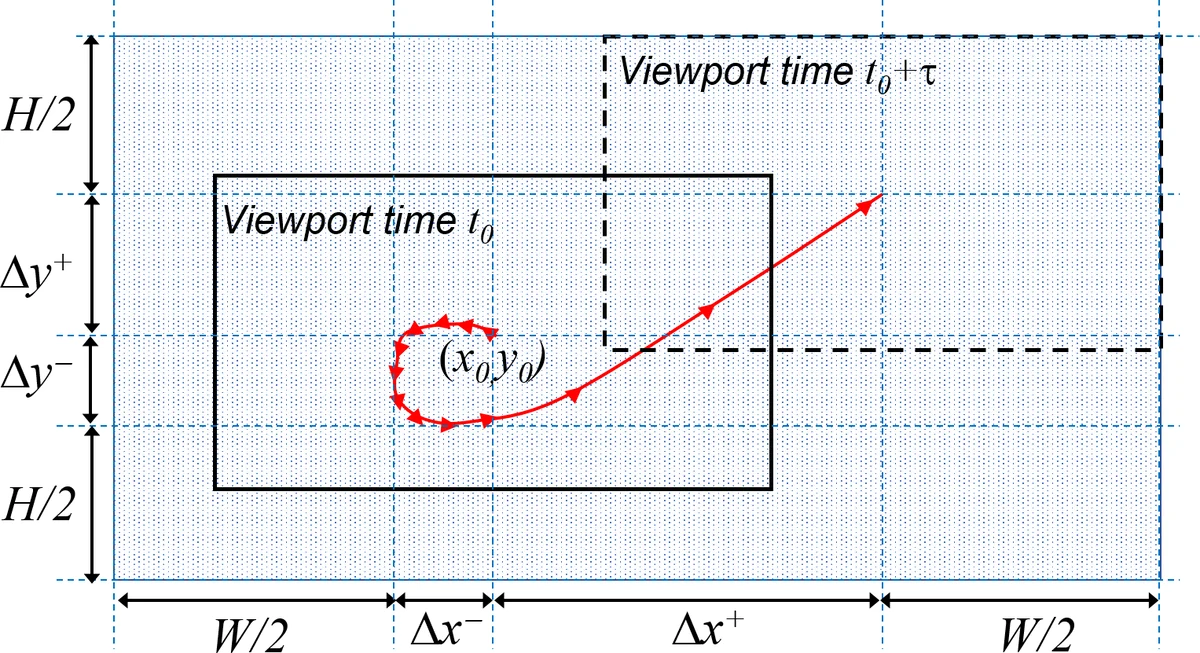
The demand and usage of 360$^{\circ}$ video services are expected to increase. However, despite these services being highly bandwidth intensive, not much is known about the potential value that basic bandwidth saving techniques such as server or edge-network on-demand caching (e.g., in a CDN) could have when used for delivery of such services. This problem is both important and complicated as client-side solutions have been developed that split the full 360$^{\circ}$ view into multiple tiles, and adapt the quality of the downloaded tiles based on the user’s expected viewing direction and bandwidth conditions. This paper presents new trace-based analysis methods that incorporate users’ viewports (the area of the full 360$^{\circ}$ view the user actually sees), a first characterization of the cross-user similarities of the users’ viewports, and a trace-based analysis of the potential bandwidth savings that caching-based techniques may offer under different conditions. Our analysis takes into account differences in the time granularity over which viewport overlaps can be beneficial for resource saving techniques, compares and contrasts differences between video categories, and accounts for uncertainties in the network conditions and the prediction of the future viewing direction when prefetching. The results provide substantial insight into the conditions under which overlap can be considerable and caching effective, and inform the design of new caching system policies tailored for 360$^{\circ}$ video.
💡 Research Summary
The paper investigates how much bandwidth can be saved in 360° video delivery by exploiting cross‑user similarities in viewports and by using edge or CDN caching of tiled video segments. While prior work has focused on client‑side techniques—splitting a 360° video into spatial tiles, predicting the user’s future viewing direction, and adapting tile quality to current bandwidth—the impact of these tiling and prefetching strategies on server‑side caching has not been studied.
To fill this gap, the authors conduct a three‑part trace‑based analysis using a publicly available head‑movement dataset collected from 32 participants watching 30 different 360° videos (totaling over 21 hours of viewing). The videos are pre‑classified into five semantic categories: Explore (free exploration), Static (fixed point of interest), Moving (object of interest moves across the sphere), Rides (high‑speed forward motion), and Miscellaneous. The dataset provides yaw and pitch angles at 10 ms granularity, which the authors interpolate to a 50 ms sampling interval for analysis.
Part 1 – Viewport similarity metrics.
The authors define basic similarity measures: (i) pairwise angular difference between two users’ view directions at the same playback instant, and (ii) the average of these differences over an entire session pair. Cumulative distribution functions (CDFs) show that Explore videos exhibit near‑independent viewing directions (80 % of instantaneous differences exceed 45°), whereas the other categories have much tighter clustering—80 % of differences are below 45°. When averaging over a whole session, Static, Moving, and Ride videos still show substantially lower angular dispersion than Explore, confirming that many users tend to look at the same region of the sphere for a large portion of the playback.
Part 2 – Chunk‑level aggregation.
Adaptive streaming with HTTP‑based Adaptive Streaming (HAS) typically uses chunks of 2–5 seconds. The authors extend the similarity analysis to this granularity by aggregating viewport angles over each chunk and measuring the overlap between two users’ aggregated viewports. Even if instantaneous viewports differ, the aggregated viewports may overlap, allowing both users to request the same set of tiles. Results indicate that longer chunks increase the probability of overlap for Static and Moving categories, while for Ride videos the fast camera motion reduces overlap as chunk length grows. This demonstrates that the choice of chunk duration directly influences the potential cache hit rate.
Part 3 – Cache performance simulation.
A novel steady‑state simulation framework is built to evaluate cache hit rates under realistic network conditions while re‑using a limited set of traces. The simulator models a proxy cache (e.g., an edge node in a CDN) that stores previously requested tiles at various quality levels. It varies three key parameters: (a) network bandwidth distributions (different means and variances), (b) prediction error of future view direction (0°, 5°, 10°), and (c) tile‑quality selection policies (fixed quality vs. adaptive quality based on bandwidth).
Findings:
- Cache hit rates are strongly correlated with viewport overlap measured in Parts 1 and 2. Static videos achieve hit rates above 70 % under stable bandwidth and accurate prediction, while Explore videos rarely exceed 30 %.
- Accurate view‑direction prediction dramatically improves cache performance; a 5° error reduces hit rates by roughly 10–15 % compared to perfect prediction, and a 10° error degrades them further.
- Bandwidth volatility hurts hit rates, but adaptive quality selection can recover about 10 % of the lost hits by allowing lower‑quality tiles to be cached and reused.
- The benefit of caching is highest after the initial “exploratory phase” (≈20–30 seconds) of Static videos, where users converge on a common focus point.
Design implications.
- Category‑aware caching: Edge caches should weight tile insertion decisions by video category and by chunk position (early exploratory vs. later focused phases).
- Leveraging prior viewports: For categories with high convergence (Static, Moving), using the aggregate viewports of previous users as a prediction baseline yields substantial gains; for Explore videos, such reuse is less effective.
- Network‑stabilization synergy: Techniques that smooth client‑side bandwidth (e.g., CAP‑based throttling) can indirectly improve cache efficiency by reducing the need for frequent quality switches.
The paper concludes that cross‑user viewport similarity is a decisive factor for the effectiveness of caching in tiled 360° video delivery. By quantifying how similarity varies across content categories, chunk granularities, and network conditions, the authors provide concrete guidance for designing CDN/edge caching policies that are tailored to 360° video workloads. Future work is suggested in integrating machine‑learning based viewport prediction with real‑time cache admission control, and in extending the analysis to live 360° streaming scenarios.
Comments & Academic Discussion
Loading comments...
Leave a Comment