DeepHAM: A Global Solution Method for Heterogeneous Agent Models with Aggregate Shocks
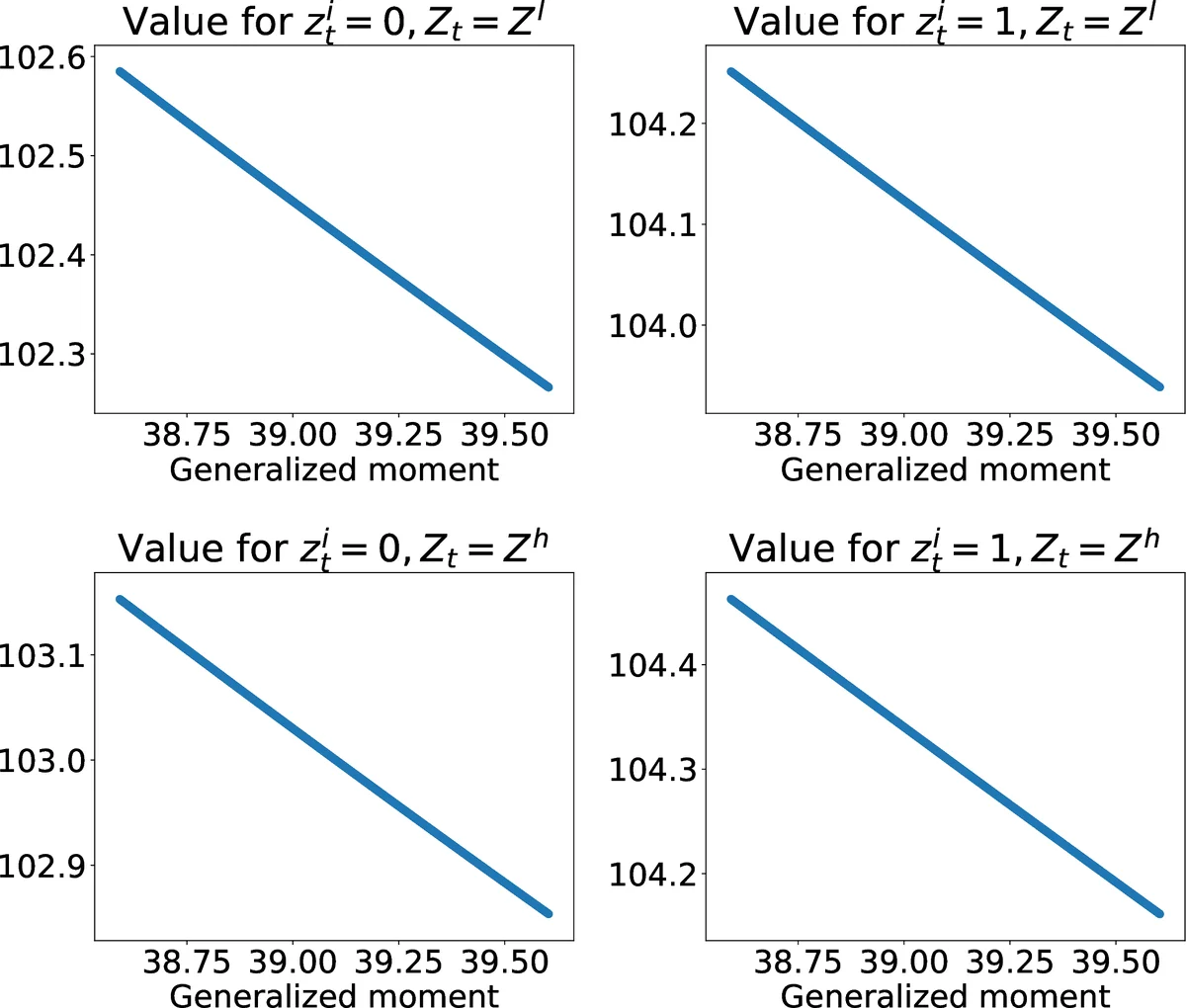
An efficient, reliable, and interpretable global solution method, the Deep learning-based algorithm for Heterogeneous Agent Models (DeepHAM), is proposed for solving high dimensional heterogeneous agent models with aggregate shocks. The state distribution is approximately represented by a set of optimal generalized moments. Deep neural networks are used to approximate the value and policy functions, and the objective is optimized over directly simulated paths. In addition to being an accurate global solver, this method has three additional features. First, it is computationally efficient in solving complex heterogeneous agent models, and it does not suffer from the curse of dimensionality. Second, it provides a general and interpretable representation of the distribution over individual states, which is crucial in addressing the classical question of whether and how heterogeneity matters in macroeconomics. Third, it solves the constrained efficiency problem as easily as it solves the competitive equilibrium, which opens up new possibilities for studying optimal monetary and fiscal policies in heterogeneous agent models with aggregate shocks.
💡 Research Summary
The paper introduces DeepHAM, a deep‑learning‑based global solution method for heterogeneous agent (HA) models with aggregate shocks. Traditional approaches—Krusell‑Smith (KS) and local perturbation—each satisfy only a subset of the desiderata for HA models: computational efficiency, reliability beyond local linear approximations, interpretability of the distribution of agents, and generality across model specifications. KS approximates the distribution with a few moments (typically the mean) and works well for simple models but suffers from the curse of dimensionality as the number of shocks or endogenous states grows. Local perturbation can handle complex models but fails when aggregate shocks generate strong non‑linear or non‑local effects (e.g., zero lower bound, large shocks, risky steady states).
DeepHAM addresses these limitations by (1) representing the state distribution with a set of “generalized moments” that are learned end‑to‑end by neural networks, and (2) approximating the agents’ value and policy functions with deep neural networks (DNNs). The generalized moments are permutation‑invariant functions of the unordered set of individual states; they automatically extract the most relevant information for aggregate dynamics and welfare, while remaining interpretable (they can be viewed as data‑driven sufficient statistics). Because they compress the high‑dimensional distribution into a low‑dimensional vector, the method avoids the curse of dimensionality while preserving the ability to capture distributional effects beyond the mean.
The algorithm proceeds iteratively: (i) simulate a large number of paths for the economy given current DNN parameters and generalized moments, (ii) compute a loss that combines Bellman residuals and any equilibrium constraints (including the constrained‑efficiency conditions), (iii) update both the DNN weights and the parameters defining the generalized moments via stochastic gradient descent. Unlike recent works that require accurate approximations of value‑function derivatives, DeepHAM directly minimizes the residuals on simulated paths, sidestepping the need for higher‑order derivative estimation.
Empirically, the authors benchmark DeepHAM on the classic Krusell‑Smith model. Using only the first generalized moment (the mean) reduces the Bellman error by 37.5 % relative to KS; adding a second learned moment cuts the error by 54.2 %. This demonstrates that a small number of learned moments can capture distributional information more efficiently than the ad‑hoc moment selection in KS. The method also scales to models with multiple endogenous states (e.g., housing, mortgage choices), multiple shocks (e.g., COVID‑19 shock), and a financial sector à la Brunnermeier‑Sannikov, all without a noticeable increase in computational cost.
A particularly novel contribution is the seamless extension of DeepHAM to the constrained‑efficiency problem. By incorporating the planner’s resource constraints into the same loss function, the algorithm solves for the socially optimal allocation in the same framework used for the competitive equilibrium. This opens the door to quantitative studies of optimal monetary and fiscal policy in HA settings with aggregate uncertainty—an area previously limited by computational tractability.
The paper situates its contribution within three strands of literature: (i) the traditional HA‑with‑aggregate‑shocks literature (KS, perturbation), (ii) recent machine‑learning approaches to high‑dimensional dynamic programming (Han & E, Maliar et al., Azinovic et al.), and (iii) the emerging use of deep learning for macro‑economic policy analysis. Compared with Maliar et al. (2021) and Azinovic et al. (2022), DeepHAM differs by (a) introducing permutation‑invariant generalized moments for distribution representation, (b) optimizing directly on simulated path residuals rather than a weighted sum of Bellman errors and first‑order conditions, and (c) being the first to solve constrained‑efficiency problems in HA models with aggregate shocks using machine learning.
In conclusion, DeepHAM delivers four key advantages: (1) computational efficiency that scales to high‑dimensional HA models, (2) global accuracy that captures non‑linear aggregate‑shock effects, (3) an interpretable, low‑dimensional representation of the agent distribution, and (4) a unified framework for solving both competitive equilibria and constrained‑efficiency allocations. The authors argue that these properties make DeepHAM a powerful tool for future research on heterogeneous agents, asset pricing, wealth inequality, and optimal macro‑policy in environments where heterogeneity and aggregate uncertainty interact in complex ways.
Comments & Academic Discussion
Loading comments...
Leave a Comment