Pathwidth and nonrepetitive list coloring
A vertex coloring of a graph is nonrepetitive if there is no path in the graph whose first half receives the same sequence of colors as the second half. While every tree can be nonrepetitively colored with a bounded number of colors (4 colors is enough), Fiorenzi, Ochem, Ossona de Mendez, and Zhu recently showed that this does not extend to the list version of the problem, that is, for every $\ell \geq 1$ there is a tree that is not nonrepetitively $\ell$-choosable. In this paper we prove the following positive result, which complements the result of Fiorenzi et al.: There exists a function $f$ such that every tree of pathwidth $k$ is nonrepetitively $f(k)$-choosable. We also show that such a property is specific to trees by constructing a family of pathwidth-2 graphs that are not nonrepetitively $\ell$-choosable for any fixed $\ell$.
💡 Research Summary
The paper investigates the list version of non‑repetitive vertex coloring, also known as the Thue choice number πₗ(G). A coloring is non‑repetitive if no path in the graph contains a sequence of colors that repeats consecutively (i.e., a block of the form x₁…x_r x₁…x_r). While it is known that every tree admits a non‑repetitive coloring with at most four colors, Fiorenzi, Ochem, Ossona de Mendez, and Zhu showed that the list version behaves very differently: for any fixed integer ℓ≥1 there exist trees that are not ℓ‑choosable in the non‑repetitive sense. This raises the natural question whether additional structural restrictions on trees can bound the Thue choice number.
The authors answer this by focusing on pathwidth, a graph parameter measuring how “linear” a graph is. They prove two complementary results.
Theorem 1 (negative result for bounded pathwidth graphs).
For every ℓ>1 there exists a graph G of pathwidth 2 such that πₗ(G)>ℓ. The construction Gₙ,ℓ starts from a path on 2n vertices; every even‑indexed vertex is “blown up’’ into an independent set of ℓ n vertices. The resulting graph has pathwidth exactly 2. The authors assign lists as follows: odd‑indexed vertices receive pairwise disjoint ℓ‑element lists that together form the set {1,…,ℓ n}; even‑indexed vertices receive all ℓ‑subsets of {1,…,ℓ n} in some order. By a careful counting argument involving “witnesses’’ (pairs of vertices that would force a repetition on a certain interval) they show that if n>e^{ℓ}+2 then any coloring respecting the lists inevitably creates a repeated block, contradicting non‑repetitiveness. Hence the Thue choice number is unbounded even for graphs of pathwidth 2, which is the smallest possible bound given that pathwidth 1 graphs (caterpillars) are known to be ℓ‑choosable for ℓ=4.
Theorem 2 (positive result for trees of bounded pathwidth).
There exists a function b:ℕ→ℕ such that every tree T of pathwidth k satisfies πₗ(T) ≤ b(k). The proof proceeds in two stages.
-
Path‑partition of a tree.
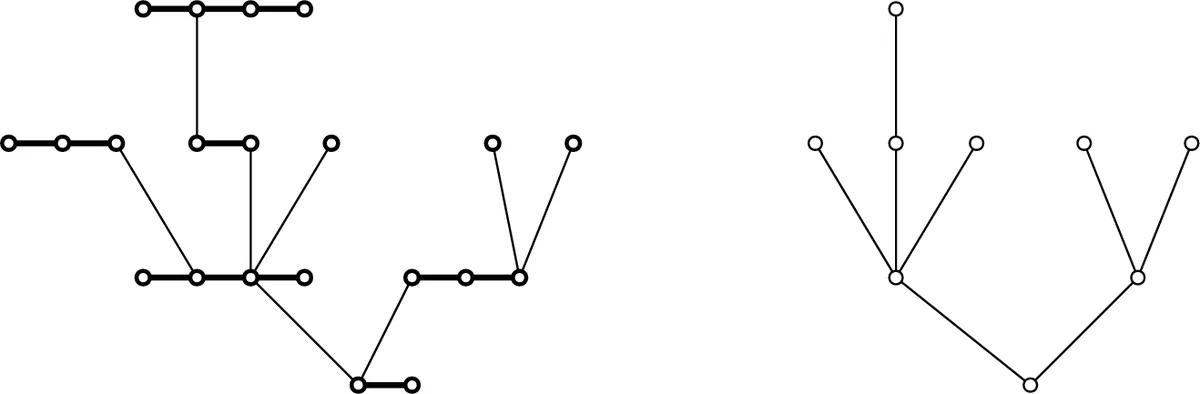
Lemma 4 shows that any tree of pathwidth k admits a path‑partition of height at most 2k. A path‑partition consists of a rooted auxiliary tree whose nodes correspond to vertex‑disjoint horizontal paths in the original tree; edges of the auxiliary tree indicate adjacency between the corresponding paths. The authors construct such a partition by induction on k, using a path decomposition of width k and carefully stitching together the pieces while preserving the height bound. -
Algorithmic non‑repetitive list coloring.
With a path‑partition of height h≤2k, the tree can be embedded in the plane so that each horizontal path lies on a distinct “level”. The authors then apply a randomized algorithm inspired by the Moser–Tardos constructive proof of the Lovász Local Lemma. The algorithm processes the levels from bottom to top, assigning colors from the given lists. Whenever a newly created color sequence would create a repetition (i.e., a block x₁…x_r x₁…x_r), the algorithm “resamples’’ the colors on the offending block, effectively rewinding and trying again. Because the dependency graph of bad events (the possible repetitions) has bounded degree that depends only on the pathwidth, the LLL guarantees that the resampling process terminates with positive probability. A careful analysis yields an explicit bound on the required list size: the function b(k) obtained is doubly exponential in k (roughly 2^{2^{O(k)}}). The authors note that this bound is far from optimal and stems from the crude estimates in the LLL application.
Together, these results delineate the landscape of non‑repetitive list coloring with respect to pathwidth. While bounded pathwidth alone does not guarantee a bounded Thue choice number for arbitrary graphs (Theorem 1), it does for trees (Theorem 2). The paper thus identifies a structural property—being a tree of bounded pathwidth—that restores the positive behavior observed for ordinary non‑repetitive coloring, and it highlights the delicate interplay between graph topology and list‑coloring constraints. The techniques blend combinatorial constructions, tree‑decomposition theory, and algorithmic applications of the Lovász Local Lemma, offering a framework that may be refined in future work to improve the quantitative bounds or to extend to broader graph classes.
Comments & Academic Discussion
Loading comments...
Leave a Comment