Spectral Proper Orthogonal Decomposition using Multitaper Estimates
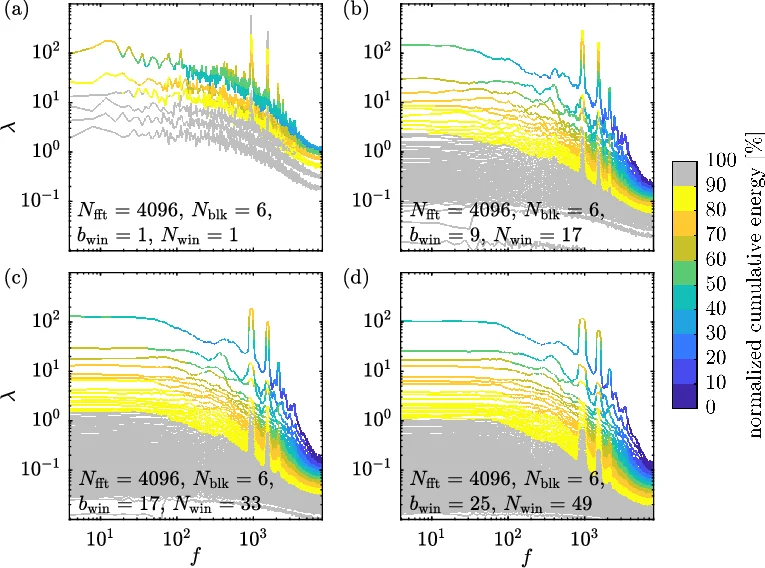
The use of multitaper estimates for spectral proper orthogonal decomposition (SPOD) is explored. Multitaper and multitaper-Welch estimators that use discrete prolate spheroidal sequences (DPSS) as orthogonal data windows are compared to the standard SPOD algorithm that exclusively relies on weighted overlapped segment averaging, or Welch’s method, to estimate the cross-spectral density matrix. Two sets of turbulent flow data, one experimental and the other numerical, are used to discuss the choice of resolution bandwidth and the bias-variance tradeoff. Multitaper-Welch estimators that combine both approaches by applying orthogonal tapers to overlapping segments allow for flexible control of resolution, variance, and bias. At additional computational cost but for the same data, Multitaper-Welch estimators provide lower variance estimates at fixed frequency resolution or higher frequency resolution at similar variance compared to the standard algorithm.
💡 Research Summary
This paper investigates the use of multitaper spectral estimation techniques within the framework of Spectral Proper Orthogonal Decomposition (SPOD). SPOD is a frequency‑domain variant of Proper Orthogonal Decomposition that extracts orthogonal modes and associated energy spectra from stationary, multivariate time‑series data by solving a weighted eigenvalue problem for the cross‑spectral density (CSD) matrix. The conventional SPOD implementation relies on Welch’s method: the data are divided into overlapping blocks, each block is windowed (typically with a Hamming window), and the resulting Fourier transforms are averaged to form the CSD estimate. While Welch’s method is asymptotically unbiased, the choice of block length (N_fft), overlap, and window shape imposes a fixed trade‑off between frequency resolution, variance, and bias.
Multitaper (MT) estimation, originally introduced by Thomson, replaces the single window with a set of orthogonal Discrete Prolate Spheroidal Sequences (DPSS, also known as Slepian functions). DPSS are optimal in the sense that, for a given time‑half‑bandwidth product b_win = δf·N, the first N_win ≈ 2b_win–1 tapers concentrate most of their spectral energy inside the target band
Comments & Academic Discussion
Loading comments...
Leave a Comment