Evolutionary Hierarchical Harvest Schedule Optimization for Food Waste Prevention
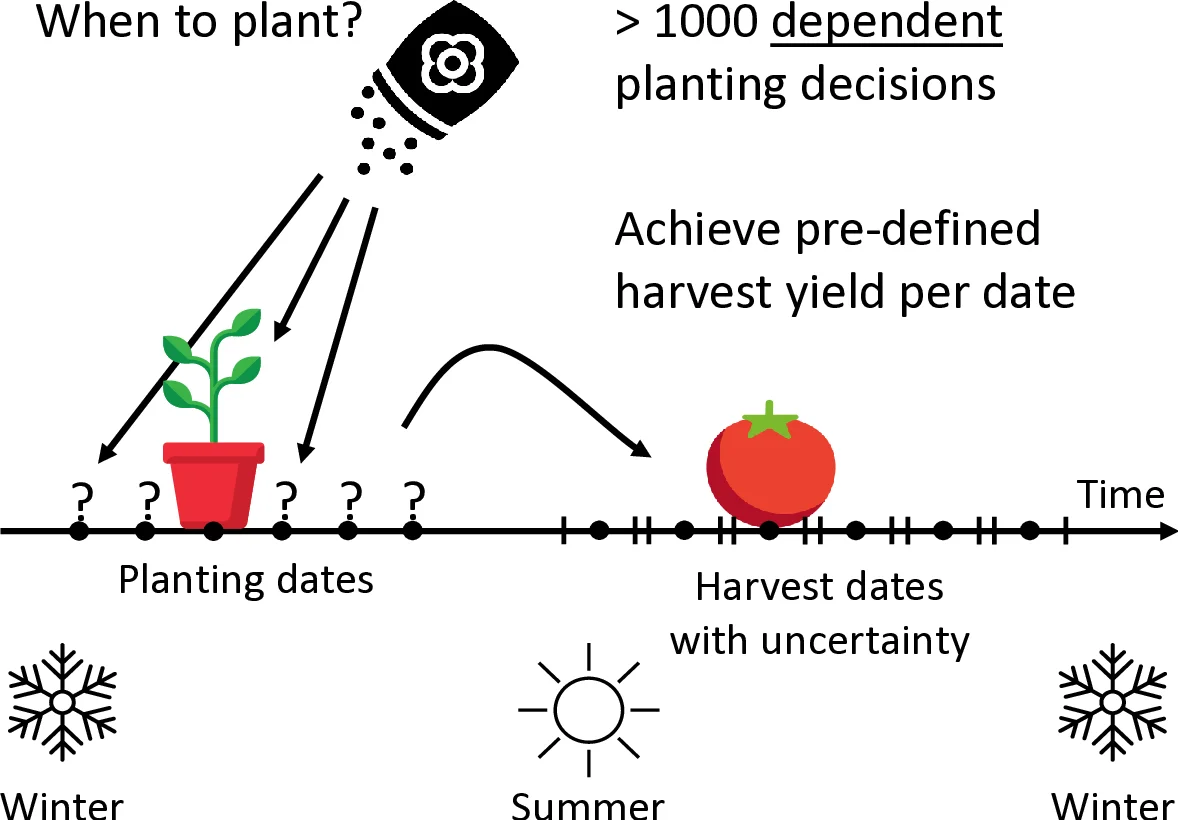
In order to avoid disadvantages of monocropping for soil and environment, it is advisable to practice intercropping of various plant species whenever possible. However, intercropping is challenging as it requires a balanced planting schedule due to individual cultivation time frames. Maintaining a continuous harvest reduces logistical costs and related greenhouse gas emissions, and contributes to food waste prevention. In this work, we address these issues and propose an optimization method for a full harvest season of large crop ensembles that complies with given constraints. By using an approach based on an evolutionary algorithm combined with a novel hierarchical loss function and adaptive mutation rate, we transfer the multi-objective into a pseudo-single-objective optimization problem and obtain faster convergence and better solutions than for conventional approaches.
💡 Research Summary
The paper tackles the pressing problem of food waste and greenhouse‑gas emissions caused by inefficient harvest scheduling in large‑scale intercropping systems. The authors formalize the harvest‑schedule optimization problem for more than a thousand crop species, each with its own planting window, required Growing Degree Unit (GDU) accumulation, and desired yield. By pre‑computing a harvest matrix that maps every feasible planting date to its corresponding harvest date (using a GDU accumulation model based on Gaussian Process Regression), the evaluation of a candidate schedule becomes a simple matrix lookup, dramatically speeding up fitness calculations.
To convert the inherently multi‑objective nature of the problem (minimizing both over‑capacity “overshoot” and under‑capacity “undershoot”) into a single‑objective framework, the authors introduce a hierarchical loss function. The loss vector L = (L⁺, L⁻) separates harvest quantities above the target capacity C_target (L⁺) from those below it (L⁻). L⁺ is a convex penalty that strongly discourages overshoot, while L⁻ is a concave penalty that pushes low‑yield weeks toward either full capacity or zero harvest. By giving strict priority to L⁺, the hierarchy encodes a policy preference: prevent food waste first, then reduce logistical emissions.
The optimization engine is a (1 + 1) Evolution Strategy (ES). The key novelty is an adaptive, oscillating mutation rate defined as
ρ(j) = (1/|S|) ·
Comments & Academic Discussion
Loading comments...
Leave a Comment