The emergence of burstiness in temporal networks
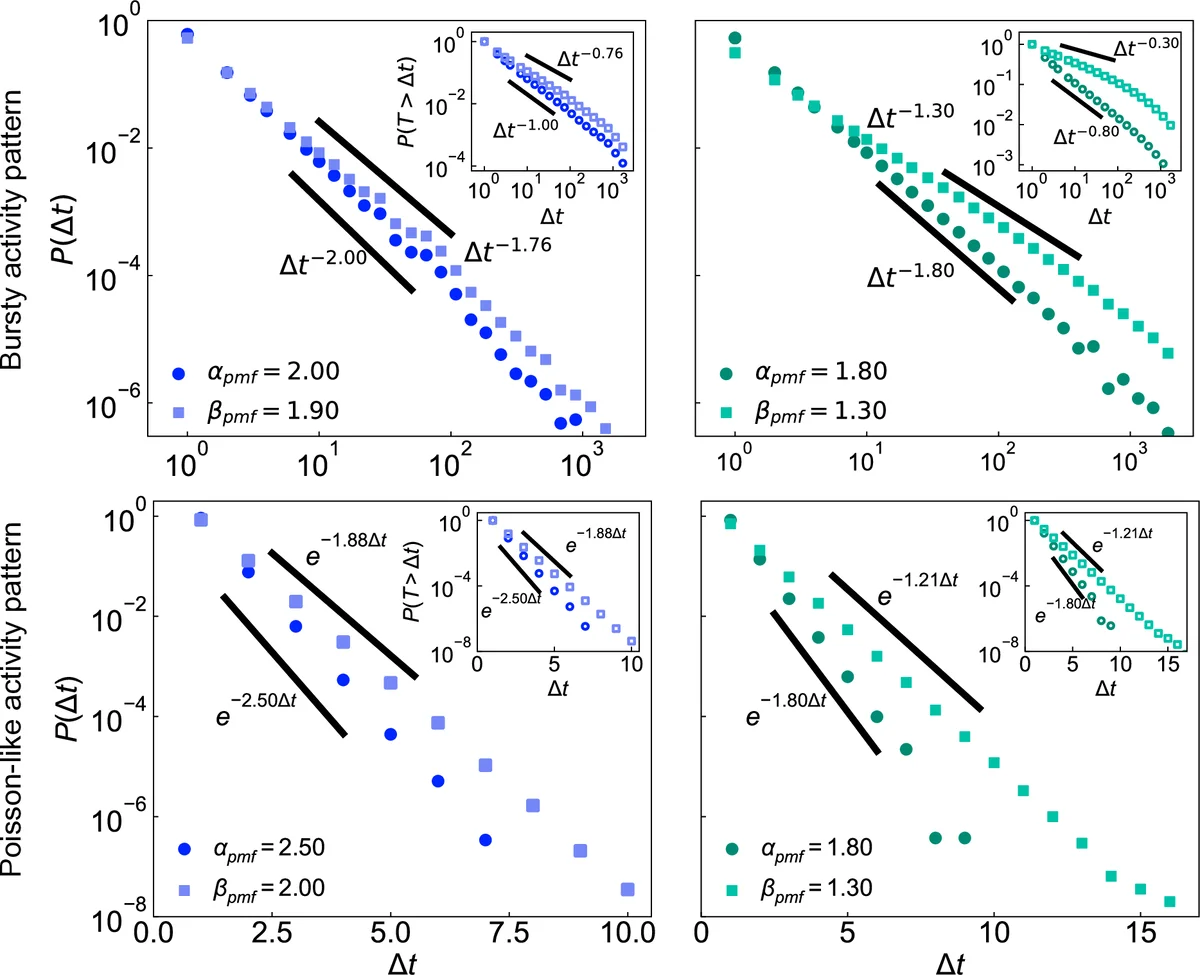
Human social interactions tend to vary in intensity over time, whether they are in person or online. Variable rates of interaction in structured populations can be described by networks with the time-varying activity of links and nodes. One of the key statistics to summarize temporal patterns is the inter-event time (IET), namely the duration between successive pairwise interactions. Empirical studies have found IET distributions that are heavy-tailed (or"bursty"), for temporally varying interaction, both physical and digital. But it is difficult to construct theoretical models of time-varying activity on a network that reproduces the burstiness seen in empirical data. Here we develop a spanning-tree method to construct temporal networks and activity patterns with bursty behavior. Our method ensures a desired target IET distribution of single nodes/links, provided the distribution fulfills a consistency condition, regardless of whether the underlying topology is static or time-varying. We show that this model can reproduce burstiness found in empirical datasets, and so it may serve as a basis for studying dynamic processes in real-world bursty interactions.
💡 Research Summary
The paper addresses a central challenge in modeling temporal networks: reproducing the heavy‑tailed, bursty inter‑event time (IET) distributions observed in empirical human interaction data. Existing synthetic models either apply dynamics on static topologies or generate contact streams based on heuristic mechanisms, but they typically fail to match the level of burstiness seen in real datasets and lack rigorous guarantees about the resulting temporal patterns.
The authors introduce a spanning‑tree construction method that can generate temporal networks with prescribed IET distributions for both nodes and edges, provided the target distributions satisfy a simple consistency condition. The method proceeds in three hierarchical steps.
- Two‑node system – The basic unit consists of two nodes (x, y) and the link (z) connecting them. Each entity follows a binary renewal process with a given target IET distribution (F for x, G for y, H for z). The link is defined to be active only when both incident nodes are active (zₙ = xₙ·yₙ). At each discrete time step the algorithm computes four conditional probabilities (p₁…p₄) derived from the renewal processes. These probabilities represent the chances that (i) the link is active, (ii) node x is active while the link is inactive, (iii) node y is active while the link is inactive, and (iv) both nodes are inactive. The consistency condition requires all pᵢ to lie in
Comments & Academic Discussion
Loading comments...
Leave a Comment