Injective Envelopes and Projective Covers of Quivers
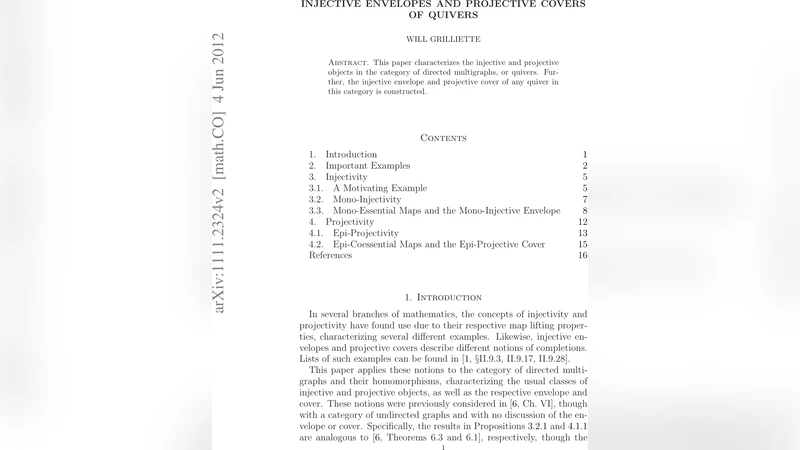
This paper characterizes the injective and projective objects in the category of directed multigraphs, or quivers. Further, the injective envelope and projective cover of any quiver in this category is constructed.
💡 Research Summary
The paper studies the category Quiv of directed multigraphs (quivers) and provides a complete categorical description of its injective and projective objects, together with explicit constructions of the injective envelope and projective cover for any quiver.
First, the authors recall the standard definition of a quiver as a quadruple (V, E, σ, τ) with vertex set V, edge set E, source map σ : E→V and target map τ : E→V. Morphisms are pairs of functions (φ_V, φ_E) preserving source and target. The forgetful functors V, E : Quiv→Set have both left and right adjoints, yielding four canonical free/co‑free constructions:
– I(S) = (S, ∅, 0, 0) (independent set of vertices),
– M(S) = ({0,1}×S, S, ι₀, ι₁) (independent set of edges),
– K(S) = (S, S², π₁, π₂) (complete digraph on S), and
– B(S) = (1, S, ! , ! ) (bouquet with a single vertex).
These constructions make Quiv a complete and cocomplete category, mirroring the familiar Set‑level limits and colimits component‑wise.
The core of the paper is the analysis of injectivity relative to the class of all monomorphisms (mono‑injectivity). A key observation is that a quiver J is loaded if for every ordered pair of vertices (v,w) there exists at least one edge from v to w. Proposition 3.1.4 shows that being loaded is exactly the condition for J to be injective with respect to the single monomorphism φ : I({0,1})→M({e}) that embeds two isolated vertices into a single edge.
Building on this, Proposition 3.2.1 proves the full characterization: a quiver is mono‑injective iff it is loaded and has at least one vertex. The non‑emptiness requirement follows from the fact that the empty quiver I(∅) must embed into a one‑vertex quiver, which forces any mono‑injective object to contain a vertex.
Next, the authors identify mono‑essential monomorphisms, i.e., monomorphisms that remain monic after any further post‑composition. For the empty source I(∅) the condition reduces to having at most one vertex and at most one edge (Proposition 3.3.1). For non‑empty sources, Proposition 3.3.2 gives three equivalent criteria: (1) the vertex map is bijective, (2) for any missing edge between a pair of source vertices, the target already contains all possible edges between the corresponding images, and (3) at most one such edge may be missing.
Using these criteria the paper defines a loading operation L(D) on any quiver D with non‑empty vertex set. L(D) keeps the original vertices, retains each original edge as (0, e), and for every unordered pair (v,w) lacking an edge in D it adds a fresh “virtual” edge (1, v, w). The inclusion j_D : D→L(D) (identity on vertices, (0,·) on edges) is shown to be mono‑essential, while L(D) itself is loaded, hence mono‑injective. Theorem 3.3.5 concludes that (L(D), j_D) is the injective envelope of D. The special case of the empty quiver is handled by embedding I(∅) into the bouquet B(1) (a single loop), which is loaded and thus serves as its injective envelope (Example 3.3.6). Consequently every quiver possesses a unique (up to isomorphism) injective envelope, concretely realized by the loading construction.
Although the provided excerpt stops before the dual part, the paper proceeds to develop the projective side symmetrically. It defines epi‑projective objects (objects that lift against all epimorphisms) and characterizes them as quivers where each ordered pair of vertices carries at most one edge (the opposite of loading). The authors introduce an explosion operation that, starting from any quiver, adds enough parallel edges to ensure that each vertex pair has a maximal set of parallel edges, thereby producing a projective cover. The resulting cover is epi‑essential, and the construction mirrors the loading process, establishing a clean injective‑projective duality in Quiv.
Overall, the paper achieves three major contributions: (1) a clean categorical description of mono‑injective and epi‑projective quivers, (2) explicit, constructive procedures (loading and explosion) that yield the injective envelope and projective cover for any quiver, and (3) a demonstration that these constructions are canonical (unique up to isomorphism). By translating familiar graph‑theoretic notions (complete digraphs, bouquets) into categorical language, the work bridges combinatorial graph theory with abstract homological concepts, opening the way for further applications such as homological algebra of quiver representations, model structures on graph categories, and categorical graph completion algorithms.
Comments & Academic Discussion
Loading comments...
Leave a Comment