Convolution symmetries of integrable hierarchies, matrix models and tau-functions
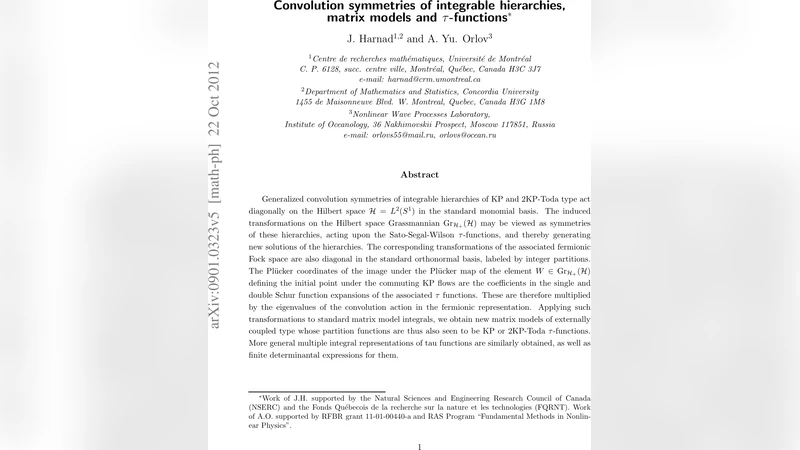
Generalized convolution symmetries of integrable hierarchies of KP and 2KP-Toda type multiply the Fourier coefficients of the elements of the Hilbert space $\HH= L^2(S^1)$ by a specified sequence of constants. This induces a corresponding transformation on the Hilbert space Grassmannian $\Gr_{\HH_+}(\HH)$ and hence on the Sato-Segal-Wilson \tau-functions determining solutions to the KP and 2-Toda hierarchies. The corresponding action on the associated fermionic Fock space is also diagonal in the standard orthonormal base determined by occupation sites and labeled by partitions. The Pl"ucker coordinates of the element element $W \in \Gr_{\HH_+}(\HH)$ defining the initial point of these commuting flows are the coefficients in the single and double Schur function of the associated \tau function, and are therefore multiplied by the corresponding diagonal factors under this action. Applying such transformations to matrix integrals, we obtain new matrix models of externally coupled type that are hence also KP or 2KP-Toda \tau-functions. More general multiple integral representations of \tau functions are similarly obtained, as well as finite determinantal expressions for them.
💡 Research Summary
The paper introduces a novel class of symmetry transformations—generalized convolution symmetries—acting on the Hilbert space (\mathcal H = L^{2}(S^{1})). For a prescribed sequence of complex numbers ({r_{n}}{n\in\mathbb Z}) the operator (\mathcal C{r}) multiplies each Fourier coefficient of a function by the corresponding (r_{n}). When (\mathcal C_{r}) preserves the standard splitting (\mathcal H = \mathcal H_{+}\oplus\mathcal H_{-}), it induces a well‑defined map on the Sato‑Segal‑Wilson Grassmannian (\operatorname{Gr}{\mathcal H{+}}(\mathcal H)). Consequently, a point (W) of the Grassmannian, which encodes a solution of the KP or 2‑KP‑Toda hierarchy, is sent to a new point (W^{(r)} = \mathcal C_{r}W).
In the fermionic picture the transformation is represented by a diagonal operator (g_{r}) acting on the standard basis ({|\lambda\rangle}) labelled by partitions. The eigenvalue of (g_{r}) on (|\lambda\rangle) is the product of the (r)-factors over all cells of the Young diagram, i.e. (\prod_{(i,j)\in\lambda} r_{j-i}). This directly modifies the Plücker coordinates of (W), which are precisely the coefficients (c_{\lambda}) in the Schur‑function expansion of the associated (\tau)-function. Under the convolution symmetry the new coefficients become (c_{\lambda}^{(r)} = c_{\lambda}\prod_{(i,j)\in\lambda} r_{j-i}). Hence the whole hierarchy of KP or 2‑KP‑Toda (\tau)-functions is closed under this diagonal action.
The authors exploit this structure to generate new matrix‑model representations. Starting from a standard unitary matrix integral (e.g., the Harish‑Chandra–Itzykson–Zuber integral) they insert the diagonal weight (\prod_{i=1}^{N} r_{i}) and obtain an externally coupled matrix model whose partition function is exactly the transformed (\tau)-function (\tau^{(r)}). This partition function admits a finite determinant expression, reflecting the underlying Grassmannian geometry.
More generally, the paper derives multiple‑integral formulas of the form
\
Comments & Academic Discussion
Loading comments...
Leave a Comment