TSO-DSOs Stable Cost Allocation for the Joint Procurement of Flexibility: A Cooperative Game Approach
💡 Research Summary
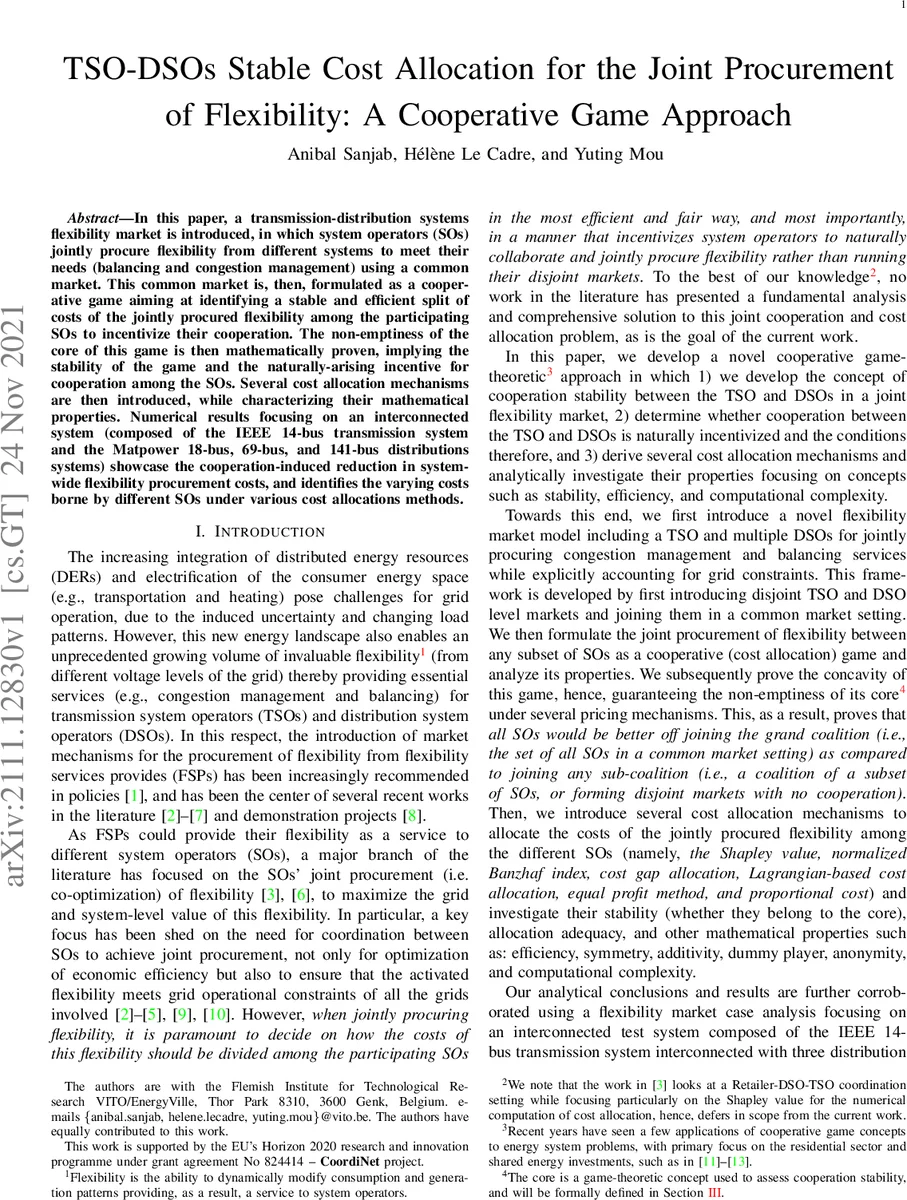
The paper introduces a novel flexibility market that brings together the transmission system operator (TSO) and multiple distribution system operators (DSOs) to jointly procure flexibility resources for balancing and congestion management. Unlike traditional approaches where TSO and DSOs operate separate markets, the authors formulate a common market in which bids from both transmission‑level and distribution‑level resources are pooled and cleared simultaneously.
The authors first describe the separate transmission‑level and distribution‑level market models as linear programs (LPs) that minimize the cost of upward/downward generation and demand adjustments while respecting power‑flow, line‑loading, voltage, and bid‑limit constraints. These models are then merged into a compact LP representing the common market. In this unified formulation, the interface power exchange between each DSO and the transmission grid (Tp) becomes a decision variable, enabling true coordination between the two layers.
To assess the incentives for cooperation, the authors cast the joint procurement problem as a cooperative cost‑allocation game. Each player (the TSO or an individual DSO) can form any coalition S⊆N, and the value v(S) is defined as the minimum total cost obtained by solving the common‑market LP restricted to the members of S. The authors prove that v(·) is a convex (sub‑modular) function, which guarantees that the core of the game is non‑empty. Consequently, every player has a rational incentive to join the grand coalition (the set of all SOs) because the total cost in the grand coalition is lower than in any sub‑coalition.
Six cost‑allocation mechanisms are proposed and analytically examined:
- Shapley value – averages marginal contributions over all permutations; satisfies efficiency, symmetry, and fairness but has exponential computational complexity.
- Normalized Banzhaf index – scales each player’s marginal contribution by the total; computationally simple but core membership depends on the specific game instance.
- Cost‑gap allocation – distributes the difference between the grand‑coalition cost and each player’s stand‑alone cost; intuitive and can belong to the core.
- Lagrangian‑based allocation – uses the optimal dual variables of the LP to attribute cost to constraints and thus to players; highly efficient computationally and provably core‑stable.
- Equal profit method – forces all participants to achieve the same net profit; may lie in the core but can distort actual cost structures.
- Proportional cost allocation – assigns costs proportionally to the amount of flexibility each player provides; the simplest rule but offers limited incentive for cooperation.
For each method the authors evaluate classic game‑theoretic properties (efficiency, symmetry, dummy player, additivity, anonymity) and determine whether the allocation lies within the core. The Lagrangian‑based and cost‑gap allocations are shown to be core‑stable, providing both fairness and stability with modest computational effort.
Numerical experiments are conducted on an integrated test system consisting of the IEEE 14‑bus transmission network coupled with three Matpower distribution networks (18‑bus, 69‑bus, and 141‑bus). Results demonstrate that:
- Joint procurement reduces total flexibility procurement cost by 15 %–30 % compared with operating separate markets.
- The magnitude of interface power flows strongly influences the cost‑saving potential; larger exchanges yield greater benefits from cooperation.
- Different allocation rules lead to markedly different cost burdens for the TSO and each DSO. For example, the Shapley value tends to allocate higher costs to DSOs that are more heavily used for congestion relief, while proportional allocation spreads costs evenly regardless of actual usage.
- The Lagrangian‑based and cost‑gap methods achieve allocations within the core, confirming the theoretical stability results, and they can be computed quickly enough for practical market clearing.
The paper concludes that a cooperative game‑theoretic formulation provides a rigorous foundation for designing joint flexibility markets that are both economically efficient and stable. By offering a suite of allocation mechanisms with clear analytical properties, the work equips regulators and system operators with tools to select a cost‑sharing rule that balances fairness, incentive compatibility, and computational tractability. Future research directions include extending the model to nonlinear AC power flows, incorporating stochastic renewable generation, and exploring multi‑period markets to capture temporal flexibility.
Comments & Academic Discussion
Loading comments...
Leave a Comment