Cluster Synchronization of Coupled Systems with Nonidentical Linear Dynamics
This paper considers the cluster synchronization problem of generic linear dynamical systems whose system models are distinct in different clusters. These nonidentical linear models render control design and coupling conditions highly correlated if s…
Authors: Zhongchang Liu, Wing Shing Wong, Hui Cheng
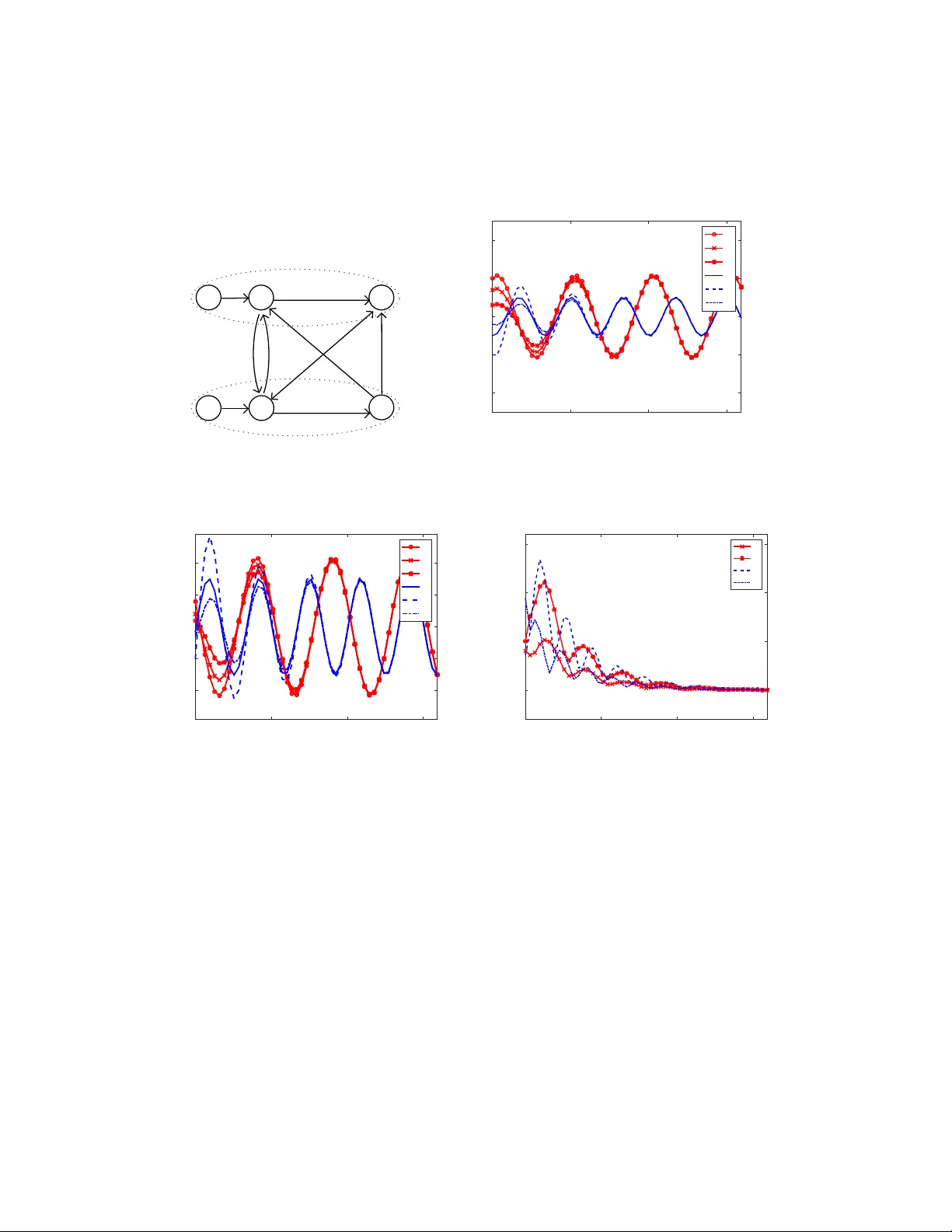
1 Cluster synchronization of coupled systems with nonidentical linear dynamics ‡ Zhongchang Liu 1 , ∗ , † , W ing Shing W ong 2 and Hui Cheng 1 Abstract This paper considers the cluster synchronization problem of generic linear dynamical systems whose system models are distinct in dif ferent clusters. These nonidentical linear models render control design and coupling conditions highly correlated if static couplings are used for all individual systems. In this paper, a dynamic coupling structure, which incorporates a global weighting factor and a vanishing auxiliary control variable, is proposed for each agent and is sho wn to be a feasible solution. Lower bounds on the global and local weighting f actors are deri ved under the condition that ev ery interaction subgraph associated with each cluster admits a directed spanning tree. The spanning tree requirement is further sho wn to be a necessary condition when the clusters connect acyclically with each other . Simulations for two applications, cluster heading alignment of nonidentical ships and cluster phase synchronization of nonidentical harmonic oscillators, illustrate essential parts of the deriv ed theoretical results. Copyright ©2017 John W iley & Sons, Ltd. K ey W ords: cluster synchronization; coupled linear systems; nonidentical systems; graph topology I . I N T RO D U C T I O N Understanding the interaction of coupled indi vidual systems continues to receiv e interest in the engi- neering research community [1]. The problem of complete synchronization or consensus has been studied for more than a decade, e.g., [2]–[6] to name a few . And application areas include synchronization of coupled harmonic oscillators [3], [4], formation flying of spacecrafts [5], time synchronization in wireless sensor networks [7], and ener gy management in a smart grid [8]. Recently , more attention has been drawn to cluster synchronization problems that study multi-group local interactions. This problem requires indi vidual systems belonging to the same cluster to achie ve synchronization while dif ferent clusters can achie ve distinct synchronized states. Since each system can be af fected by systems belonging to external clusters, ho w to achie ve synchronization in each group is a nontrivial e xtension of consensus problems. The cluster synchronization problem also has wide applications, such as segregation of a robotic team [9] or physical particles [10] into small subgroups, predicting opinion dynamics in social networks [11], and cluster phase synchronization of coupled oscillators [12], [13]. In the models reported in most of the literature, the clustering pattern is predefined and fixed; research focuses are on deri ving conditions that can enforce cluster synchronization for various system models [14]–[24]. Preliminary studies in [14]–[17] reported algebraic conditions on the interaction graph for coupled agents with simple integrator dynamics. Subsequently , a cluster -spanning tree condition is used to achiev e intra-cluster synchronization for first-order integrators (discrete time [18] or continuous time [19]), while inter-cluster separations are realized by using nonidentical feed-forward input terms. For more 1 School of Data and Computer Science, Sun Y at-sen University , Guangzhou 510006, P .R. China 2 Department of Information Engineering, The Chinese Univ ersity of Hong K ong, Shatin, N.T ., Hong K ong ∗ Correspondence to: Zhongchang Liu, School of Data and Computer Science, Sun Y at-sen Univ ersity , Guangzhou 510006, P .R. China. † E-mail: zcliu@foxmail.com ‡ This is the accepted version of the following article: [Liu Z, W ong W S, Cheng H. Cluster synchronization of coupled systems with nonidentical linear dynamics. International Journal of Robust and Nonlinear Control, 2017, 27(9): 1462–1479], which has been published in final form at [https://onlinelibrary .wiley .com/doi/10.1002/rnc.3811 ]. This article may be used for non-commercial purposes in accordance with Wile y T erms and Conditions for Use of Self-Archiv ed V ersions. This article may not be enhanced, enriched or otherwise transformed into a deriv ative work, without express permission from Wile y or by statutory rights under applicable legislation. Copyright notices must not be removed, obscured or modified. The article must be linked to Wile y’ s version of record on Wile y Online Library and any embedding, framing or otherwise making av ailable the article or pages thereof by third parties from platforms, services and websites other than Wile y Online Library must be prohibited. 2 complicated system models, e.g., nonlinear systems ( [20]–[22]) and generic linear systems ( [23], [24]), both control designs and inter-agent coupling conditions are responsible for the occurrence of cluster synchronization. For coupled nonlinear systems, e.g., chaotic oscillators, algebraic and graph topological clustering conditions are deri ved for either identical models ( [20]) or nonidentical models ( [21], [22]) under the key assumption that the input matrix of all systems is identical and it can stabilize the system dynamics of all indi vidual agents via linear state feedback (i.e., the so-called QU AD condition). For identical generic linear systems which are partial-state coupled [23], [24], a stabilizing control gain matrix solved from a Ricatti inequality is utilized by all agents, and agents are pinned with some additional agents so that the interaction subgraph of each cluster contains a directed spanning tree. The system models introduced above can describe a rich class of applications for multi-agent systems. A common characteristic is that the uncoupled system dynamics of all the agents can be stabilized by linear state feedback attenuated by a unique matrix (i.e., static state feedback) [23], [24]. This simplification allo ws the deriv ation of coupling conditions to be independent of the control design of an y agent, and thus of fers scalability to a static coupling strategy . This kind of benefit still e xists for nonidentical nonlinear systems ( [21], [22]) which are full-state coupled, since all the system dynamics can be constrained by a common Lipchitz constant (Lipchitz can imply the QU AD condition [25]). Howe ver , for the class of partial-state coupled nonidentical linear systems, the stabilizing matrices for distinct linear system models are usually different. It follo ws that if con ventional static couplings (e.g. those in [23], [24]) are utilized, the required conditions for the interaction graph will be correlated with the control designs of all individual systems, and e ven worse these conditions may nev er be satisfied for some system models (These points will become clear in Remark 3 of the main part). Therefore, new coupling strategies should be designed so as to cope with the nonidentical system parameters. The goal of this paper is to achie ve state cluster synchronization for partial-state coupled nonidentical linear systems, where agents with the same uncoupled dynamics are supposed to synchronize together . This is a problem of practical interest, for instance, maintaining dif ferent formation clusters for different types of interconnected vehicles, pro viding dif ferent synchronization frequencies for different groups of clocks using coupled nonidentical harmonic oscillators, reaching dif ferent consensus v alues for people with dif ferent opinion dynamics, and so on. In order to tackle the issues raised by using the con ventional static couplings, this paper proposes to use couplings with a dynamic structure that incorporates a vanishing auxiliary variable to facilitate interactions among connected agents. W ith the proposed dynamic couplings, an algebraic necessary and sufficient condition is deri ved to check the cluster synchronizability of a nonidentical linear multi-agent system. This newly deri ved algebraic condition is independent of the control design of any agent, and can subsume those published results for integrator systems in [14]–[17] as special cases. Due to the entanglement between nonidentical system matrices and the parameters from the interaction graph, the algebraic condition may not be straightforward to check. Thus, a graph topological interpretation of the algebraic condition is provided which requires that the interaction subgraph associated with each cluster contains a directed spanning tree. This spanning tree condition is further shown to be a necessary condition when the clusters and the inter -cluster links form an ac yclic structure. This conclusion re veals the indispensability of direct links among agents belonging to the same cluster under such special inter-cluster structures, and further strengthens the suf ficiency statement presented initially in [23]. W e also deriv ed lower bounds for the local coupling strengths in different clusters, which are independent of the control designs of any agent thanks to the dynamic coupling structure. Using the commonly used static coupling structures as in [23], [24], these lower bounds may need centralized computation and may ev en hav e no feasible solutions at all. The deri ved results in this paper are illustrated by simulation e xamples for two applications: cluster heading alignment of nonidentical ships and cluster phase synchronization of nonidentical harmonic oscillators. The organization of this paper is as follows: Follo wing this section, the problem formulation is presented in Section II. In Section III, both algebraic and graph topological conditions for cluster synchronization are dev eloped. Applications of this w ork and simulation examples are pro vided in Section IV. Concluding remarks and discussions for future in vestigations follow in Section V. 3 I I . P RO B L E M S T A T E M E N T Consider a multi-agent system consisting of L agents, index ed by I = { 1 , . . . , L } , and N ≤ L clusters. Let C = {C 1 , . . . , C N } be a nontrivial partition of I , that is, S N i =1 C i = I , C i 6 = ∅ , and C i ∩ C j = ∅ , ∀ i 6 = j . W e call each C i a cluster . T wo agents, l and k in I , belong to the same cluster C i if l ∈ C i and k ∈ C i . Agents in the same cluster are described by the same linear dynamic equation: ˙ x l ( t ) = A i x l ( t ) + B i u l ( t ) , l ∈ C i , i = 1 , . . . , N (1) where x l ( t ) ∈ R n with initial v alue, x l (0) , is the state of agent l and u l ( t ) ∈ R m i is the control input; A i ∈ R n × n and B i ∈ R n × m i are constant system matrices which are distinct for different clusters. A. Interaction graph topology and gr aph partitions A directed interaction graph G = ( V , E , A ) is associated with system (1) such that each agent l is regarded as a node v l ∈ V , and a link from agent k to agent l corresponds to a directed edge ( v k , v l ) ∈ E . An agent k is said to be a neighbor of l if and only if ( v k , v l ) ∈ E . The adjacency matrix A = [ a lk ] ∈ R L × L has entries defined by: a lk 6 = 0 if ( v k , v l ) ∈ E , and a lk = 0 otherwise. In addition, let a ll = 0 to av oid self-links. Note that a lk < 0 means that the influence from agent k to agent l is r epulsive , while links with a lk > 0 are cooperative . Define L = [ b lk ] ∈ R L × L as the Laplacian of G , where b ll = P L k =1 a lk and b lk = − a lk for any k 6 = l . Corresponding to the partition C = {C 1 , . . . , C N } , a subgraph G i , i = 1 , . . . , N , of G contains all the nodes with index es in C i , and the edges connecting these nodes. See Figure 1 for an illustration. W ithout loss of generality , we assume that each cluster C i , i = 1 , . . . , N , consists of l i ≥ 1 agents ( P N i =1 l i = L ), such that C 1 = { 1 , . . . , l 1 } , . . . , C i = { σ i + 1 , . . . , σ i + l i } , . . . , C N = { σ N + 1 , . . . , σ N + l N } where σ 1 = 0 and σ i = P i − 1 j =1 l j , 2 ≤ i ≤ N . Then, the Laplacian L of the graph G can be partitioned into the following form: L = L 11 L 12 · · · L 1 N L 21 L 22 · · · L 2 N . . . . . . . . . . . . L N 1 L N 2 · · · L N N , (2) where each L ii ∈ R l i × l i specifies intra-cluster couplings and each L ij ∈ R l i × l j with i 6 = j , specifies inter-cluster influences from cluster C j to C i , i, j = 1 , · · · , N . Note that L ii is not the Laplacian of G i in general. 2 4 -1 -1 1 -1 1 -a a 1 5 6 2 -1 1 -1 1 3 4 c 1 -1 1 1 -1 c 1 c 2 1 3 4 3 2 1 6 5 8 7 4 1 -1 1 c 2 c 3 c 1 c 1 1 1 c 3 -1 -1 -1 2 1 3 4 01 2 1 3 4 02 G 2 G 2 G 1 G 1 ¹ G 2 ¹ G 2 ¹ G 1 ¹ G 1 Fig. 1. A graph topology partitioned into two subgraphs. This paper will sho w that both inter-cluster and intra-cluster couplings are important in resulting cluster synchronization. T o describe inter-cluster structures, we construct a ne w graph by collapsing e very subgraph G i of G into a single node, and define a directed edge from node i to node j if and only if there exists a directed edge in G from a node in G i to a node in G j . W e say G admits an acyclic partition with 4 respect to C , if the newly constructed graph does not contain any c yclic components. If the latter holds, by relabeling the clusters and the nodes in G , we can represent the Laplacian L in a lo wer triangular form L = L 11 0 . . . . . . L N 1 · · · L N N , (3) so that each cluster C i recei ves no input from clusters C j if j > i . In Figure 1, the two subgraphs G 1 and G 2 illustrate an acyclic partition of the whole graph. B. The cluster synchr onization pr oblem The main task in this paper is to achiev e cluster synchronization for the states of systems in (1) via distributed couplings through the control inputs u l ( t ) . These controls hav e dynamic structures as defined belo w: for l ∈ C i , i = 1 , . . . , N u l ( t ) = K i η l ( t ) (4a) ˙ η l ( t ) = ( A i + B i K i ) η l + c c i X k ∈C i a lk ( η k − η l + x l − x k ) + X k / ∈C i a lk ( η k − η l + x l − x k ) , (4b) where K i is the control gain matrix to be specified; the vector η l ( t ) ∈ R n , l ∈ I is an auxiliary control v ariable with initial value, η l (0) ; c > 0 is the global weighting factor for the whole interaction graph G ; each c i > 0 is a local weighting factor used to adjust the intra-cluster coupling strength of cluster C i , i = 1 , . . . , N . Remark 1. The above contr ol input of each agent uses linear couplings similarly to those static couplings (e.g ., those in [20]–[24]) which don’t use the variables ( η k − η l ) . These linear couplings ar e distributed and ar e easy to implement. The intr oduction of the auxiliary variables η l ( t ) to form a dynamic structur e is partially motivated by the dynamic contr ollers used for achieving complete synchr onization of identical linear systems in [4]. This str ate gy can con vert the pr oblem of synchr onizing x l ’ s to the pr oblem of synchr onizing η l − x l , and thus will pr ovide mor e de grees of fr eedom to cope with nonidentical system parameter s as will become clear in the main part of this paper . The r easons why con ventional static couplings (e.g ., those in [20]–[24]) are not utilized for nonidentical linear systems will also be e xplained in details in the main part (see Remark 3). The global weighting factor c is e xpected to pr ovide lar ge enough coupling str ength against the individual system models. The local weighting factors c i ’ s ar e supposed to pr ovide lar ge enough intra-cluster coupling str engths against inter -cluster influences. So, the lower bounds of these weighting factor s will be presented along with the main r esults derived in the sequel. The cluster synchronization problem is defined belo w . Definition 1 ( [16]) . A linear multi-agent system in (1) with couplings in (4) is said to achie ve N -cluster synchr onization with r espect to the partition C if the following holds: for any x l (0) and η l (0) , l ∈ I , lim t →∞ k x l ( t ) − x k ( t ) k = 0 ∀ k , l ∈ C i , i = 1 , . . . , N , lim t →∞ η l ( t ) = 0 ∀ l ∈ I , and for any set of x l (0) , l ∈ I there exists a set of η l (0) , l ∈ I such that lim sup t →∞ k x l ( t ) − x k ( t ) k > 0 ∀ l ∈ C i , ∀ k ∈ C j , ∀ i 6 = j . By this definition, the system states of agents in the same cluster will synchronize together (i.e., achie ve intra-cluster synchronization) while the system states of agents in distinct clusters will be dif ferent (i.e., realize inter-cluster separations). In comparison with the definitions in existing papers (e.g., [16]), the abov e definition has the extra requirement that all auxiliary v ariables, η l ( t ) , l ∈ I decay to zero so as to guarantee that the control effort of e very agent is essentially of finite duration. Further note that intra-cluster state synchronization is required for all x l (0) ∈ R n and η l (0) ∈ R n , l ∈ I , but inter-cluster separation is only required for all x l (0) ∈ R n . This is because state separations cannot be guaranteed 5 for any set of x l (0) ’ s and η l (0) ’ s; an obvious example is that all system states will stay at zero when x l (0) = η l (0) = 0 for all l ∈ I . Some assumptions throughout the paper are in order . Assumption 1. Each of the pairs ( A i , B i ) , i = 1 , . . . , N is stabilizable. Assumption 2. Each A i has at least one eigen value on the closed right half plane. Note that Assumption 1 is a necessary condition for achieving consensus for linearly coupled unstable linear multi-agent systems [6]. Assumption 2 excludes trivial scenarios where all system states synchronize to zero. T o deal with stable A i ’ s, one may introduce distinct feed-forward terms in u l ( t ) as studied in [18], [19]. In order to segreg ate the system states according to the uncoupled system dynamics in (1), the system matrices A i ’ s are assumed to satisfy an additional mild condition, namely , they can produce distinct trajectories; rigorously speaking, for an y i 6 = j , the solutions x i ( t ) and x j ( t ) to the linear dif ferential equations ˙ x i ( t ) = A i x i ( t ) and ˙ x j ( t ) = A j x j ( t ) , respectiv ely satisfy lim sup t →∞ k x i ( t ) − x j ( t ) k > 0 for almost all initial states x i (0) ∈ R n and x j (0) ∈ R n . Assumption 3. Every block L ij of L defined in (2) has zer o r ow sums, i.e ., L ij 1 l j = 0 . This assumption guarantees the in variance of the clustering manifold { x ( t ) = [ x T 1 ( t ) , . . . , x T L ( t )] T : x 1 ( t ) = · · · = x l 1 ( t ) , . . . , x σ N +1 ( t ) = · · · = x L ( t ) } . It is imposed frequently in the literature to result in cluster synchronization for v arious multi-agent systems, e.g., [14]–[17], [20], [21], [23], [24]. T o fulfill it, one can let positi ve and negati ve weights be balanced for all of the links directing from one cluster to any agent in another cluster . The negati ve weights for inter -cluster links is supposed to pro vide desynchronizing influences. Note also that with Assumption 3 each L ii is the Laplacian of a subgraph G i , i = 1 , . . . , N . Notation : 1 n = [1 , 1 , . . . , 1] T ∈ R n . The identity matrix of dimension n is I n ∈ R n × n . The sym- bol bl ock diag { M 1 , . . . , M N } represents the block diagonal matrix constructed from the N matrices M 1 , . . . , M N . “ ⊗ ” stands for the Kronecker product. A symmetric positiv e (semi-) definite matrix S is represented by S > 0( S ≥ 0) . R eλ ( A ) is the real part of the eigen value of a square matrix A , and σ ( A ) is the spectrum of A . I I I . C O N D I T I O N S F O R A C H I E V I N G C L U S T E R S Y N C H R O N I Z A T I O N In this section, we first present a necessary and suf ficient algebraic clustering condition that entangles parameters from the Laplacian L and the system matrices A i ’ s. Then, we present some graph topological conditions which offer more intuitiv e interpretations. The following discussion mak es use of the weighted graph Laplacian L c = c 1 L 11 · · · L 1 N . . . . . . . . . L N 1 · · · c N L N N ∈ R L × L , (5) and the following matrix: ˆ L c = c 1 ˆ L 11 · · · ˆ L 1 N . . . . . . . . . ˆ L N 1 · · · c N ˆ L N N ∈ R ( L − N ) × ( L − N ) , (6) where each ˆ L ij , i, j = 1 , . . . , N is a block matrix defined as ˆ L ij = ˜ L ij − 1 l i γ T ij , (7) 6 with γ ij = [ b σ i +1 ,σ j +2 , · · · , b σ i +1 ,σ j + l j ] T ∈ R l j − 1 , ˜ L ij = b σ i +2 ,σ j +2 · · · b σ i +2 ,σ j + l j . . . . . . . . . b σ i + l i ,σ j +2 · · · b σ i + l i ,σ j + l j ∈ R ( l i − 1) × ( l j − 1) . The two matrices L c and ˆ L c hav e the follo wing algebraic relationship. Lemma 1. Under Assumption 3, each diagonal block L ii in L c has exactly one zer o eigen value if and only if the corr esponding matrix ˆ L ii defined in (7) is nonsingular . Mor eover , L c defined in (5) has e xactly N zer o eigen values if and only if the matrix ˆ L c defined in (6) is nonsingular . The proof of this lemma is sho wn in Appendix V -A. This conclusion will be used frequently for deri ving the main results in the follo wing two subsections. A. Algebr aic clustering conditions Under Assumption 1, for each i = 1 , . . . , N there e xists a matrix P i > 0 satisfying the Riccati equation P i A i + A T i P i − P i B i B T i P i = − I . (8) Choose the control gain matrices as K i = − B T i P i , and denote ˆ A = bl ock diag { I l 1 − 1 ⊗ A 1 , . . . , I l N − 1 ⊗ A N } . Then, we hav e the following algebraic condition to check the cluster synchronizability of a linear multi- agent system. Theorem 1. Under Assumptions 1 to 3, the multi-agent system in (1) with couplings in (4) achieves N -cluster sync hr onization if and only if the matrix ˆ A − c ˆ L c ⊗ I n is Hurwitz, wher e ˆ L c is defined in (6) . The proof is gi ven in Appendix V -B. The matrix ˆ A − c ˆ L c ⊗ I n contains parameters from the interaction graph that entangle intimately with those from the system dynamics. In general, it is not possible to verify the abov e synchronization condition by simply comparing the eigen values of ˆ L with those of A i ’ s. Ho we ver , one can do so for a homogeneous multi-agent system as stated in the following corollary . Corollary 1. Under Assumptions 1 to 3, and with identical system parameters: A i = A , B i = B , K i = K , for all i = 1 , . . . , N , a multi-agent system in (1) with couplings in (4) achie ves N -cluster synchr onization if and only if the following holds: min σ ( ˆ L c ) Reλ ( c ˆ L c ) > max σ ( A ) Reλ ( A ) . (9) A sketch of the proof for this corollary is giv en in Appendix V -C. Remark 2. In wor ds, the alg ebraic condition (9) states that the weighted graph Laplacian L c has e xactly N zer o eigen values, and all the nonzer o eigen values have larg e enough positive real parts to dominate the unstable system dynamics described by A . This condition implies that r elated r esults in [14]–[16] ar e special cases with A = 0 , B = 1 and K = 1 . It also includes part of the r esults in [17], which ar e obtained for identical double inte grators. Note that with identical system parameter s, one can use static contr ollers without in volving the auxiliary variables η l ’ s. However , in that case the synchr onized state in eac h cluster depends linearly on the initials states x l (0) ’ s only . F or certain initial state sets, state separations in the limit cannot be guar anteed. 7 B. Graph topological conditions The matrix ˆ A − c ˆ L c ⊗ I n in Theorem 1 can be proven to be Hurwitz for certain graph topologies in conjunction with some lo wer bounds on the weighting factors. T o do so, the following well-known result for subgraphs will be useful. Lemma 2 ( [2]) . Let G i be a non-ne gatively weighted subgraph. Then, the Laplacian L ii of G i has a simple zer o eigen value and all the nonzer o eigen values have positive r eal parts if and only if G i contains a dir ected spanning tr ee. If a subgraph G i satisfies the conditions in Lemma 2, then, by Lemma 1, there exists a positive definite matrix ˆ W i ∈ R ( l i − 1) × ( l i − 1) such that ˆ W i ˆ L ii + ˆ L T ii ˆ W i > 0 , i = 1 , . . . , N . (10) Denote ˆ W = bl ock diag { ˆ W 1 , . . . , ˆ W N } , and let ˆ L o = ˆ L c − ˆ L d , (11) with ˆ L d = bl ock diag { c 1 ˆ L 11 , . . . , c N ˆ L N N } . The following theorem states the main result of this subsection. Theorem 2. Under Assumptions 1 to 3, a multi-agent system in (1) with couplings in (4) achieves N - cluster synchr onization exponentially fast if eac h subgr aph, G i , contains only cooperative edges and has a dir ected spanning tr ee, and the weighting factor s satisfy c > max i ∈{ 1 ,...,N } λ max ( A i + A T i ) , (12) and for each i = 1 , . . . , N c i ≥ λ max ( ˆ W ) − λ min ( ˆ W ˆ L o + ˆ L T o ˆ W ) λ min ( ˆ W i ˆ L ii + ˆ L T ii ˆ W i ) , (13) wher e each ˆ W i satisfies (10) . Pr oof. Follo wing the proof of the sufficienc y part of Theorem 1, we need to show that the system ˙ ζ ( t ) = ( ˆ A − c ˆ L c ⊗ I n ) ζ ( t ) (14) is exponentially stable under the conditions in Theorem 2. First, these conditions guarantee the existence of positiv e definite matrices, ˆ W i ’ s, satisfying (10). Hence, (13) can be written as c i λ min ( ˆ W i ˆ L ii + ˆ L T ii ˆ W i ) + λ min ( ˆ W ˆ L o + ˆ L T o ˆ W ) ≥ λ max ( ˆ W ) for i = 1 , . . . , N . These inequalities together with W eyl’ s eigen v alue theorem ( [26]) yield the follo wing: λ min ( ˆ W ˆ L c + ˆ L T c ˆ W ) = λ min ( ˆ W ˆ L d + ˆ L T d ˆ W + ˆ W ˆ L o + ˆ L T o ˆ W ) ≥ λ min ( ˆ W ˆ L d + ˆ L T d ˆ W ) + λ min ( ˆ W ˆ L o + ˆ L T o ˆ W ) ≥ λ max ( ˆ W ) , which further implies that ˆ W ˆ L c + ˆ L T c ˆ W ≥ ˆ W . (15) 8 No w , consider the L yapunov function candidate V ( t ) = ζ ( t ) T ( ˆ W ⊗ I n ) ζ ( t ) for the system (14). T aking time deriv ativ e on both sides of V ( t ) , one gets ˙ V ( t ) = ζ T ( t )[( ˆ W ⊗ I n )( ˆ A − c ˆ L c ⊗ I n ) + ( ˆ A − c ˆ L c ⊗ I n ) T ( ˆ W ⊗ I n )] ζ ( t ) = ζ T ( t )[( ˆ W ⊗ I n )( ˆ A + ˆ A T ) − c ( ˆ W ˆ L c + ˆ L T c ˆ W ) ⊗ I n ] ζ ( t ) ≤ ζ T ( t )[( ˆ W ⊗ I n )( ˆ A + ˆ A T ) − c ˆ W ⊗ I n ] ζ ( t ) ≤ ζ T ( t )[( ˆ W ⊗ I n )( λ max ( ˆ A + ˆ A T ) − c )] ζ ( t ) = − [ c − λ max ( ˆ A + ˆ A T )] V ( t ) , where the first inequality follows from (15). Since c − λ max ( ˆ A + ˆ A T ) > 0 according to (12), the exponential stability of system (14) is v alidated. W e ha ve the following comments on the condition in (12): 1) From the above proof, one can find another lo wer bound for c as follows: c > λ max (( ˆ W ⊗ I n )( ˆ A + ˆ A T )) λ min ( ˆ W ˆ L c + ˆ L T c ˆ W ) . (16) This bound is tighter than that in (12) since the inequality in (15) and λ max ( ˆ W i ) > 0 , λ max ( A i + A T i ) ≥ 0 for any i imply that the right-hand side (RHS) of (16) ≤ λ max ( ˆ W ) λ max ( ˆ A + ˆ A T ) λ max ( ˆ W ) = RHS of (12). Ho wev er , the tighter bound (16) only guarantees that ˙ V ( t ) < 0 , and does not specify the con ver gence rate. Moreov er , the RHS of (16) in volves all the c i ’ s in ˆ L c , and no kno wn distrib uted algorithm is av ailable for the computation. 2) Note that the role of c is more essential in stabilizing the unstable modes of the system matrices, A i ’ s, than in strengthening the connecti ve ability of the interaction graph. A global weighting factor similar to c is utilized in a related paper [24] where the clustering problem for identical linear systems are solv ed via a pinning control approach. Howe ver , the global factor in [24] serves as a parameter in a Ricatti inequality so as to result in a control gain matrix. In contrast, the selection of c in this paper is independent of the control designs in (8). The follo wing two remarks e xplain why the commonly used static couplings are not suitable choices when dealing with nonidentical linear systems. Remark 3. T o achieve state cluster synchr onization for a gr oup of generic linear systems, a natural choice of static couplings is the following (slightly modified fr om the static couplings for homogeneous linear systems in [23], [24]): for each l ∈ C i , i = 1 , . . . , N u l ( t ) = K i c i X k ∈C i b lk x k ( t ) + X k / ∈C i b lk x k ( t ) (17) However , following a similar pr ocedur e as in [24], one will need the following condition c i λ min (( ˆ W i ˆ L ii + ˆ L T ii ˆ W i ) ⊗ P i B i B T i P i ) ≥ ρ, (18) for each i = 1 , . . . , N , wher e ρ = λ max (( ˆ W ⊗ I n ) PBB T P ) − λ min ( PBB T P ( ˆ W L o ⊗ I n ) + ( L T o ˆ W ⊗ I n ) PBB T P ) . T o compute ρ , one needs information on the contr ol design of all agents, i.e., B T P = bl ock diag { I l 1 − 1 ⊗ B 1 P 1 , . . . , I l N − 1 ⊗ B N P N } . This fact r enders the selection of local weighting factors, c i ’ s, a centralized decision. Mor eover , (18) cannot be satisfied by any c i in the nontrivial case that ρ > 0 and P i B i B T i P i is singular for some i . In contrast to (18) , the condition (13) specifies e xplicitly the r equir ements for c i ’ s, and it is independent of the design of contr ol gain matrices. In this sense, the dynamic couplings in (4) are prefer able to the static ones in (17) . 9 Remark 4. F or nonidentical nonlinear systems of the form, ˙ x l ( t ) = f i ( x l , t ) , l ∈ C i , static couplings are used to result in closed-loop systems as follows ( [21], [22]): ˙ x l ( t ) = f i ( x l , t ) − Γ c i X k ∈C i b lk x k ( t ) + X k / ∈C i b lk x k ( t ) , wher e Γ is a constant (usually nonne gative-definite) matrix. It was shown that clustering conditions in volve only the graph Laplacian (see [22]) if all individual self-dynamics ar e constrained by the so-called QU AD condition: for any x, y ∈ R n , ( x − y ) T [ f l ( x ) − f l ( y ) − Γ( x − y )] ≤ − ω ( x − y ) T ( x − y ) , wher e ω > 0 is a pr escribed positive scalar . F or generic linear systems with static couplings in (17) , this QU AD condition r equir es that for any x ∈ R n , x T ( A i − Γ) x ≤ − ω x T x with Γ = B i K i for all i = 1 , . . . , N . Given a Γ , for the existence of contr ol gains K i ’ s, one needs all B i ’ s to satisfy R ank ( B i ) = Rank ([ B i Γ]) . However , this rank condition is too r estrictive. F or example, for the models in (21) , an applicable choice of Γ is I 2 , b ut then Rank ( B i ) < Rank ([ B i Γ]) and thus no K i can be solved fr om Γ = B i K i . In contr ast, the dynamic couplings in (4) do not impose such constraints on the system models. Generally , it is not always necessary to let e very subgraph contain a directed spanning tree. In fact, agents belonging to a common cluster may not need to hav e direct connections at all as long as the algebraic condition in Theorem 1 is satisfied. This point is illustrated by a simulation example in the ne xt section. Nevertheles s, the spanning tree condition turns out to be necessary under some particular graph topologies as stated by the corollary belo w . Corollary 2. Let G be an interaction graph with an acyclic partition as in (3) , and let the edg e weights of every subgraph G i be nonne gative. Under Assumptions 1 to 3, a multi-agent system (1) with couplings in (4) achieves N -cluster synchr onization if and only if every G i contains a directed spanning tr ee, and the weighting factors satisfy c · c i > max σ ( A i ) Reλ ( A i ) min σ ( ˆ L ii ) Reλ ( ˆ L ii ) , ∀ i = 1 , . . . , N , (19) wher e each ˆ L ii is defined in (7) . Pr oof. By Theorem 1, we can e xamine the stability of ˆ A − c ˆ L c ⊗ I n . Let T i ∈ R ( l i − 1) × ( l i − 1) , i = 1 , . . . , N , be a set of nonsingular matrices such that T − 1 i ˆ L ii T i = J i , where J i is the Jordan form of ˆ L ii . Denote T = bl ock diag { T 1 ⊗ I n , . . . , T N ⊗ I n } . Then, the block triangular matrix T − 1 ( ˆ A − c ˆ L c ⊗ I n ) T has diagonal blocks A i − ˜ c i λ k ( ˆ L ii ) I n , where ˜ c i = c · c i , k = 1 , . . . , l i − 1 , i = 1 , . . . , N . Hence, the matrix ˆ A − c ˆ L c ⊗ I n is Hurwitz if and only if ˜ c i min k Reλ k ( ˆ L ii ) > max m Reλ m ( A i ) for any i . This claim is equiv alent to the conclusion of this corollary due to Lemma 2, the first claim of Lemma 1, and Assumption 2 that requires max m Reλ m ( A i ) ≥ 0 . This corollary re veals the indispensability of direct links among agents in the same cluster under an acyclically partitioned interaction graph. Note that such direct interaction requirement for intra-cluster agents is not necessary under a nonne gativ ely weighted interaction graph (see [18], [19], [22] for refer- ences). Remark 5. It is worth mentioning for the condition in (19) that one can set c i = 1 for all i , and adjust the global factor c only to r esult in cluster synchr onization. In contrast, without the acyclic partitioning structur e, the local weighting factors c i ’ s need to satisfy the lower bound conditions in (13) . Note that (19) specifies the tightest lower bound for c , while a lower bound r eported in [23] for identical linear systems via Lyapuno v stability analysis can be quite loose. 10 I V . A P P L I C A T I O N S A N D S I M U L A T I O N E X A M P L E S In this section, we provide application examples for cluster synchronization of nonidentical linear systems. W e also conduct numerical simulations using these models to illustrate the deri ved theoretical results. A. Example 1: Heading alignment of nonidentical ships Consider a group of four ships with the interaction graph described by Figure 2(a), where ship 1 and 2 (respectiv ely , ship 3 and 4) are of the same type. The purpose is to synchronize the heading angles for ships of the same type. The steering dynamics of a ship is described by the well-kno wn Nomoto model [27]: ˙ ψ l ( t ) = v l ( t ) ˙ v l ( t ) = − 1 τ i v l ( t ) + κ i τ i u l ( t ) (20) where ψ l is the heading angle (in degree) of a ship l ∈ I , v l (deg/s) is the yaw rate, and u l is the output of the actuator (e.g., the rudder angle). The parameter τ i is a time constant, and κ i is the actuator gain, both of which are related to the type of a ship. 2 c 1 - 1 - 1 1 1 - 1 1 1 5 6 2 - 1 1 -1 1 3 4 c 1 - 1 1 1 - 1 c 1 c 2 1 3 4 3 2 1 6 5 8 7 4 1 - 1 1 c 2 c 3 c 1 c 1 1 1 c 3 - 1 - 1 -1 2 1 3 4 0 1 2 1 3 4 0 2 c 2 1 1 2 1 1 -1 5 1 3 4 1 1 -5 2 1 -1 5 1 3 4 1 - 5 r 2 1 - 1 5 r 1 r 3 r 4 1 1 - 5 s 1 s 2 1 1 1 (a) Interaction graph partitioned into two clusters C 1 = { 1 , 2 } and C 2 = { 3 , 4 } . t (sec) 0 50 100 150 200 250 300 A ( t ) (d eg) -60 -40 -20 0 20 40 60 A 1 A 2 A 3 A 4 (b) The heading angles ψ l ( t ) synchronize into two groups. t (sec) 0 50 100 150 200 250 300 v ( t ) (d eg/s) -2 -1 0 1 2 v 1 v 2 v 3 v 4 (c) The velocities v l ( t ) of all ships conv erge to zero. t (sec) 0 50 100 150 200 250 300 auxili ary variable k 2 ( t ) k -10 0 10 20 30 40 50 60 k 2 1 k k 2 2 k k 2 3 k k 2 4 k (d) All auxiliary control variables η l ( t ) con ver ge to zero. Fig. 2. Cluster synchronization for systems in (20) under interaction graph in Figure 2(a). Define the system matrices A i = 0 1 0 − 1 τ i , B i = 0 κ i τ i , (21) 11 for i = 1 , 2 , and assume that τ 1 = 42 . 21 , τ 2 = 107 . 3 , κ 1 = 0 . 181 , κ 2 = 0 . 185 . Clearly , these system matrices satisfy Assumptions 1 & 2. The solutions to the Riccati equations in (8) are given by P 1 = 22 . 3 233 . 2 233 . 2 3915 . 4 and P 2 = 34 580 580 16875 , which lead to the control gain matrices K 1 = − [1 16 . 79] and K 2 = − [1 29 . 09] . The weighted graph Laplacian of the interaction graph in Figure 2(a) is giv en by L c = 0 0 5 − 5 − c 1 c 1 1 − 1 − 1 1 0 0 0 0 − c 2 c 2 , which satisfies Assumption 3 when partitioned from the second ro w and column with respect to C 1 = { 1 , 2 } and C 2 = { 3 , 4 } . Using the definition in (6) yields ˆ L c = c 1 4 − 1 c 2 , which indicates that ˆ L 11 = 1 and ˆ L 22 = 1 . Hence, the inequalities in (10) hold for any ˆ W 1 > 0 and ˆ W 2 > 0 . W e choose ˆ W 1 = ˆ W 2 = 1 . It follo ws that λ max ( ˆ W ) = 1 , λ min ( ˆ W ˆ L o + ˆ L T o ˆ W ) = − 3 , and λ min ( ˆ W i ˆ L ii + ˆ L T ii ˆ W i ) = 2 for i = 1 , 2 . Then, we can choose c 1 = c 2 = 2 so that the inequalities in (13) are satisfied. Since max i =1 , 2 λ max ( A i + A T i ) = 0 . 99 , we set c = 1 according to (12). Further noticing that the subgraph of each cluster in Figure 2(a) contains a spanning tree and the edges in each subgraph all hav e positiv e weights, we see that all conditions in Theorem 2 are met. Note also that with the parameters designed abov e, the matrix ˆ A − c ˆ L c ⊗ I 2 in Theorem 1 has eigen values {− 2 ± 2 j, − 2 . 0165 ± 2 j } where j = √ − 1 , and thus is Hurwitz. The simulation result in Figure 2(b) sho ws that cluster synchronization is achieved for the heading angles (the velocity v l ( t ) of e very agent will be stabilized to zero as shown in Figure 2(c)), and the auxiliary control v ariables η l ( t ) of all ships con verge to zero as sho wn in Figure 2(d). No w , let c 1 = 0 so that agents 1 and 2 in cluster C 1 hav e no direct connection as sho wn in Figure 3(a). Then the matrix ˆ A − c ˆ L c ⊗ I 2 in Theorem 1 has eigen v alues {− 1 ± 1 . 7321 i, − 1 . 0165 ± 1 . 7362 i } , and thus is still Hurtwiz. Simulation result in Figure 3(b) shows that cluster synchronization is achiev ed for the heading angles (The v elocities v l ( t ) and auxiliary control variables η l ( t ) , l ∈ I all con ver ge to zero in the simulation, and their ev olution figures are omitted for simplicity). This example illustrates that containing a spanning tree for the subgraph of each cluster is only a suf ficient condition for achie ving cluster synchronization under a c yclically partitioned interaction graph. Ho wev er , with an ac yclic partition as in Figure 4(a), the agents in cluster C 1 , having no direct connections, cannot achiev e state synchronization as sho wn in Figure 4(b). This v erifies the necessity of the spanning tree condition in Corollary 2. Furthermore, observing the following matrix associated with the acyclically partitioned graph in Figure 4(a) ˆ A − c ˆ L c ⊗ I 2 = 0 1 0 − 1 τ 1 0 1 0 − 1 τ 2 − c 0 4 I 2 0 c 2 I 2 , we find that it cannot be made stable for an y c > 0 and c 2 > 0 . So, this example also v erifies the necessity of the algebraic condition in Theorem 1. B. Example 2: Cluster sync hr onization of harmonic oscillators The studied cluster synchronization problem for nonidentical linear systems may find applications in the coexistence of oscillators with different frequencies. T o see this, let us consider two clusters of coupled harmonic oscillators with graph topology in Figure 5(a), where the first cluster contains a sender s 1 and two receiv ers r 1 and r 2 , the second cluster contains a sender s 2 and two receiv ers r 3 and r 4 , and the four receivers are coupled by some directed links. Assume the angular frequencies of the two clusters of 12 2 c 1 - 1 - 1 1 1 - 1 1 1 5 6 2 - 1 1 -1 1 3 4 c 1 - 1 1 1 - 1 c 1 c 2 1 3 4 3 2 1 6 5 8 7 4 1 - 1 1 c 2 c 3 c 1 c 1 1 1 c 3 - 1 - 1 -1 2 1 3 4 0 1 2 1 3 4 0 2 c 2 1 1 2 1 1 -1 5 1 3 4 1 -5 2 1 -1 5 1 3 4 1 - 5 r 2 1 - 1 5 r 1 r 3 r 4 1 1 - 5 s 1 s 2 1 1 1 (a) Interaction graph partitioned into two clusters where nodes in the first cluster have no direct interaction. t (sec) 0 50 100 150 200 250 300 A ( t ) (deg) -60 -40 -20 0 20 40 60 A 1 A 2 A 3 A 4 (b) Under the interaction graph in Figure 3(a), the head- ing angles ψ l ( t ) of the ships synchronize into tw o groups. Fig. 3. Cluster synchronization is achiev ed for systems in (20) under the above interaction graph. 2 c 1 - 1 - 1 1 1 - 1 1 1 5 6 2 - 1 1 -1 1 3 4 c 1 - 1 1 1 - 1 c 1 c 2 1 3 4 3 2 1 6 5 8 7 4 1 - 1 1 c 2 c 3 c 1 c 1 1 1 c 3 - 1 - 1 -1 2 1 3 4 0 1 2 1 3 4 0 2 c 2 1 1 2 1 1 - 1 5 1 3 4 1 - 5 2 1 -1 5 1 3 4 1 -5 r 2 1 - 1 5 r 1 r 3 r 4 1 1 - 5 s 1 s 2 1 1 1 (a) Interaction graph partitioned acycli- cally into two clusters where nodes in the first cluster have no direct interaction. t (sec) 0 50 100 150 200 250 300 A ( t ) (deg) -60 -40 -20 0 20 40 60 A 1 A 2 A 3 A 4 (b) The heading angles ψ 1 and ψ 2 of ships in cluster C 1 did not synchronize together . Fig. 4. Under an acyclically partitioned graph, the systems in (20) cannot achieve cluster synchronization. oscillators are w 1 = 2 rad/s and w 2 = 3 rad/s, respecti vely . Then, the dynamic equation of each oscillator is giv en by ( [3]) ˙ x 1 l ( t ) = x 2 l ( t ) , ˙ x 2 l ( t ) = − w 2 i x 1 l ( t ) + u l ( t ) , l ∈ C i , i = 1 , 2 (22) which corresponds to the following system matrices: A i = 0 1 − w 2 i 0 , B i = 0 1 , i = 1 , 2 . The objectiv e is to let the recei vers of each cluster follow the state of the sender . Note that the above system matrices satisfy Assumptions 1 & 2, and the Laplacian matrix of the interaction graph in Figure 5(a) satisfies Assumption 3. Besides, e very subgraph G i , i = 1 , 2 in Figure 5(a) contains a directed spanning tree with the recei ver being the root node. Then, follo wing a similar design procedure as in the pre vious example, we can set K 1 = − [0 . 1231 1 . 1163] , K 2 = − [0 . 0554 1 . 0539] , c = 6 , and c 1 = c 2 = 13 . Simulation results in Figure 5(b) and Figure 5(c) sho w the synchronized oscillations of the harmonic oscillators with two distinct frequencies. Figure 5(d) shows the con vergence of all recei vers’ 13 auxiliary control v ariables. (Note that the tw o senders don’ t need to be controlled. Hence their auxiliary control v ariables stay at zero all the time and are not sho wn in the figure). This example indicates that our result can include the leader-follo wer structure (or pinning control approach [24]) as a special case since the senders play the role of leaders and the recei vers can be considered as follo wers. 2 c 1 -1 -1 1 1 -1 1 1 5 6 2 -1 1 -1 1 3 4 c 1 -1 1 1 -1 c 1 c 2 1 3 4 3 2 1 6 5 8 7 4 1 -1 1 c 2 c 3 c 1 c 1 1 1 c 3 -1 -1 -1 2 1 3 4 01 2 1 3 4 02 G 2 G 2 G 1 G 1 ¹ G 2 ¹ G 2 ¹ G 1 ¹ G 1 G 1 G 1 G 2 G 2 c 2 1 1 2 1 1 -1 5 1 3 4 G 1 G 1 G 2 G 2 1 1 -5 2 1 -1 4 1 3 4 G 1 G 1 G 2 G 2 1 -4 (a) (b ) r 2 1 -1 5 r 1 r 3 r 4 G 1 G 1 G 2 G 2 1 1 -5 s 1 s 2 1 1 1 (a) Interaction graph partitioned into two clusters C 1 = { s 1 , r 1 , r 2 } and C 2 = { s 2 , r 3 , r 4 } . t (sec) 0 : 2 : 3 : x 1 l ( t ) -20 -10 0 10 20 s 1 r 1 r 2 s 2 r 3 r 4 (b) The first components x 1 l ( t ) in (22) synchronize into two groups. t (sec) 0 : 2 : 3 : x 2 l ( t ) -20 -10 0 10 20 s 1 r 1 r 2 s 2 r 3 r 4 (c) The second components x 2 l ( t ) in (22) synchronize into two groups. t (sec) 0 : 2 : 3 : auxili ary variable k 2 ( t ) k 0 5 10 15 r 1 r 2 r 3 r 4 (d) The auxiliary control variables of all receivers con verge to zero. Fig. 5. Cluster synchronization for the nonidentical harmonic oscillators in (22). V . C O N C L U S I O N S This paper in vestigates the state cluster synchronization problem for multi-agent systems with noniden- tical generic linear dynamics. By using a dynamic structure for coupling strategies, this paper derives both algebraic and graph topological clustering conditions which are independent of the control designs. For future studies, cluster synchronization which can only be achiev ed for the system outputs is a promising topic, especially for linear systems with parameter uncertainties or for heterogeneous nonlinear systems. For completely heterogenous linear systems, research works following this line are conducted by the authors in [28] and others in [29]. F or nonlinear heterogeneous systems, the new theory being established for complete output synchronization problems [30], [31] may be further extended. Another interesting challenge existing in cluster synchronization problems is to discov er other graph topologies that meet the algebraic conditions. If the interactions among agents are based on communication systems, the issue of reducing communication demands by ev ent-triggered control techniques [32], [33] would also be a promising topic for future studies. 14 A P P E N D I X A. Pr oof of Lemma 1 Pr oof. Denote S i = 1 0 1 l i − 1 I l i − 1 ∈ R l i × l i for i = 1 , . . . , N , and let S = bl ock diag { S 1 , . . . , S N } . Clearly , S i has the in verse matrix S − 1 i = 1 0 − 1 l i − 1 I l i − 1 . By direct computation one can show that S − 1 i L ij S j = 0 γ ij 0 ˆ L ij . This implies the first claim when i = j . For the second claim, consider that S − 1 L c S = 0 γ 11 · · · 0 γ 1 N 0 c 1 ˆ L 11 · · · 0 ˆ L 1 N . . . . . . . . . . . . . . . 0 γ N 1 · · · 0 γ N N 0 ˆ L N 1 · · · 0 c N ˆ L N N . Rearrange the columns and rows of S − 1 L c S by permutation and similarity transformations to get the follo wing block upper-triangular matrix 0 1 × N γ 11 · · · γ 1 N . . . . . . . . . . . . 0 1 × N γ N 1 · · · γ N N 0 ( L − N ) × N ˆ L c , where ˆ L c is defined in (6). Then, the second claim of this lemma follo ws immediately . B. Pr oof of Theor em 1 Pr oof. The closed-loop system equations for (1) using couplings (4) are given as ˙ z l = A ci z l − c c i X k ∈C i b lk E z k + X k / ∈C i b lk E z k , (23) for all l ∈ C i , i = 1 . . . , N , where z l = [ x T l , η T l ] T and A ci = A i B i K i 0 A i + B i K i , E = 0 0 − I n I n . (24) Let e l ( t ) := z l ( t ) − z σ i +1 ( t ) for l ∈ C i and l 6 = σ i + 1 , i = 1 , . . . , N . It follows from (23) and Assumption 3 that ˙ e l ( t ) = A ci e l ( t ) − c c i X k ∈C i ( b lk − b σ i +1 ,k ) E e k ( t ) + X k / ∈C i ( b lk − b σ i +1 ,k ) E e k ( t ) . (25) Define a nonsingular transformation matrix Q as follo ws: Q = I n 0 I n I n , Q − 1 = I n 0 − I n I n , (26) 15 and let ε l ( t ) := [ ξ T l ( t ) , ζ T l ( t )] T = Q − 1 e l ( t ) . Clearly , ξ l = x l − x σ i +1 and ζ l = η l − η σ i +1 − x l + x σ i +1 . By (25), one can obtain the follo wing dynamic equations: ˙ ξ l ( t ) = ( A i + B i K i ) ξ l ( t ) + B i K i ζ l ( t ) , ˙ ζ l ( t ) = A i ζ l ( t ) − c c i X k ∈C i ( b lk − b σ i +1 ,k ) ζ k ( t ) + X k / ∈C i ( b lk − b σ i +1 ,k ) ζ k ( t ) , for l ∈ C i and l 6 = σ i + 1 , i = 1 , . . . , N . Since K i stabilizes ( A i , B i ) , the variable ε l ( t ) tends to zero as t → ∞ if and only if ζ l ( t ) tends to zero. Denote ζ ( t ) = [ ζ T σ 1 +2 ( t ) , . . . , ζ T σ 1 + l 1 ( t ) , · · · , ζ T σ N +2 ( t ) , . . . , ζ T σ N + l N ( t )] T , which ev olves with the following dif ferential equation ˙ ζ ( t ) = ˆ A − c ˆ L c ⊗ I n ζ ( t ) . (27) Clearly , ζ ( t ) and ev ery ε l ( t ) (hence e very e l ( t ) ) all conv erge to zero if and only if ˆ A − c ˆ L c ⊗ I n is Hurwitz. That is, we hav e shown that lim t →∞ k x l ( t ) − x k ( t ) k = 0 and lim t →∞ k η l ( t ) − η k ( t ) k = 0 , ∀ l , k ∈ C i , i = 1 , . . . , N . Next, we prove that η l ( t ) for any l ∈ I v anishes as t → ∞ . T o this end, for each i = 1 , . . . , N , let η i ( t ) be the solution of ˙ η i ( t ) = ( A i + B i K i ) η i ( t ) with an arbitrary initial value η i (0) . Since P k ∈C j b lk = 0 ∀ l ∈ I by Assumption 3, we ha ve that ˙ η i ( t ) = ( A i + B i K i ) η i ( t ) = ( A i + B i K i ) η i ( t ) − c " c i ( X k ∈C i b lk )( η σ i +1 − x σ i +1 ) + N X j =1 ,j 6 = i ( X k ∈C j b lk )( η σ j +1 − x σ j +1 ) , for any l ∈ C i . Subtracting the abo ve from (4b) yields ˙ η l ( t ) − ˙ η i ( t ) = ( A i + B i K i )( η l ( t ) − η i ( t )) − c c i X k ∈C i b lk ζ k + N X j =1 ,j 6 = i X k ∈C j b lk ζ k . The abo ve system is exponentially stable and driv en by inputs which all con verge to zero exponentially fast. Therefore, for any η l (0) , l ∈ I , we have η l ( t ) → η i ( t ) → 0 ∀ l ∈ C i , as t → ∞ . Lastly , we show that inter-cluster state separations can be achie ved for any initial states x l (0) ’ s by selecting η l (0) ’ s properly . Giv en any set of x l (0) , l ∈ I , choose η l (0) , l ∈ I such that x l (0) − η l (0) = x σ i +1 (0) − η σ i +1 (0) for all l ∈ C i , i = 1 . . . , N , and lim sup t →∞ k e A i t [ x l (0) − η l (0)] − e A j t [ x l (0) − η l (0)] k 6 = 0 for any i 6 = j . Considering the definition of ζ l and the linear dif ferential equation (27), one has x l ( t ) − η l ( t ) = x σ i +1 ( t ) − η σ i +1 ( t ) for all t > 0 . This together with (4) lead to the follo wing dynamics ˙ x l ( t ) − ˙ η l ( t ) = A i ( x l ( t ) − η l ( t )) , ∀ l ∈ C i . It follo ws that x l ( t ) = e A i t [ x l (0) − η l (0)] + η l ( t ) → e A i t [ x l (0) − η l (0)] , ∀ l ∈ C i as t → ∞ . Therefore, lim sup t →∞ k x l ( t ) − x k ( t ) k 6 = 0 ∀ l ∈ C i , ∀ k ∈ C j , ∀ i 6 = j . This completes the proof. C. Pr oof of Cor ollary 1 Pr oof. The proof for the necessity and suf ficiency of (9) is straightforward using the results in Lemma 1 and Theorem 1, and thus is omitted for simplicity . W e only sho w that state separations are possible for any initial states x l (0) , l ∈ I by using the dynamic couplings even for systems with identical parameters. Constellate the states z l ( t ) = [ x T l ( t ) , η T l ( t )] T of all L agents to form z ( t ) := [ z T 1 ( t ) , z T 2 ( t ) , . . . , z T L ( t )] T . It follows that ˙ z ( t ) = ( I L ⊗ A c − c L c ⊗ E ) z ( t ) , (28) 16 with A c = A B K 0 A + B K and E = 0 0 − I n I n . One can deri ve, after a series of manipulations, that z ( t ) → " ( N X i =1 µ i ν T i ) ⊗ e A c t # z (0) , as t → ∞ , where each ν i = [ ν i 1 , . . . , ν iL ] T ∈ R L is a left eigen vector of L c such that ν T i L c = 0 , ν T i µ i = 1 , and ν T i µ j = 0 , ∀ i 6 = j , with µ 1 = [ 1 T l 1 , 0 T L − l 1 ] T , µ 2 = [ 0 T l 1 , 1 T l 2 , 0 T L − l 1 − l 2 ] T , . . . , µ N = [ 0 T L − l N , 1 T l N ] T . It then follo ws from the definitions of z l ( t ) and z ( t ) that for all l ∈ C i , x l ( t ) → L X k =1 ν ik [ e At x k (0) + ( e ( A + B K ) t − e At ) η k (0)] → e At L X k =1 ν ik [ x k (0) − η k (0)] , as t → ∞ . Since A is non-Hurwitz, e At is nonzero as t → ∞ . Then, for any set of initial states x l (0) , l ∈ I , one can always find a set of η l (0) , l ∈ I such that lim sup t →∞ k x l ( t ) − x k ( t ) k 6 = 0 for an y tw o agents l ∈ C i and k ∈ C j , i 6 = j . This completes the proof. Acknowledg ements This work is supported by the Hong Kong RGC Earmark ed Grant CUHK 14208314, Guangdong Natural Science F oundation (1614050001452), and Guangdong Science and T echnology Program (2013B010406005, 2015B010128009). R E F E R E N C E S [1] Cao Y , Y u W , Ren W , Chen G. An overview of recent progress in the study of distributed multi-agent coordination. IEEE T ransactions on Industrial Informatics 2013; 9 (1): 427–438. [2] Ren W , Beard R. Consensus seeking in multiagent systems under dynamically changing interaction topologies. IEEE T rans. Autom. Contr ol 2005; 50 (5): 655–661. [3] Ren W . Synchronization of coupled harmonic oscillators with local interaction. Automatica 2008; 44 (12): 3195–3200. [4] Scardovi L, Sepulchre R. Synchronization in networks of identical linear systems. Automatica 2009; 45 (11): 2557–2562. [5] Li Z, Duan Z, Chen G, Huang L. Consensus of multiagent systems and synchronization of complex netw orks: a unified vie wpoint. IEEE T rans. Circuits Syst. I: Reg . P apers 2010; 57 (1): 213–224. [6] Ma C, Zhang J. Necessary and suf ficient conditions for consensusability of linear multi-agent systems. IEEE T rans. Autom. Contr ol 2010; 55 (5): 1263–1268. [7] He J, Cheng P , Shi L, Chen J. T ime synchronization in wsns: A maximum-value-based consensus approach. IEEE T rans. Autom. Contr ol 2014; 59 (3): 660–675. [8] Zhao C, He J, Cheng P , Chen J. Consensus-based energy management in smart grid with transmission losses and directed communication. IEEE T rans. Smart Grid 2016; doi: 10.1109/TSG.2015.2513772. [9] Kumar M, Garg DP , Kumar V . Segregation of heterogeneous units in a swarm of robotic agents. IEEE T ransactions on Automatic Contr ol 2010; 55 (3): 743–748. [10] Chen Z, Liao H, Chu T . Aggregation and splitting in self-driv en swarms. Physica A: Statistical Mechanics and its Applications 2012; 391 (15): 3988–3994. [11] De Smet F , Aeyels D. Clustering in a netw ork of non-identical and mutually interacting agents. Pr oceedings of the Royal Society A 2009; 465 : 745–768. [12] Qin WX, Chen G. Coupling schemes for cluster synchronization in coupled Josephson equations. Physica D: Nonlinear Phenomena 2004; 197 (3): 375–391. [13] Belykh VN, Osipo v GV , Petrov VS, Suykens J A, V andewalle J. Cluster synchronization in oscillatory networks. Chaos 2008; 18 (3), 037 106. [14] Y u J, W ang L. Group consensus of multi-agent systems with undirected communication graphs, Pr oceedings of the 7th Asian Contr ol Confer ence , 2009; 105–110. [15] Y u J, W ang L. Group consensus in multi-agent systems with switching topologies and communication delays. Systems & Contr ol Letters 2010; 59 (6): 340–348. [16] Xia W , Cao M. Clustering in diffusi vely coupled networks. Automatica 2011; 47 (11): 2395–2405. [17] Feng Y , Xu S, Zhang B. Group consensus control for double-integrator dynamic multiagent systems with fixed communication topology . International Journal of Robust and Nonlinear Control 2014; 3 : 532–547. 17 [18] Han Y , Lu W , Chen T . Cluster consensus in discrete-time networks of multiagents with inter-cluster nonidentical inputs. IEEE T ransactions on Neural Networks and Learning Systems 2013; 24 (4): 566–578. [19] Han Y , Lu W , Chen T . Achieving cluster consensus in continuous-time networks of multi-agents with inter-cluster non-identical inputs. IEEE T ransactions on Automatic Contr ol 2015; 60 (3): 793–798. [20] W u W , Zhou W , Chen T . Cluster synchronization of linearly coupled complex networks under pinning control. IEEE T ransactions on Cir cuits and Systems I: Re gular P apers 2009; 56 (4): 829–839. [21] Sun W , Bai Y , Jia R, Xiong R, Chen J. Multi-group consensus via pinning control with nonlinear heterogeneous agents, Pr oceedings of the Asian Contr ol Confer ence , 2011; 323–328. [22] Lu W , Liu B, Chen T . Cluster synchronization in networks of coupled nonidentical dynamical systems. Chaos 2010; 20 (1), 013 120. [23] Qin J, Y u C. Cluster consensus control of generic linear multi-agent systems under directed topology with acyclic partition. Automatica 2013; 49 (9): 2898 – 2905. [24] Y u C, Qin, J, Gao H. Cluster synchronization in directed networks of partial-state coupled linear systems under pinning control. Automatica 2014; 50 (9): 2341 – 2349. [25] DeLellis P , Di Bernardo M, Russo G. On quad, lipschitz, and contracting vector fields for consensus and synchronization of networks. IEEE T ransactions on Circuits and Systems I: Re gular P apers 2011; 58 (3): 576–583. [26] Horn RA, Johnson CR. Matrix Analysis . Cambridge University Press: Cambridge, 1987. [27] Fossen TI. Guidance and Contr ol of Ocean V ehicles . John W iley & Sons Ltd: Chichester, 1994. [28] Liu Z, W ong WS. Output cluster synchronization for heterogeneous linear multi-agent systems, Proceedings of IEEE Conference on Decision and Control , Osaka, Japan, 2015; 2853-2858. [29] Liu H, De Persis C, Cao M. Robust decentralized output regulation with single or multiple reference signals for uncertain heterogeneous systems. International Journal of Robust and Nonlinear Contr ol 2015; 25 (9): 1399–1422. [30] W ieland P , Sepulchre R, Allg ¨ ower F . An internal model principle is necessary and suf ficient for linear output synchronization. A utomatica 2011; 47 (5): 1068–1074. [31] Su Y , Huang J. Cooperative global output regulation of heterogeneous second-order nonlinear uncertain multi-agent systems. Automatica 2013; 49 (11): 3345–3350. [32] Meng W , W ang X, Liu S. Distributed load sharing of an inv erter-based microgrid with reduced communication. IEEE T rans. Smart Grid 2016; doi: 10.1109/TSG.2016.2587685. [33] Y ang D, Ren W , Liu X, Chen W . Decentralized ev ent-triggered consensus for linear multi-agent systems under general directed graphs. Automatica 2016; 69 : 242–249.
Original Paper
Loading high-quality paper...
Comments & Academic Discussion
Loading comments...
Leave a Comment