Market Design for Drone Traffic Management
💡 Research Summary
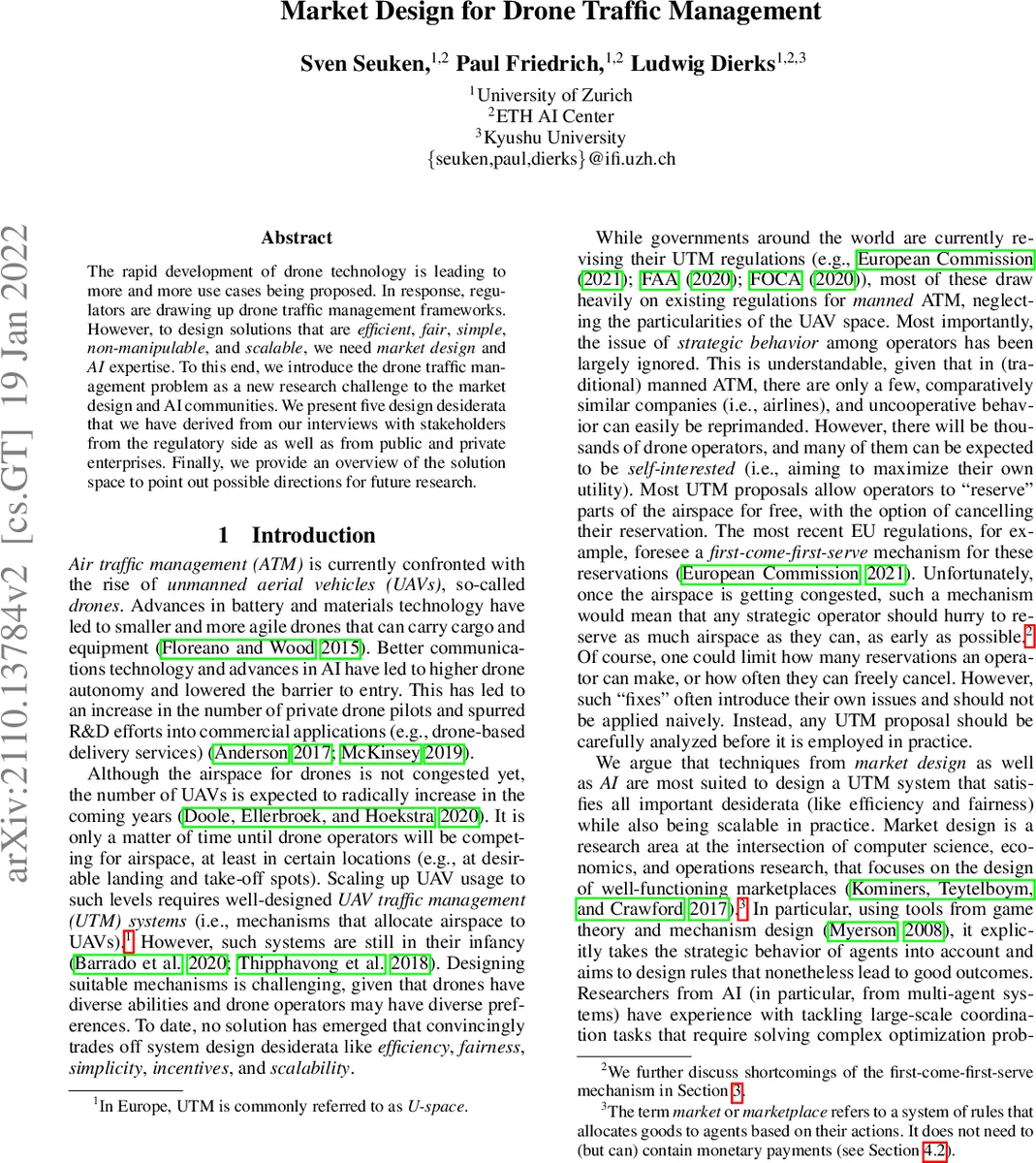
The paper “Market Design for Drone Traffic Management” argues that the emerging proliferation of unmanned aerial vehicles (UAVs) creates a pressing need for a well‑designed drone traffic management (UTM) system, and that the tools of market design together with artificial‑intelligence (AI) techniques are uniquely suited to meet this need. The authors begin by describing how advances in battery technology, lightweight materials, communications, and autonomous navigation have turned drones from hobbyist toys into commercial platforms for photography, parcel delivery, emergency response, and eventually air‑taxis. Although the airspace is not yet congested, forecasts predict a rapid increase in the number of operators, many of whom will be small, self‑interested firms or individuals. Existing regulatory proposals, especially the European “first‑come‑first‑serve” reservation scheme, simply inherit rules from manned aviation and ignore strategic behavior. The paper shows that such a scheme can lead to severe inefficiencies: low‑value operators who book far in advance can block high‑value, time‑critical flights, and the mechanism makes no trade‑offs between competing preferences.
To ground their design discussion, the authors conducted ten semi‑structured interviews with regulators, public agencies, and private companies. From these interviews they distilled five core design desiderata for any UTM mechanism:
-
Economic Efficiency – the allocation should maximize social welfare (or at least achieve Pareto efficiency or non‑wastefulness). This requires eliciting operators’ private values for specific trajectories and their costs of deviation, then solving a large‑scale optimization problem that respects spatial‑temporal conflict constraints.
-
Fairness – multiple notions are relevant: egalitarian welfare (maximizing the minimum utility), proportional fairness, and envy‑freeness. Stakeholders disagree on which is most appropriate; regulators must choose a fairness metric that aligns with policy goals (e.g., equal opportunity versus equity for smaller operators).
-
Simplicity – the user interface must be low‑barrier. Full preference revelation (reporting values for all possible 4‑D paths) is infeasible, while a pure first‑come‑first‑serve request is too coarse. The authors suggest “smart market” tools that let operators submit compact, AI‑assisted preference bundles (e.g., preferred time windows, acceptable deviation costs) while hiding the underlying combinatorial complexity.
-
Incentives – operators should have a dominant‑strategy incentive to report truthfully (strategy‑proofness) or at least be Bayes‑Nash incentive compatible. The paper critiques current proposals that rely on post‑hoc monitoring to detect manipulation, arguing that such reactive approaches cannot guarantee truthful data. Instead, mechanisms should be designed to be strategy‑proof, approximately strategy‑proof, or computationally hard to manipulate, and should also address false‑name and collusion resistance.
-
Scalability – the system must handle thousands to millions of flight requests in real time. This calls for distributed optimization, online algorithms, and machine‑learning models that predict demand and compress preferences. The design must also be technology‑agnostic, yet respect concrete constraints such as minimum separation distances, line‑of‑sight requirements, and jurisdiction‑specific noise or privacy rules.
The authors then sketch a solution space. Price‑based auctions can improve efficiency by allocating high‑value flights to the highest bidders, but raise fairness concerns because richer operators could dominate the airspace. Priority‑based schemes can guarantee that public‑interest flights (emergency services, police) receive pre‑emptive access, while the remaining capacity is allocated using efficiency‑oriented mechanisms. Hybrid markets that combine a priority score with a price signal are proposed as a way to balance efficiency and fairness. AI can support the system by (i) automatically generating feasible trajectories given operator constraints, (ii) learning compact preference representations from limited inputs, and (iii) enabling rapid re‑allocation when unexpected events (e.g., battery failure, weather) occur.
In conclusion, the paper positions drone traffic management as a quintessential interdisciplinary problem that sits at the intersection of economics, computer science, and aviation safety. Without a principled market‑design approach enriched by AI, the rapid growth of drone operations could lead to airspace congestion, unsafe interactions, and market failure. The authors call for a research agenda that develops strategy‑proof, efficient, fair, simple, and scalable mechanisms, and for collaboration between regulators, industry, and the academic market‑design community to bring such mechanisms into practice.
Comments & Academic Discussion
Loading comments...
Leave a Comment