On some combinatorial sequences associated to invariant theory
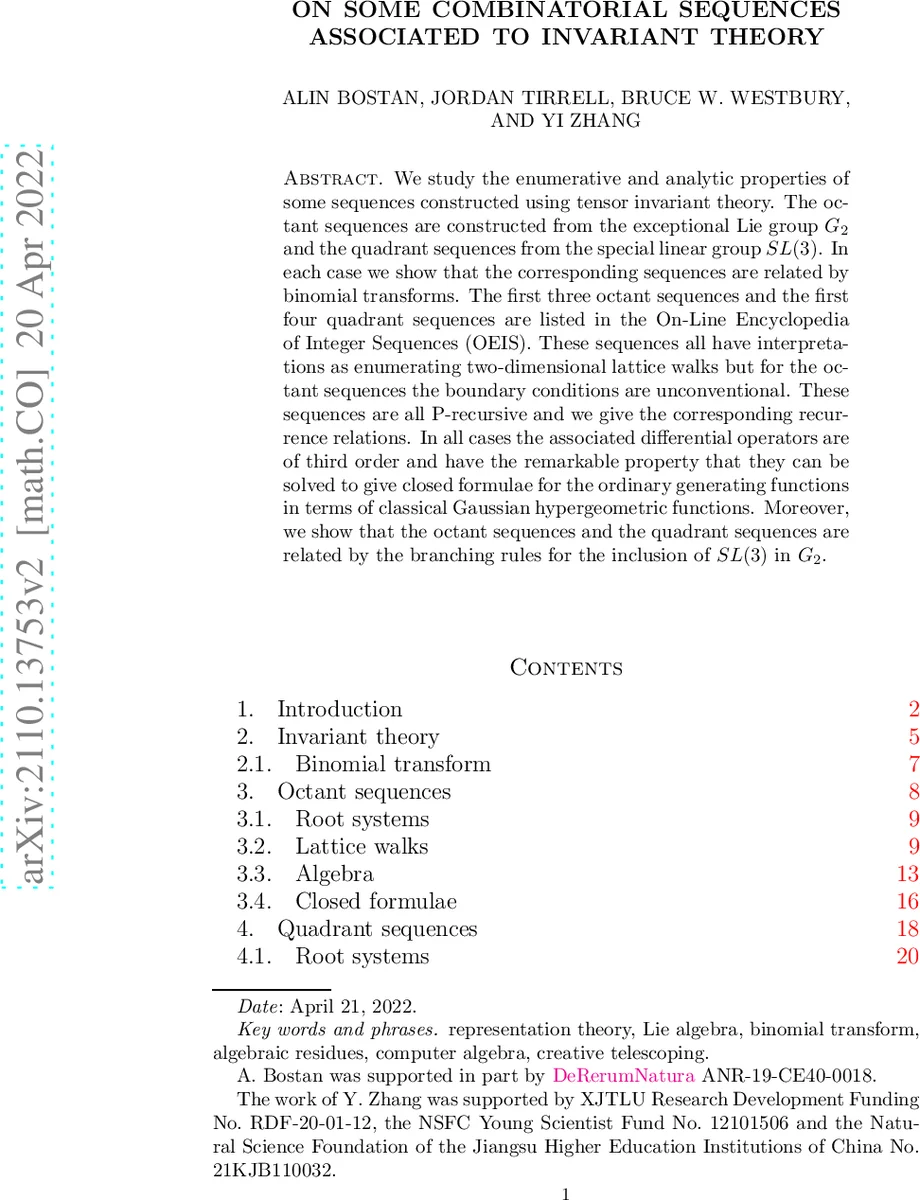
💡 Research Summary
The paper investigates two families of integer sequences that arise naturally from the invariant theory of tensor powers of representations of the exceptional Lie group G₂ and the special linear group SL(3). The authors call the first family “octant sequences” because the underlying combinatorial model consists of walks confined to the region 0 ≤ y ≤ x in the plane (an octant when the zero‑step is forbidden on the diagonal). The second family, “quadrant sequences,” comes from walks confined to the first quadrant 0 ≤ x, y. Both families are generated by taking a finite‑dimensional representation V of the respective group, forming the tensor powers ⊗ⁿV, and counting the dimension of the subspace of invariant tensors (i.e., the multiplicity of the trivial representation).
The paper begins by formalising this construction (Definition 2.1) and showing that for any reductive complex algebraic group G and representation V the sequence a_V is P‑recursive (holonomic). Classical examples are given: for SL(2) with its defining 2‑dimensional representation the even terms are Catalan numbers; for SL(3) the non‑zero terms give the three‑dimensional Catalan numbers.
A key technical tool is the binomial transform. Lemma 2.8 proves that adding a trivial one‑dimensional summand to a representation corresponds exactly to applying the binomial transform to the associated sequence. Lemma 2.9 gives a lattice‑walk interpretation: inserting a zero‑step into the step set produces the binomial transform of the walk‑counting sequence. Consequently, the second octant sequence E₃ (OEIS A108307) is the binomial transform of the first octant sequence T₃ (OEIS A059710).
The authors give three combinatorial interpretations of T₃ (Theorem 1.1): (i) hesitating tableaux of shape (2,2,2,2,2,2,2), (ii) set partitions with no singletons and no enhanced 3‑crossings, and (iii) sequences (x₁,…,x_n) with 1 ≤ x_i < i and without a weakly decreasing subsequence of length three. All three follow from the known interpretation of the binomial transform of T₃.
A major contribution is Theorem 1.3, which supplies a fourth‑order linear recurrence with polynomial coefficients for T₃. The recurrence is
14(n+1)(n+2) T₃(n) + (n+2)(19n+75) T₃(n+1) + 2(n+2)(2n+11) T₃(n+2) − (n+8)(n+9) T₃(n+3)=0
for n ≥ 0, with initial values T₃(0)=1, T₃(1)=0, T₃(2)=1. The authors provide three independent proofs: a creative‑telescoping argument, a computer‑algebra verification, and a direct algebraic derivation. This recurrence confirms a conjecture of Mihailovs.
By standard holonomic theory, the recurrence translates into a third‑order linear differential equation satisfied by the ordinary generating function T(t)=∑_{n≥0}T₃(n)tⁿ. Solving this ODE yields a closed form in terms of the Gaussian hypergeometric function ₂F₁, showing that the generating function is not algebraic but hypergeometric. Similar differential equations and closed forms are known for the other octant sequences (E₃ and the third octant sequence).
The second part of the paper deals with the quadrant sequences. Starting from the direct sum of the three‑dimensional defining representation of SL(3) and its dual, the authors obtain a family of sequences whose first four members appear in OEIS as A151366, A236408, A001181, and A216947. The third member enumerates Baxter permutations; the fourth counts non‑crossing 2‑coloured set partitions (Marberg’s sequence). All four admit lattice‑walk interpretations with six non‑zero steps (the weights of the SL(3) representation) confined to the first quadrant.
Section 4.4 derives a general recurrence for the k‑th quadrant sequence, where k appears as a parameter, and gives a hypergeometric closed form for its generating function.
A unifying theme is the branching rule for the inclusion SL(3) ⊂ G₂. The seven‑dimensional fundamental representation of G₂, when restricted to SL(3), decomposes as the direct sum of two copies of the three‑dimensional fundamental representation plus a trivial one. Consequently, the (k+1)‑st octant sequence coincides with the k‑th quadrant sequence (Theorem 4.3). This explains why the binomial transform links the two families and provides a representation‑theoretic proof of the combinatorial relationship.
In summary, the paper makes the following contributions:
- It formalises the construction of invariant‑tensor sequences for arbitrary reductive groups and shows they are always holonomic.
- It identifies two concrete families (octant and quadrant) arising from G₂ and SL(3), provides explicit combinatorial models (lattice walks, tableaux, set partitions), and lists their first terms in OEIS.
- It proves that the second octant sequence is the binomial transform of the first, and more generally that adding trivial summands corresponds to binomial transforms.
- It derives a new fourth‑order recurrence for the primary octant sequence, confirms a conjecture, and solves the associated differential equation to obtain a hypergeometric generating function.
- It gives a parameterised recurrence and hypergeometric generating function for the entire quadrant family, including the Baxter permutation sequence.
- It connects the two families via the branching rule for SL(3)⊂G₂, showing that the restriction of the G₂ representation yields the SL(3) sequences.
These results bridge invariant theory, combinatorial enumeration, and holonomic analysis, and they suggest that similar phenomena should appear for other exceptional groups or higher‑rank representations, opening avenues for further exploration of invariant‑tensor sequences and their combinatorial avatars.
Comments & Academic Discussion
Loading comments...
Leave a Comment