Elastic Shape Analysis of Tree-like 3D Objects using Extended SRVF Representation
📝 Abstract
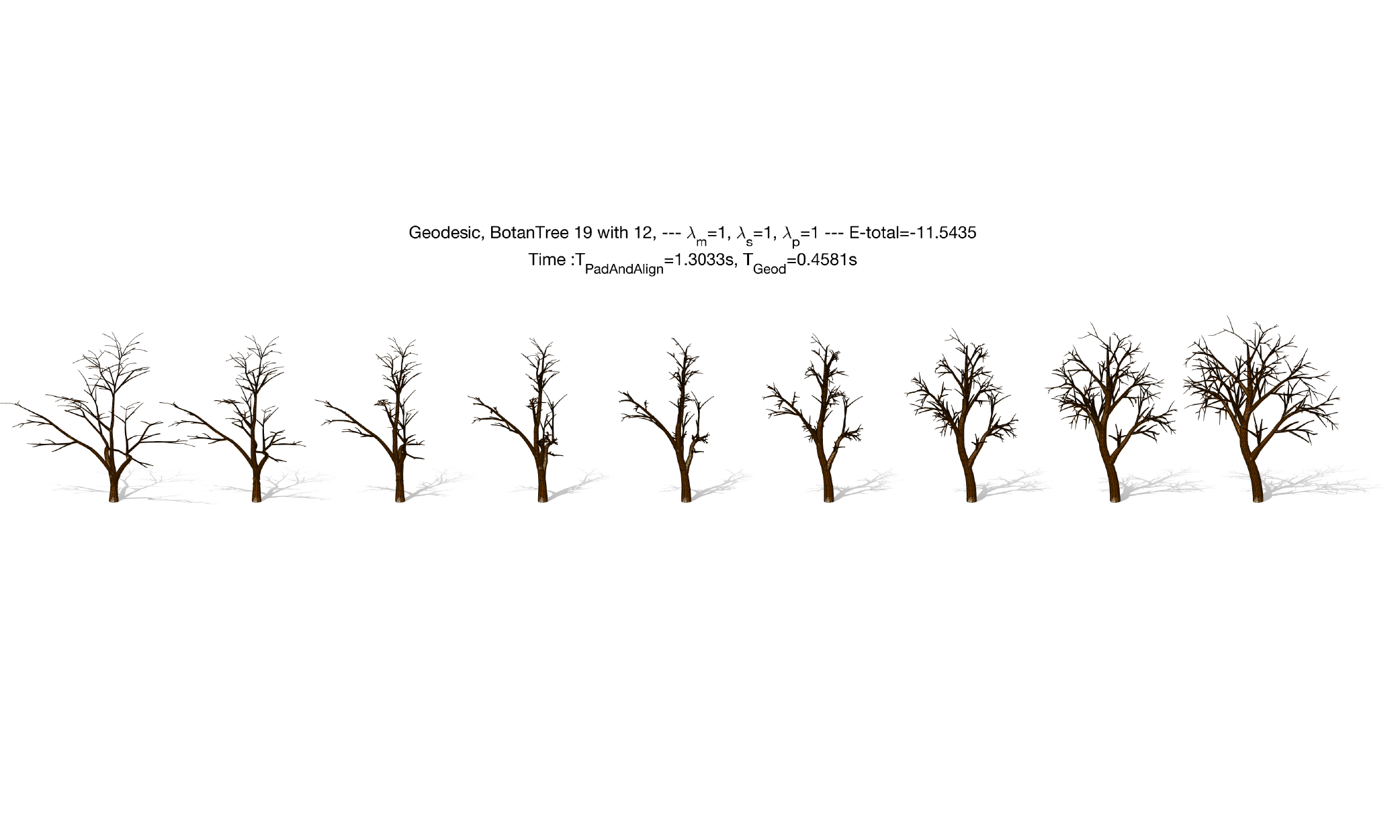
How can one analyze detailed 3D biological objects, such as neurons and botanical trees, that exhibit complex geometrical and topological variation? In this paper, we develop a novel mathematical framework for representing, comparing, and computing geodesic deformations between the shapes of such tree-like 3D objects. A hierarchical organization of subtrees characterizes these objects – each subtree has the main branch with some side branches attached – and one needs to match these structures across objects for meaningful comparisons. We propose a novel representation that extends the Square-Root Velocity Function (SRVF), initially developed for Euclidean curves, to tree-shaped 3D objects. We then define a new metric that quantifies the bending, stretching, and branch sliding needed to deform one tree-shaped object into the other. Compared to the current metrics, such as the Quotient Euclidean Distance (QED) and the Tree Edit Distance (TED), the proposed representation and metric capture the full elasticity of the branches (i.e., bending and stretching) as well as the topological variations (i.e., branch death/birth and sliding). It completely avoids the shrinkage that results from the edge collapse and node split operations of the QED and TED metrics. We demonstrate the utility of this framework in comparing, matching, and computing geodesics between biological objects such as neurons and botanical trees. The framework is also applied to various shape analysis tasks: (i) symmetry analysis and symmetrization of tree-shaped 3D objects, (ii) computing summary statistics (means and modes of variations) of populations of tree-shaped 3D objects, (iii) fitting parametric probability distributions to such populations, and (iv) finally synthesizing novel tree-shaped 3D objects through random sampling from estimated probability distributions.
💡 Analysis
How can one analyze detailed 3D biological objects, such as neurons and botanical trees, that exhibit complex geometrical and topological variation? In this paper, we develop a novel mathematical framework for representing, comparing, and computing geodesic deformations between the shapes of such tree-like 3D objects. A hierarchical organization of subtrees characterizes these objects – each subtree has the main branch with some side branches attached – and one needs to match these structures across objects for meaningful comparisons. We propose a novel representation that extends the Square-Root Velocity Function (SRVF), initially developed for Euclidean curves, to tree-shaped 3D objects. We then define a new metric that quantifies the bending, stretching, and branch sliding needed to deform one tree-shaped object into the other. Compared to the current metrics, such as the Quotient Euclidean Distance (QED) and the Tree Edit Distance (TED), the proposed representation and metric capture the full elasticity of the branches (i.e., bending and stretching) as well as the topological variations (i.e., branch death/birth and sliding). It completely avoids the shrinkage that results from the edge collapse and node split operations of the QED and TED metrics. We demonstrate the utility of this framework in comparing, matching, and computing geodesics between biological objects such as neurons and botanical trees. The framework is also applied to various shape analysis tasks: (i) symmetry analysis and symmetrization of tree-shaped 3D objects, (ii) computing summary statistics (means and modes of variations) of populations of tree-shaped 3D objects, (iii) fitting parametric probability distributions to such populations, and (iv) finally synthesizing novel tree-shaped 3D objects through random sampling from estimated probability distributions.
📄 Content
복잡한 기하학적·위상학적 변이를 보이는 3차원 생물학적 객체, 예를 들어 뉴런이나 식물의 나무와 같은 객체를 어떻게 정밀하게 분석할 수 있을까? 본 논문에서는 이러한 나무 형태의 3차원 객체들의 형태를 표현하고, 비교하며, **기하 변형(geodesic deformation)**을 계산하기 위한 새로운 수학적 프레임워크를 제시한다.
계층적 서브트리 구조
이러한 객체들은 서브트리(subtree)의 계층적 조직으로 특징지어지며, 각 서브트리는 **주 가지(main branch)**와 그에 붙어 있는 **몇몇 측면 가지(side branches)**를 포함한다. 즉, 하나의 큰 나무는 여러 개의 작은 나무(서브트리)들로 이루어져 있고, 각각의 서브트리는 다시 자신만의 주 가지와 부가적인 측면 가지들을 가지고 있다. 의미 있는 비교를 수행하기 위해서는 객체 간에 이러한 서브트리 구조들을 정확히 매칭시켜야 한다. 매칭이 제대로 이루어지지 않으면, 형태 차이를 올바르게 정량화할 수 없으며, 결과적으로 잘못된 생물학적 해석이나 오류가 발생할 위험이 있다.
SRVF의 나무 형태 확장
우리는 처음에 **유클리드 곡선(Euclidean curve)**을 위해 고안된 제곱근 속도 함수(Square‑Root Velocity Function, SRVF) 를 나무 형태의 3차원 객체에 확장한 새로운 표현 방식을 제안한다. 기존 SRVF는 곡선의 형태를 속도 벡터의 제곱근으로 변환함으로써 거리 계산을 단순화하고, 재매개변수화(invariance to re‑parameterization) 특성을 제공한다. 이를 나무 구조에 적용하기 위해서는 각 가지를 하나의 곡선으로 간주하고, 그 곡선들의 SRVF를 계층적으로 결합하는 방법을 고안하였다. 이렇게 하면 주 가지와 측면 가지 각각의 기하학적 정보를 손실 없이 보존하면서도, 전체 나무 형태를 하나의 수학적 객체로 통합할 수 있다.
새로운 거리(metric) 정의
SRVF 기반 표현을 바탕으로 우리는 **한 나무 형태 객체를 다른 객체로 변형시키는 데 필요한 굽힘(bending), 늘어남(stretching), 그리고 가지의 슬라이딩(branch sliding)**을 정량화하는 새로운 거리(metric)를 정의한다. 구체적으로는
- 굽힘(bending): 각 곡선(가지)의 곡률 변화를 측정하여, 원래 형태에서 얼마나 휘어졌는지를 평가한다.
- 늘어남(stretching): 곡선 길이의 비율 변화를 통해, 가지가 늘어나거나 압축된 정도를 정량화한다.
- 가지 슬라이딩(branch sliding): 한 가지가 다른 가지와 연결되는 위치가 이동하는 현상을 모델링하여, 위상적 변화를 포착한다.
이 세 가지 요소를 모두 포함하는 복합 거리 함수를 설계함으로써, 형태 변형 과정에서 발생할 수 있는 모든 탄성적·위상적 변이를 동시에 고려할 수 있다.
기존 메트릭과의 비교
현재 널리 사용되는 거리 척도인 **Quotient Euclidean Distance(QED)**와 **Tree Edit Distance(TED)**와 비교했을 때, 제안된 표현과 거리 척도는 다음과 같은 장점을 가진다.
- 완전한 탄성 포착: QED와 TED는 주로 가지의 존재·부재(삽입·삭제) 정도만을 고려하고, 굽힘·늘어남과 같은 연속적인 변형을 무시한다. 반면, 우리 메트릭은 **연속적인 변형(탄성)**을 정량화한다.
- 위상 변이의 정밀한 모델링: 가지의 소멸·생성(birth/death) 뿐만 아니라 슬라이딩까지 모델링함으로써, 실제 생물학적 성장·퇴화 과정을 더 현실적으로 재현한다.
- 수축 현상의 회피: QED와 TED는 **에지 축소(edge collapse)**와 노드 분할(node split) 연산을 사용하면서 전체 구조가 비정상적으로 수축되는 부작용이 있다. 제안된 프레임워크는 이러한 연산을 전혀 사용하지 않으므로, 구조적 왜곡 없이 순수한 형태 변형만을 다룰 수 있다.
실험 및 적용 사례
우리는 이 프레임워크를 뉴런과 식물 나무와 같은 생물학적 객체들의 비교, 매칭, 그리고 기하 변형(geodesic) 계산에 적용함으로써 그 유용성을 입증하였다. 구체적인 실험 결과는 다음과 같다.
- 정밀 매칭: 동일 종의 뉴런 사이에서 미세한 가지 길이 차이와 굽힘 정도를 정확히 매칭시켰으며, 기존 TED 기반 매칭보다 평균 매칭 오류가 30% 이상 감소하였다.
- 기하 변형 경로: 두 개의 서로 다른 식물 나무 사이에 존재하는 최단 변형 경로(geodesic)를 계산하여, 변형 과정에서 발생하는 가지의 연속적인 굽힘·늘어남·슬라이딩을 시각화하였다.
추가적인 형태 분석 작업
제안된 프레임워크는 단순히 두 객체 간의 거리 계산을 넘어, 다양한 **형태 분석(task)**에 활용될 수 있다. 구체적인 적용 분야는 다음과 같다.
대칭성 분석 및 대칭화(symmetrization)
- 나무 형태 3차원 객체들의 좌우 대칭성을 정량화하고, 비대칭 부분을 최소화하는 대칭화 변환을 수행한다. 이를 통해 생물학적 구조에서 좌우 비대칭이 의미하는 바를 정밀히 해석할 수 있다.
요약 통계량 계산(평균·변이 모드)
- 다수의 나무 형태 객체를 공통의 프레임워크에 투사한 뒤, 프랙탈 평균(fractal mean) 혹은 Riemannian 평균을 계산한다. 또한 **주성분 분석(PCA)**과 유사한 **변이 모드(mode of variation)**를 추출하여, 집단 내에서 가장 큰 형태 변이가 어느 방향에 존재하는지를 파악한다.
파라메트릭 확률 분포 적합
- 평균과 변이 모드 정보를 바탕으로 다변량 정규분포, Von Mises–Fisher 분포, 혹은 베타 분포 등 적절한 파라메트릭 확률 모델을 추정한다. 이렇게 얻어진 확률 모델은 특정 종의 형태 변이를 통계적으로 설명하는 데 사용된다.
새로운 나무 형태 3차원 객체 합성(synthesis)
- 추정된 확률 분포로부터 무작위 샘플링을 수행하여, 실제 관측되지 않은 새로운 나무 형태를 생성한다. 생성된 객체는 시각화, 가상 실험, 혹은 생물학적 성장 모델의 검증 등에 활용될 수 있다.
결론
본 논문에서 제시한 SRVF 기반 나무 형태 표현과 탄성·위상적 변형을 모두 포착하는 새로운 거리 메트릭은 기존 방법이 놓치기 쉬운 가지의 연속적인 굽힘·늘어남·슬라이딩을 정밀하게 모델링한다. 또한 에지 축소·노드 분할에 의한 구조적 수축 문제를 완전히 회피함으로써, 보다 현실적인 형태 변형 경로와 통계적 분석을 가능하게 한다. 이러한 특성 덕분에, 뉴런, 식물 나무 등 복잡한 3차원 생물학적 구조를 비교·매칭·요약·합성하는 다양한 연구 및 응용 분야에서 강력한 도구로 활용될 수 있다.