Mapping radii of metric spaces
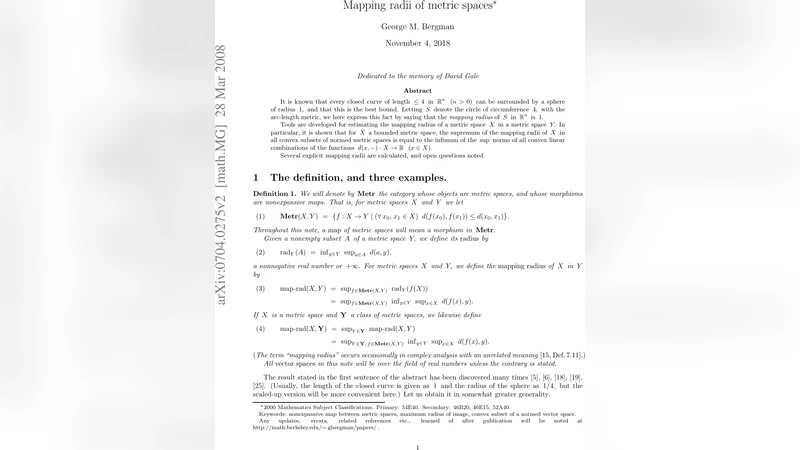
It is known that every closed curve of length \leq 4 in R^n (n>0) can be surrounded by a sphere of radius 1, and that this is the best bound. Letting S denote the circle of circumference 4, with the arc-length metric, we here express this fact by saying that the “mapping radius” of S in R^n is 1. Tools are developed for estimating the mapping radius of a metric space X in a metric space Y. In particular, it is shown that for X a bounded metric space, the supremum of the mapping radii of X in all convex subsets of normed metric spaces is equal to the infimum of the sup norms of all convex linear combinations of the functions d(x,-): X –> R (x\in X). Several explicit mapping radii are calculated, and open questions noted.
💡 Research Summary
The paper introduces the notion of “mapping radius” as a quantitative invariant that measures how tightly a metric space X can be embedded, via a non‑expansive (1‑Lipschitz) map, into another metric space Y. Formally, for a given embedding f : X → Y the radius of f(X) is the smallest r such that f(X) is contained in a closed ball of radius r in Y; the mapping radius of X in Y is the infimum of these radii over all such embeddings. This concept generalizes the classical geometric fact that any closed curve of length ≤ 4 in ℝⁿ can be enclosed by a unit sphere, which the author re‑states as “the mapping radius of the circle S of circumference 4 in ℝⁿ equals 1”.
The central theoretical contribution is a dual characterization of the supremal mapping radius of a bounded metric space X when the target ranges over all convex subsets of arbitrary normed spaces. Let dₓ(y)=d_X(x,y) denote the distance function from a point x∈X. The author proves that
\
Comments & Academic Discussion
Loading comments...
Leave a Comment